Sunday, June 5, 2016

Dragon by Dragon - May 1981 (49)

May of 1981 saw me turn 9. I hadn't heard of D&D back then (and wouldn't for another 3 years), but if I had heard of D&D, and subscribed to Dragon Magazine, this is what would have shown up in my mailbox that month.

Pretty cool cover, right? There's more inside, in a 12-page section dedicated to the work of Tim Hildebrandt.

Of course there's more than just my Hildebrandt in this issue ... let's check it out.

First up is a new ad by Ral Partha, this time featuring their new line-up of Adventurers miniatures. I got curious this time and decided to look up Ral Partha's address - 5938 Carthage Ct, Cincinnati OH.

It came up with this impressive ediface:


I'll show off a few more old RPG addresses in this post if I get a chance.

Now that we've looked at Ral Partha's old digs, let's get to the fun of complaining readers, in this case William G. Welsh, on the archer class in last issue:

"Second — “Kobolds, goblins, dwarves, gnomes and halflings cannot become archers.” In the last chapter of the third book of the Lord of the Rings trilogy, there are no less than three incidents where the effectiveness of hobbit archers is demonstrated. Also, refer to the AD&D Monster Manual, p. 50, under halflings, under special attacks, note “+3 with bow or sling.”

This stuff kills me. The answer from the editor was:

"None of the ideas presented in articles in DRAGON magazine are official rule changes or additions, unless the article specifically says so (and there haven’t been very many of those). The people who write articles that we publish aren’t trying to get everyone to play the way they do, and we certainly don’t hold that opinion ourselves. As is the case with many of the game rules themselves, the articles in DRAGON magazine are suggestions, ideas and alternatives."

It amazes me when that has to be said, but if comment sections on the internet have done anything, it's to prove that things like that still need to be said. Could various school systems around the globe please spend a few minutes explaining to people what "opinion" means?

The meat and drink of this issue, other than the special art section, is about tournaments. No, not knights trying to poke each other with lances and Robin Hood splitting an arrow, but D&D tournaments. If I'm honest ... I have no interest at all in them, but I'll try to give them a quick review.

The first article discusses fairness in scoring tournaments, giving a long list of actions that should go into scoring points, and explaining that DMs need to make sure players know how they'll be scored. Sounds logical to me.

The next bit discusses improving on the Slave Pits tournament adventure, followed by Mentzer's reply that "It isn't that easy". I can remember getting the Slave Pits module as a kid (I guess about 4 years after this issue was published) and being confused about the whole tournament concept - how you didn't use the full map, and scored things. As a kid, I wasn't sure if I was supposed to care about this stuff or not.

Strangely enough, the article complaining about the adventure is really complaining about the size of the teams in the AD&D Open, specifically that nine-person teams are too large. Mentzer explains the problem - not enough Dungeon Masters at the tournaments. Can't argue with that.

Dig this:


Old Horny indeed. Let's hope those horns on his head were the source of his nickname. And here, keeping with the theme of this post, is Dragontooth Miniatures old location:


Or is it? A Hilton? I'm thinking perhaps the old building was torn down and replaced. That, or Conrad Hilton had a secret hobby.

The next few articles are a bit too timely to make sense to talk about here - GenCon is growing, , GenCon East fills the Origins 'hole' (I'm sure that's not as filthy as it sounds) and there are nine ways to win the painting contest at GenCon.

Okay, enough of that convention stuff. Next up: Samurai!


This is an interesting take on the character class. The editor's note mentions that the author, Anthony Salva, holds a first degree black belt in Hapkido. The class that follows is heavily influenced by this, and it's really a bit more like an alternate monk than the samurai most people would expect.

That said, it's a pretty groovy class. It's tough to make it in - you need Str 15, Dex 17 and Int 15 to qualify, but the class is open to gnomes, halflings, elves, half-elves and humans.

This version of the samurai cannot use armor, but his AC improved by 1 per 4 levels. They can use two-handed swords, short swords, bows and staffs, and a samurai of 4th level or higher can obtain his "personal weapons", which are sacred to him. It mentions the weapons of honor - "Katana, Wakizashi and Nunchakos" are described later in the article.

Apparently Dragon Magazine got there first. Source
The samurai's special abilities are as follows: Jump front kick (-3 to hit, 2d6 damage), judo throw, ceremony of fealty-weapons of honor (4th level; and here it mentions that katana do 1d12 or 1d10 damage, wakizashi 2d4 or 1d8 and nunchako 1d8 damage), sweep and double chop (5th level), crescent kick/side kick combination, back roundhouse kick, illusionist spell ability (8th level), "360" and downward kick, the slaying hand (10th level), flying side kick (requires movement, -3 to hit, 1d20 damage) and a samurai who becomes a shogun (13th level) has a 25% chance to obtain 30 psionic power points. They go on a bit later to mention they can reduce falling damage, hide in shadows and move silently as a thief, and can dive and roll over obstacles.

This class would probably be a blast to play, especially as a gnome. I've often thought that the monk would make a pretty good "cartoon hero" class, and this version of the samurai has me thinking of Samurai Champloo and other anime samurai. If anyone has experience with this class, please drop a note down below and let us know how it went.

Brief pause for the birthplace of Traveller


Merle Rasmussen now brings us a nice Top Secret article about special ammunition - armor-piercing, dumdum, gyrojet, duplex, etc. Lots of stats (and I mean lots with a capital "L"), but probably useful info for other games as well.

Karl Horak has an article called "Getting a world into shape", which gets into different shapes for campaign worlds, as in cylinders, polygons, etc.If you want a campaign world in the shape of a 20-sided die, this is the article for you.


Giants in the Earth in this issue presents some Poul Anderson characters - Holder Carlsen (14th level paladin) and Hugi (5th level gnome fighter). The art by Roger Raupp is great:


He's always fantastic with knights and warriors. The article also has stats for T. J. Morgan's Ellide (6th level fighter)

G. Arthur Rahman has an article on historical names - Anglo-Saxon, Byzantine, etc. Very useful then, less so now with the resources of the internet at one's disposal.

Jon Mattson's article "Monster mixing - AD&D creatures adapted to a C&S campaign" show that Dragon was not yet the house organ for TSR that it would become (though it always had more outside content than White Dwarf once it became GW's house organ). While the article is quite useful for players of Chivalry & Sorcery, it also has an interesting piece at the end - a flowchart of AD&D monster predation:


And now you know.

Up next in the magazine is the section on Tim Hildebrandt's art. I'd post some images (aside from the cover above), but a Google search (or clicking on the artist's name up above) will do you more good these days. Take a look - I think you'll like what you see. I will post this quote from the interview with the artist:

“One thing leads to another thing leads to another thing and you start growing and growing. Things keep expanding, and the more I do myself, the more I see that there is to learn.”

Lots of wisdom in those words.

The Dragon's Bestiary in this issue features the Loren Kruse's Nogra ("a small creature with long, sharp claws which somewhat resembles a hairless lynx"). The basic stats for Blood & Treasure are below:

Nogra, Small Magical Beast: HD 2, AC 15, ATK 1 bite (1d4), MV 20', SV F12 R11 W15, INT Low, AL Neutral (N), XP 200 (CL 3), Special-Body secretes a substance which absorbs all light (including into the infrared and ultraviolet spectrums), liquid is also a contact poison (save or blinded for 2d4 rounds), light sensitivity

Leonard Lakofka has a new class for this issue (which hopefully doesn't do halflings wrong) called the Alchemist. Another old Dragon classic. It seems like such an obvious class for D&D, but it's tricky. My version was essentially Dr. Jekyll, to give it a twist and make more than a guy who isn't remotely as useful as a magic-user. Lakofka's is, in fact, not an adventurer.

Lakofka's alchemist has to have Str 9, Int 10, Wis 6, Dex 9, Con 14 and Cha 16 to qualify, and they must be human, elf or half-elf, with only the humans hitting the highest levels. They only earn XP by "plying their trade", not adventuring. They can make pottery, blow glass, identify potions, manufacture poisons and manufacture magic potions. It's a useful class, and could be adjusted to be an adventurer, but as a non-adventuring NPC I'm not sure why one needs to go to the trouble of having levels. It seems like a "novice-veteran-master" approach would work just as well, or even just "the alchemist can do what the DM to needs her do" concept. That being said, Lakofka always puts a lot of work into these things, and his alchemist is no different and thus is worth the read.

Gary Snyder now gets into the weeds on the issue of wishes and how to adjudicate them. This brings up a great point about fantasy gaming and gamers. I'll often be watching some tv show or movie and think, "That ploit element would never work in a game - the players would kill that guy in a heartbeat / or they would never touch that statue, 'cause statues are always trouble in a dungeon." The idea of wishes probably seemed so simple when the game was first written, and then creative players got ahold of the concept and made DM heads explode. Snyder gives ten rules to keep wishes in check which have largely been adopted into the game.

It's followed up by a short article/story about wishing by Roger E. Moore.

Paul Montgomery Crabaugh has an artcle about travel and clothing in DragonQuest.

If you need a time keeper program in BASIC, Mark Herro has you covered in this month's The Electric Eye. Blast from the past to see those IF ... THEN statements and GOTO commands. I learned on a VIC-20, which is actually still sitting in my closet.

Side note - I love this Grenadier miniature ...


Great sculpt

Side note II - A bit of Wormy


And now on to White Dwarf 25, the June/July 1981 issue. I'll keep this one brief, and just cover the bases:

Lewis Pulsipher has the third part of the Introduction to D&D series, covering spellcasters. Great art in this one.

Trevor Graver has Optional Skill Acquisition for Travellers. This one ditches the random tables (which are pretty cool) for a skill point system. Control vs. Chaos, the eternal struggle in game design.

Roger Musson has a nice article on The Interesting Dungeon - worth the read.

Tony Chamberlain & Paul Skidmore have an interesting "clerical AD&D skirmish for a large number of players" called Lower Canon Court. This is another one that would probably be fun to play with a big group on Google+.

This issue has some clever magic items - the bowl of everlasting porridge, the bell of watchfulness - a notion on determining handedness in games by Lew Pulsipher (left-handed males 8%, females 4%), and Roger E. Moore has a bit on fake torture items.

Andy Slack has Vacc Suits in Traveller.

Dream Demon!
The Fiend Factory this issue is themed The Black Manse, and has stats for Dream Demons (which are really cool) by Phil Masters, the Incubus by Roger E. Moore, Brain Suckers by John R. Gordon and the Guardian by Simon Tilbrook. As always, the art is top notch. It's a shame there was never a Fiend Folio II - so many great monsters were left behind.

Lewis Pulsipher's second article this issue is on "What Makes a Good AD&D Character Class". I would answer - people want to play it and it doesn't screw up the game. This is pretty much what he says, focusing especially on the class not being overpowering. His example of an overpowering class makes me actually want to create it - The Guardian class he posits can listen at doors, use x-ray vision, become ethereal and has a psionic boomerang defense that kills some mind flayers. I dig it.

And that's that ... except for one more thing ...


Games Workshop's location back in 1981 ... or close to it. Hard to make out the address.

Have fun on the internet!

Tuesday, May 31, 2016

A Duet of Spells

Since most of my time right now is devoted to editing, it's been tough to produce new material for the blog. I guess I had the Bard of Avon buzzing in my ear this weekend, though, when I wrote these thought up these spells ...

Star Crossed
Magic-User 3
30’ range
Permanent until removed

The magic-user causes two creatures within 30 feet to have their fates exchanged. The two creatures must be friends or allies of one another. The spell exchanges the ability score modifiers, attack bonus and saving throw values between the two creatures. The spell lasts until the two creatures make contact with one another while remove curse is cast on them.

Zounds
Cleric (Lawful) 2
30’ range
Lasts a number of rounds equal to the cleric’s level

One target within 30 feet has terrible, bleeding wounds opened up on its hands and feet. The pain is terrible, leaving the creature crippled (see Conditions) and imposing a -3 penalty to attack and perform tasks involving holding tools or using their hands (pick pocket, open lock, etc.).

For Lawful clerics, though, it also brings on an apotheosis, increasing their caster level by +2 and granting them a +1 bonus to save vs. magic for 24 hours.


I've been wanting to do something Shakespearean - perhaps this points the way.

Wednesday, May 25, 2016

Spell Hooks

I've been busy editing Blood & Treasure Second Edition for the last couple weeks, a great deal of that time spent on the spells. I'm trying to streamline them wherever possible, and there are plenty of them to edit.

While doing so, it's occurred to me how many of them are really more NPC spells than PC spells. That's not to say they cannot be used by PCs, but they often require more forethought than most players can realistically use (i.e. they are meant for plots, rather than reactions to plots), and they are not as action oriented as most PCs need in dungeon delving.

These NPC spells are useful for GM's to use as adventure hooks or encounters. Here are three such ideas:

Magic Jar

Magic jar is a natural, but I don't know that is sees much use as an adventure hook. An evil magic-user hides his essence in some vessel, and uses it as a base of operations for possessing the adventurers or their henchmen, slowly picking them off, one by one, until they are destroyed.

The plan would work as follows: There's a plain vessel in one of the rooms of a dungeon. It's plain so the adventurers leave it alone. An evil magic-user has used it as a magic jar. When adventurers first enter the room, he possesses one of the henchmen, grabbing the vessel before he leaves. He using the form to spy on the party, maybe steal something, maybe put one or more adventurers or henchmen in mortal peril in a way that is not obviously his fault. Since the henchman is carrying the vessel with him, the magic-user can possess others, slowly tearing the party apart from the inside. Perhaps he is ultimately leading them to their doom elsewhere, where he can leap back into his own preserved form.

Secret Chest

In this scenario, an adventurer moving on the Ethereal Plane stumbles (literally) across a secret chest that was abandoned there long ago. The chest is hard to open, and probably contains something dangerous that was never meant to be found or released.

Simulacrum

The adventurers are hired by a simulacrum (they don't know this) for a mission to rescue the original magic-user. The simulacrum has 50% of the original's experience and knowledge, so she's useful in the party, but not too useful, and there are important gaps in her knowledge that relate to finding the original.

Here's the rub. The original is in mortal peril, and will die before rescued. The original is also evil, and on a very dangerous mission. After the original dies, the simulacrum begins gaining more experience and knowledge, and begins to gain the evil alignment of the original. Now, the simulacrum is leading the adventurers into a trap, where she can sacrifice them to gain the immense power the original was after.

Thursday, May 19, 2016

The Wages of Fame

William Tell
I've seen a few systems in games for measuring the reputation or fame of adventurers. They make sense, to some extent - folks spending their kind of money and killing monsters the way they do should be pretty well known in a campaign area. But should they? And how? And what do they get from it? And why am I asking so many questions? Huh?

Here's an idea for handling fame without adding too much in the way of rules or complications. It might suck, but here it is anyways.

Accumulating Fame

How do people become famous in a medieval milieu? For the purposes of D&D and similar games, it makes sense to tie fame to deeds. Hey, if Bob jumps over a cow at the local faire, people in the village will know that Bob is famous for jumping. They'll tell others, and maybe for several villages around Bob will be known as "the jumper". So it goes with adventurers.

Since fame is tied to deeds, it also makes sense that fame is tied to XP. XP are handed out for deeds, therefore XP equals fame.

Or does it?

In our example above, everyone saw Bob jump over the cow. If Bob had done it without witnesses, and just claimed to have jumped over a cow, he might have become known as Bob the Liar rather than Bob the Jumper. So, in this system, XP only turn into fame when the deeds that generated the XP are either witnessed by the public at large, or can be proved. If you want to use this system, you'll need to put a second XP number in parentheses after the normal XP number.

You accumulate these "fame XP" by doing things in front of people, or you need to spend or display the treasure you looted, and you need to bring back trophies (at least one really good one, the gorier the better) to show that you defeated monsters or black knights or wizards. If you do these things, you count those XP towards your fame level.

Since we have a separate "fame XP", we also have a separate "fame level". For simplicity's sake, use the Fighter's XP progression in your game as the Fame XP progression. Fame levels are as follows:


The Upside of Fame

So, what do these fame levels get you?

First level fame is worth nothing.

From 2nd level onward, they enjoy the following benefits:

1) They have a percent chance of drinking for free and picking up interesting rumors in taverns

2) They have a percent chance of getting an invite to dine with notables equal to their fame level, the chance depending on the size of the settlement

3) You can employ an extra number of henchmen equal to your fame level, and their base loyalty is increased by a number of percentage points equal to your fame level

4) You can request audiences with princes, kings, emperors, high priests, etc. You have half this chance of requesting a boon in exchange for a favor, and a percent chance equal to your fame level of requesting a boon in exchange for nothing

The Downside of Fame

Fame has a downside as well. When you enter an area, your fame might proceed you. You can cut the chances of being recognized by wearing a disguise and using a different name, but lose the benefits of fame (see above) if you do so. Here's a twist - if you are moving in a group and not everyone in the group is disguised, your chances of being noticed are increased by 5% per undisguised person.

If you are recognized, one of the following happens:

Challenges: You will be challenged to a duel (magical or martial) or test of skill by other notables in the area. This will be public. Losing these challenges actually reduces your fame XP level by as much as it would have increased if you had won.

Quests: If you are neutral or lawful (good), and there's trouble afoot, you will be asked to handle it. If people have been kidnapped or there are monster's raiding the area, you are expected to solve it. If you refuse, you lose enough XP to take you down a fame level. You suffer the same consequences if you fail at the quest.

Justice: If you are chaotic (evil), you are set upon by the authorities in the area, or bounty hunters or people you wronged in the past. In other words, being famous and evil means being hunted.

For this reason, characters might discover that fame is a double-edged sword.

Death

Nobody wants to die, but dying famous is probably better than dying unknown for an adventurer. When a character dies, the following happens:

6% chance per fame level of a folk song being composed in their honor

4% chance per fame level of a biography being written about them

2% chance per fame level of a monument being erected where they died or a civilized place nearby

For clerics, druids and paladins, there is a 1% chance of them being canonized

Now, total these honors received. This is the percent chance (thus, maximum 4%) that upon death they are received by "the gods" into their company as a quasi-deity. They can still be used as PC's, with powers deemed suitable by the DM, but only in the company of other quasi-deities or demi-deities and the like. Congratulations!

Sunday, May 8, 2016

Dragon by Dragon - April 1981 (48)

Happy Mothers Day to all the moms out there in blog land - and happy April Fools Day, since this week we're looking at an April issue of Dragon - #48, from good old 1981.

Before I hit the magazine, though, I'm going to do a little advertising - NOD 29 is now out as a PDF, at Lulu.com and Rpgnow.com. This one has the second half of the Trollheim hex crawl, the third part of the d20 Mecha series featuring some mecha stats that could be useful for all sorts of sci-fi games, Aaron Siddall's very cool Hyperspace campaign notes for GRIT & VIGOR, which combines Lovecraft with good old fashioned rocket-powered sci-fi, Tony Tucker's take on the luchador class for GRIT & VIGOR, a Quick & Easy mini-game pitting luchadores vs. the Aztec Mummy, a random class generator (along with a couple random classes that came out pretty good), info on using interesting historic coins in treasure hoards, the Laser Mage class and a couple tidbits for SPACE PRINCESS. All sorts of fun for $4.99.

And now, ladies and gents, on to the magazine.

We begin with an Arms Law ad, and a few thoughts on said ad by the writer of the blog:


That first bit is the problem - death being only one blow away with Arms Law. Many would argue that it's more realistic than D&D combat ... and they're right. That's precisely the problem. We already live in the real world, where death is one blow away. That's why most of us live boring lives and indulge in fantasy for our excitement. I'm not sure injecting that kind of realism in fantasy is worth the trouble. A realistic game for the sake of the challenge, on the other hand, can be quite engaging. Just a thought.

And now, God forgive me, I'm going to show another old ad. I like the tagline - "not for everybody" - clever. Here's a post about the game.

I might have mused about this before, but is anyone out there making new retro-computer dungeon crawls? For those in the know - would it be hard? I think it might be fun to create some - relatively simple games with simple mechanics for those who want to just do some old fashioned dungeon crawling.

The theme for this issue is Underwater Adventuring. I can attest to how hard it is to write underwater adventures - or at least adventure locales for my hex crawls. So much of what we take for granted on the surface doesn't work underwater. The first article, "Watery Words to the Wise" by Jeff Swycaffer, does a nice job of hitting the highlights of what does and does not work underwater. No rules, just sound advice.

Up next is the "Dragon's Bestiary", which features the Water-Horse by Roger E. Moore, Golden Ammorite by Roger E. Moore and Sea Demon by Ernest N. Rowland Jr. Nothing earthshaking here, but solid monsters for an underwater (or close-to-water) game.

The "Bazaar of the Bizarre" is also aquatically inclined, all by Roger E. Moore.

Naturally, Dragon Magazine comes through with its annual April Fools Day supplement, this one with its own cover (for Dragon #48-1/2). Truth be told, I think I like it better than the actual cover.

This month we get a bit on the Accountant character class and a game called Real Life with a nice bit of character generation:


We also get "Saturday Morning Monsters", with stats for Bugs Bunny (CG 15th level illusionist), Daffy Duck (CN and totally nuts), Popeye (LN 9th or 18th level fighter), Rocky (LG 12th level fighter) and Bullwinkle (LG 13th level fighter) and Dudley Do-Right (LG 18th level paladin).

Back into the real magazine, Tim Lasko has a bit on fleshing out the druid called "The Druid and the DM". It's a general overview of the class as presented in AD&D, along with some suggestions for rule changes involving druid spells, many involing the use of "greater mistletoe", changing the druid's initial age and how his age works in-game (kind of weird idea - not sure why I should use it, or whether it would be worth the trouble), giving them the sage's ability to answer questions about flora and fauna (good idea, but doesn't require rules in my opinion) and a few other bits. It's a combination of unnecessary complication, rules for things that don't really require rules and ticky-tack little bonuses. Not bad, per se, but not terribly useful.

Players of Top Secret, which appears to be making a comeback these days, might enjoy "Doctor Yes", a scenario written by Merle Rasmussen and James Thompson. The scenario is set on a floating island and appears to be engaging and thorough - rules for underwater adventuring in TS, and a large complex with traps and dangers. You also get stats for such personel as Chuck Morris, Bruce Nee and "Sweetbeam" Leotard.

"Giants in the Earth" presents Ursula K. LeGuin's Sparrowhawk (N 21st level Illusionist/20th level Magic-User) and Andrew Offutt and Richard Lyon's Tiana Highrider (CG 12th level Fighter/12th level Thief).

Michael Kelly's "Instant Adventures" is a neat article with a list of adventure types, along with the materials they require and the time involved in preparation. A few examples:

Assault/Raid (Bodysnatch), requires a small military encampment and takes about 20 minutes to set up.

Feud, Inter-family, requires a brief history of the feud and the feuding families, as well as a reason for the involvement of the characters; takes a couple hours to prepare.

Smuggling, Weapons, requires a war and revolutionaries in need of weapons and supplies, as well as a source for those weapons and supplies; takes about 20 minutes to prepare.

At a minimum, it's a great source of ideas for games.

Lakofka's "Mission Control" article dovetails nicely with it, being a way of detemining how tough the bad guy faced by adventurers should be. In a nutshell, it is based on the total XP of the party, that determining the level of the big bad guy and how much treasure/magic items he should have. The article gets pretty wordy and "in the weeds", but the basic ideas are solid and useful.

And so ends Dragon #48, as usual, with a frame from Wormy ...


And now begins White Dwarf #24, the April/May 1981 issue. The issue starts off with a great cover - barbarian woman and a sort of Bronze Age warrior-type before a stepped jungle pyramid with dragons or pteranodons buzzing about. Good stuff. I've mentioned this before, but I'll say again that in my opinion the quality of layout and art in White Dwarf was superior to Dragon in this period. Dragon's layout was never inspired, but the cover art got much better as time went on. Both magazines are a pain in the butt to read for folks without premium peepers, but that's not their fault, just Father Time's.

The first highlight for me in this issue of White Dwarf is some a beautiful piece of art by the great Russ Nicholson:

It suggests a great scenario - the adventurers captured and stripped of their toys - that's hard to implement. Most players don't dig it, and there's usually an idea that if you're putting them through it they're going to live through the experience. An assumed guarantee of survival takes the fun out of the scenario. Still, if you can find the right kind of players, it makes for a great game.

I found the review for a game called Quirks - the game of unnatural selection interesting. Ian Livingstone gave it a good review and it sounds like an interesting concept, wherein players create weird plants and animals and have to adapt them to survive changing climates and challenges.

WD24 also has a detective class with some interesting abilities (10% chance of noticing disguised assassins), some sage abilities, thief abilities, spells and tracking. I think I'd enjoy playing a Halfling Shamus (4th level detective).

Mark Byng has an AD&D mini-module called "The Lair of Maldred the Mighty" which is, if I'm honest, kind of hard to read for an old fart like myself. Not his fault - a layout issue.

Monster Madness has a few "of the more eccentric monsters to have graced the White Dwarf letter box" - in this case the Bonacon by David Taylor, Llort by Andrew Key, Todal and Marcus Barbor, Tali Monster by Craig Edwards, Dungeon Master by Malory Nye. For fun, the DM is below in B&T format:

Dungeon Master, Medium Humanoid: HD as many as he likes; AC 16 (chainmail and judge's shield), ATK special, MV 30', SV varies, AL CE usually, Special: 30% chance he will follow adventurers around a dungeon telling them what they can and cannot do, rolls for wandering monsters when characters make any noise at all, reading of the rules (sleep spell), consults matrices and confuses attackers, not spell affects him unless you can persuade him otherwise, weapons do half damage, susceptible to bribes of 500 gp or more (treat as charm person).
That's that, boys and girls. Have fun, do something nice for mom and then do something nice for everyone else.

Sunday, May 1, 2016

Dragon by Dragon - March 1981 (47)

It's been a little while since I had the time to review a Dragon Magazine, but today is the day!

I'm going to kick it right off with a letter to the editor ...

‘The height of absurdity’

Dear Editor:

I finished reading my December issue of DRAGON magazine in a rage. I refer to the letter from the player (“Lowly Players”) who says his DM won’t let his group subscribe to DRAGON magazine because therein are things meant only for the DM.

The height of absurdity indeed.

Aside from overwrought readers, what else does #47 offer?

Up first is the AD&D exam, which might be fun to put on Google+ for a prize ... something to think about. It looks like it's mostly True or False, which suggests starting with contestants in brackets like the NCAA basketball tournament.

A letter about the elemental planes by Steven Kienle brought up a couple neat ideas, to whit:

"Play on other planes gives the DM a chance to introduce new magic items into the campaign without “overloading” the prime material world, perhaps altering their characteristics or their effects to conform with how they would operate in the alien environment."
Nice idea - offer up some magic items to help survive on the plane, but make them useless elsewhere.
"Because of the strangeness of our appearance to natives of other planes, a character’s Charisma would be reduced by from 1-3 points in attempts to communicate or deal with the creature (but never going below 3). The amount of the reduction depends on how dissimilar the two creature types are; for instance, it might be -1 on the elemental plane of earth, because both life forms have solid bodies, but it would be greater on the elemental plane of air, where the native life form does not have a solid body."

Air elementals do not favor the "flesh time".

"Natives of the elemental planes need not be entirely alien and original; but might be adaptations of creatures found on the prime material. For example, a spider native to the plane of fire would appear as a ball of fire with eight tongues of flame sticking out of it. Most undead creatures would appear different on an elemental plane, since they would be the undead form of a creature native to that plane. For instance, a skeleton on the plane of fire would appear as a network of flames instead of a structure of bones."

Neat ideas for fire plane monsters!

The letter reminds me of the old Dragon material, where it was people throwing around clever ideas without "ruling" them to death.

It is followed by a complicated thing about using search patterns while traveling astrally, yadda yadda yadda ...

Dig this awesome art ...


It's a collection of weird planar monsters by Patrick Amory (this guy?), including the wirchler (seen above), the aruchai (blobs of flesh from Limbo), the phoenix from Elysium, the furies from Tartarus, the mapmakers from Pandemonium, the flards of Nirvana and the sugo from Acheron.

Here's a slick excerpt:

"The Wirchler originates from the plane of Gehenna, the Valley of Flame. Fire is their natural habitat, much as air is ours. They are, however, known to leave their dreadful home in groups to search for new prey. At present they pay precious Fire-gems to the Night Hags in Hades in return for Larvae to torture."

Fire-gems for night hags. Nice.

Leonard Lakofka then takes a special look at the thief. It's a nice article, covering some things he thinks players miss about playing a thief - picking more pockets, sneaking into camps to steal things or make maps, etc. He also adds a percent chance to set traps, beginning at 26% at first level and topping out at 80% at 15th level. Makes sense to me. He includes a modifier for high or low dexterity, and the following racial adjustments: Dwarves +15%, gnomes +10%, halflings +8%, half-orcs +4% and elves -5%.

Lakofka also adds this tidbit: Multiple Intelligence by 12 to discover the percentage chance that a character can read and write in a language he speaks. This would only impact characters with an intelligence of 8 or lower.

Giants in the Earth presents stats by Katharine Brahtin Kerr for P. Vergilius Maro's Camilla (a Chaotic Good 10th level fighter) and Medea, Tamer of Dragons (a Chaotic Neutral 18th level magic-user with sage abilities).

Here's a quick bit from Top Secret by Merle M. Rasmussen - determining handedness of agents:

01-89: Character is right-handed
90-99: Character is left-handed
00: Character is ambidextrous

In case you needed such a table.

Here's the good stuff - a game by David Cook called Crimefighters, for simulating the heroes of pulp fiction. I wonder if anyone has done a retro-clone of this game?

Here's the "mysterious power table" for making Shadow-esque characters:

1 - Command
2 - Confusion
3 - ESP
4 - Fear
5 - Foresight
6 - Hypnotism
7 - Invisibility
8 - Luck
9 - Shadow Control
10 - Sight

Combat is measured in seconds in a clever system that requires one to state their actions and then roll initiative. Changing one's actions mid-stream introduces a 1 second penalty.

It comes with an adventure - "The Case of the Editor's Envelope". The set up isn't unlike what I did with Mystery Men!

It looks like a very playable system, with plenty that can be used by folks playing other games.

It's times like these I wish I had the time to whip up a quick game on Google+ - would probably be a blast.

Boy, some of those alien ships in Cluster look familiar:


Also a nice little Otus sketch:


And then there's Jim Holloway's illustration for Tony Watson's review of Task Force Games' Robots!.


You can pick up a used copy at Amazon.

I leave you, as always, with a bit of Tramp


Very Disney-esque, this one.

Have fun on the internet, and don't give into rage if you discover somebody won't let their players read the Dragon.

Wednesday, April 27, 2016

Three Monsters Mild

I'm kinda sorta working on a little book called Monsters Mild, which will include 12 to 15 monsters that are not so much intended as foes to fight as they are to be things characters might meet and maybe even befriend. They are intended to be fantasy color. The first one showed up on Google+ a little while ago, and has been illustrated by the ever-wondrous Joel Priddy (blessed be his pen). The others will get their own illustrations somewhere along the line ...

Man-Wort

Medium Plant

Hit Dice: 3
Armor Class: 16
Attacks: Fist (1d6)
Move: 20’
Saves: F12 R14 W14
Intelligence: Average
No. Appearing: 1 usually, but 1d6 in the wilderness
Alignment: Neutral
XP: 300 (CL 4)

Resistance to weapons, immune to poison, ESP 1/day

These monsters look like roughly humanoid-shaped turnips, with bushy green stalks on their head and beady black eyes and thick fingers and toes on their hands and feet. They can summon up herbs of any kind in their hands, three times per day, including poisons, medicinal herbs and cooking ingredients. They are somewhat slow-witted, though not stupid, and often take a liking to children and the elderly. Many appear before the hovels of abandoned elders and become their servants and caretakers. Man-worts do not speak (they have no mouths). They need to root themselves in soil for at least one hour per day to survive, and need as much water as human beings. They will fight when people they love are threatened.

Granny Woman

Medium Fey

Hit Dice: 1
Armor Class: 11
Attacks: Rolling pin (2d6)
Move: 20’
Saves: F15 R13 W12
Intelligence: High
No. Appearing: 1
Alignment: Lawful (CG or NG)
XP: 100 (CL 2)

Magic resistance 25%

A granny woman is a fey creature that appears as a very old – an impossibly old – woman with large, knowing eyes and withered hands that hide a powerful grip. Granny women live in the woods, near enough to settlements to be helpful, but not so near as to be annoyed by all the nonsense and going’s on. They usually live with a familiar in the form of large, furry cat. These cats are ill-tempered to folks who deserve it, but quite charming (if not a little bossy) to the good-at-heart. Acceptance by a granny woman’s cat means acceptance by a granny woman.

Granny women can use the following spells as inborn abilities: At will-animal messenger, calm animals, detect invisibility, detect magic, discern aura, pass without trace, speak with animals, speak with plants; 3/day-goodberry (baked into tarts), magic stone, sleep; 1/day-cause fear, daze monster, geas/quest, mending, smoke image (from her own pipe only), summon nature's ally IV.

There is a 1 in 12 chance that a granny woman lives with a man-wort (q.v.), and a 1 in 6 chance they live with an orphaned child they are bringing up. If threatened, they have only to scream or whistle and one of the following creatures appears to aid them:

1. Grey Render (who likes its head to be scratched)
2. 1d4+1 brownies (who appreciate good cooking)
3. 1d6 wood elf, gnome or halfling warriors (who need their socks darned)
4. 1d4+2 cooshee (who will hang around for an ear scritch and soup bone)
5. A curtal friar (cleric or druid, 1d4+2 for level, old friend of the granny woman)
6. A ranger and 1d4 outlaws (ranger level 1d4; he and his men look after the old girl when they’re not being chased by the sheriff)

A granny woman will never turn away folk in need unless they are thoroughly wicked, and even then she will help but also place a geas on them with her touch that forces them to perform three acts of pure goodness in a fortnight.

Goop

Small Ooze

Hit Dice: 0 (1d4 hp)
Armor Class: 14
Attacks: Slam (1d3 + constrict)
Move: 20’ (Climb 20')
Saves: F17 R16 W17
Intelligence: Low
No. Appearing: 1d3
XP: 50 (CL 1)

Resistance to weapons, immune to acid, surprise (1-4 on 1d6)

Goops are small oozes with highly variable colors (and sometimes swirls of color). They lurk around corners and creep up on people, crawling onto them when they aren't looking. Goops are terribly insecure, and desire the warmth of humanoid contact. When they are clinging to people, they give off a telepathic purr that only the person they are touching can hear. The purr is calming (+1 bonus to save vs. emotional manipulation and fear).

Unfortunately, goops are extremely sticky (takes a combined strength of 28 to remove them, and there's a 50% chance anyone involved gets the goop re-stuck on them), and they can ruin armor, clothing and weapons with the mild acid they secrete when frustrated or afraid (item saving throw at +2 for metal items).

Each goop has one important, inborn piece of knowledge. In any “sticky situation” the adventurers find themselves in, there is a 1% chance that goop has the answer they are looking for, and will release it to the adventurer with which it has bonded.

Tuesday, April 19, 2016

Back from Vacation

After a week away from work (the real job), I'm back delving into the wonders of the Las Vegas real estate market. Over the past nine days, I managed to almost finish NOD 29 and got some heavy work done on my World War II supplement to GRIT & VIGOR. I also watched some B-movies, did some yard work, got the hard copy of MYSTERY MEN! Second Edition created and ordered a proof copy (it's going to be in color), found some cheap old AD&D artifacts at a used record store, watched my daughter in her first Shakespeare play (she played the nurse in Romeo & Juliet) and didn't shave.

I also didn't do any blog posts, though I did keep in touch with the gaming community via Google +. For those who didn't see that, I present two characters for GRIT & VIGOR, one a character from an old movie, the other an actor. For those who did, I'll throw in a third character - a dangerous lady.


Vince Kane - A Character You Probably Do Not Know

Vince Kane is the main character in an old George Raft picture called A Dangerous Profession (1949). It's not a great movie, but a movie doesn't have to be great to inspire usable game material. The beauty of B-movies and simple stories is that they're usually easier to adapt into modern game scenarios. Much of what makes a movie great - strong characterizations, interesting character relationships, etc. - does not always translate well into a game, or at least should come from the interaction of the players and game master, rather than be programmed and forced on everyone. A good game often revolves around a good plot that is not too hard to follow, since players are usually grasping around in the dark during game play. Vince Kane is also an interesting idea for an detective who isn't technically a professional detective, much in the way that Matlock and Perry Mason are detectives who are technically lawyers.

Vince Kane is an ex-cop turned bail bondsman. Things heat up when a buddy of his from the police force, Lt. Nick Ferrone (played by Jim Backus) picks up Claude Brackett, who skipped bail a few years back for an embezzlement charge. Checking Brackett’s room, Kane discovers that he’s in town with the woman who broke his heart, who turns out to now be the embezzler’s wife, Lucy Brackett. When Claude Brackett turns up murdered, Kane investigates and discovers a web of lies.

N Private Eye, LVL 8, HP 36, AC 11, MV 40, ATK +5, SV F12 R7 W9

Str 10 Int 12 Wis 15 Dex 14 Con 13 Cha 8

Special: Detect clue (2 in 6), detect lie (4 in 6), get a clue from Venture Master, back stab, note concealed items, +2 save vs. fear

Knacks: Cant*, Influence People

Skills: Cant*, Crack Code, Gather Intelligence, Hide in Shadows, Listen at Doors, Move Silently, Search, Sleight of Hand and Track (humans only)

Feats: Grappler, Iron Will, Lighting Reflexes

* Cant in this context is the tough talk of old Hollywood gangster movies

Hoot Gibson, A Man More Interesting than His Characters

Now we shift from a character to a real person who was, himself, quite a character. It’s not too often you come across an actor’s biography which is more interesting than the characters he played. Hoot Gibson is one of those fellows.

Hoot started riding horses as a boy in Nebraska, and after the family moved to California he started working on ranches. He showed a talent for it, and soon started competing in rodeos, winning several honors. It was during his rodeo days that he started acting in silent movies. After a stint as a sergeant in the Tank Corps in World War I, he went back to rodeo and movies, usually as a bit player and stunt rider. In 1922, when demand for cowboy pictures was high, he moved into starring roles and made a whole slew of pictures. Hoot also learned to fly planes, and even got injured in a crash while racing planes.

Like I said, he was an interesting fellow.

N Cowboy/Fighter, LVL 7/3, HP 39, AC 12, MV 40, ATK +4, SV F9 R8 W12, Str 13 Int 9 Wis 11 Dex 16 Con 13 Cha 13

Special: +2 save vs. trample attacks, rope (add half horse’s HD to lasso attacks), select exceptional horses, surprised 1 in 8, no penalty when grappling large animals, extra attack against opponents with fewer HD

Knacks: Don Disguise, Handle Animals, Pilot Aircraft

Skills (Cowboy): Appraise value (livestock), endure, gamble, handle animal, jump, ride mount, survive outdoors, track

Skills (Fighter): Bend bars, break down doors, endure, gunnery, jump, lift gates

Feats: Dodge, Knack, Pugilist

Weapons: Colt Single-Action Army (1d6), Winchester M1894 repeating rifle (2d4)

Ma Barker

I don't know how much cache the gangsters of the Depression have these days with the kids, but they once had a standing approaching folk heroes. Bonnie and Clyde, 'Baby Face' Nelson, John Dillinger, etc. And then there's Ma. Ma Barker. Ma Barker had four criminal sons, Herman, Lloyd, Arthur and Fred, and served as their ring leader ... or did she?

From the sound of it, Ma Barker as criminal mastermind of her sons' foul play is the bunk. One gangster, Alvin Karpis, described her as "superstitious, gullible, simple, cantankerous and, well, generally law abiding." She was clearly an accomplice in the criminal activities of the gang, helping them before and after crimes, but probably was not the gun-totin' mama of popular culture. When J. Edgar Hoover described her as "the most vicious, dangerous and resourceful criminal brain of the last decade", he was probably full of shit. I know - J. Edgar Hoover, an agent of the federal government, lying - hard to believe.

But in GRIT & VIGOR, when truth isn't stranger than fiction, we slap it around a little until it is. Our Ma Barker is the gangster of the movies, engaging in gun play and maybe even chomping on a cigar while her minions rob banks.

NE Rogue, LVL 8, HP 28, AC 10, MV 40, ATK +5, SV F12 R9 W10, Str 8 Int 15 Wis 13 Dex 11 Con 11 Cha 12

Special: Backstab for +2d6 damage, note concealed items

Knacks: Gather Intelligence*, Treat Injury

Skills : Appraise Value, Cant, Don Disguise, Gather Intelligence*, Hide in Shadows, Influence People, Listen at Doors, Move Silently

Feats: Exploit Weakness, Improvise, Iron Will, Leadership

Weapons: Thompson sub-machine gun (1d6)

Friday, April 8, 2016

Mystery Men! Let's Go!

Perhaps one of the saddest departures from television in the last few years, for me, was the Aquabat Super Show! The Aquabats are not just the greatest band to ever punch a tortilla monster in the face, they’re also bona fide superheroes, clashing with the likes of Cobra Man and Space Monster M.

In addition, they’re the perfect superheroes to stat up for Mystery Men! Second Edition, on sale now as a PDF at both Rpgnow and Lulu.com! The second edition cleans up a few errors in the first edition and streamlines the powers a bit, all while keeping character creation fun and easy, and game play just as fun and easy. It’s an old school take on superhero gaming, with a sample setting – Shore City – a sample adventure – “All Fall Down” – and skads of heroes and villains all ready to be battled. All for $6.99!

And now … the Aquabats!

M.C. Bat Commander (Super Hero)
Christian Jacobs, Lead Singer

The M.C. Bat Commander is the ever-brave, ever-pugnacious leader of the gang. While not the world’s greatest tactician, he is supremely skilled at winging it. His distinctive face decoration is designed to thwart ne’er-do-wells who would vandalize his face on posters.

Like all of the Aquabats, the Bat Commander has the following pieces of gear: An anti-negativity helmet, radioactive rash guards, and a power belt to allow him to enter “stealth mode”.
The ‘bats also have their Battle Tram, a hi-tech RV capable of flight and survival in Outer Space!

STR: 3
DEX: 3
CON: 5/+1
INT: 3
WIS: 2
CHA: 4/+1

LVL: 6
HP: 27
ATK: +5
AC: 12
XP Value: 4,850

Powers
Weapon Master (meta-, fists)

Gear
Anti-negativity helmet
Radioactive rash guard (resistance to radiation)
Power belt (invisibility, 1/day for 5 minutes)
Battle Tram (RV + rocket launcher, fly, immunity to vacuum)

Crash McLarson (Super Hero)
Chad Larson, Bass Guitar

Crash is a man-child, strong and sensitive and prone to becoming a giant when he becomes emotional. He’s the heart and soul of the Aquabats, and once met a genie that looked surprisingly like Rip Taylor.

STR: 6/+1
DEX: 2
CON: 4/+1
INT: 2
WIS: 2
CHA: 4/+1

LVL: 12
HP: 54
ATK: +9
AC: 12
XP Value: 4,075

Powers
Enlarge (cosmic; but only when emotional)
Weapon Master (meta-, fists, vs. sharks only)

Gear
Anti-negativity helmet
Radioactive rash guard (resistance to radiation)
Power belt (invisibility, 1/day for 5 minutes)

Jimmy the Robot (Super Hero)
James Briggs, Keyboard and Saxophone

The most logical and mature of the band, Jimmy the Robot was built by a farming scientist to pick apples, but instead went to the big city and joined a superhero band.

STR: 4/+1
DEX: 3
CON: 4/+1
INT: 12/+3
WIS: 4/+1
CHA: 3

LVL: 6
HP: 27
ATK: +5
AC: 14
XP Value: 5,000

Powers
Invulnerability (meta-)
Power bolt (lasers)
Sense vibrations
Super science (10,000 XP)
Super intelligence (meta-)

Gear
Anti-negativity helmet
Radioactive rash guard (resistance to radiation)
Power belt (invisibility, 1/day for 5 minutes)

Ricky Fitness (Super Hero)
Richard Falomir, Drums

Teenage heart-throb Ricky Fitness loves the ladies, but not as much as he loved fresh veggies!

STR: 3
DEX: 6/+1
CON: 3
INT: 3
WIS: 2
CHA: 5/+1

LVL: 10
HP: 35
ATK: +8
AC: 13
XP Value: 4,250

Powers
Super Speed (meta-)

Gear
Anti-negativity helmet
Radioactive rash guard (resistance to radiation)
Power belt (invisibility, 1/day for 5 minutes)
Drum-Copter (mini-helicopter with the equivalent of a non-lethal heavy machine gun)

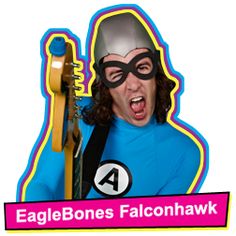
Eagle “Bones” Falconhawk (Super Hero)
Ian Fowles, Guitar

Perhaps the most determined member of the band to right wrongs, Eagle “Bones” Falconhawk has an evil brother called Eagleclaw and enjoys a relationship with the Sun Spirit, Lou Diamond Phillips. His eagle, The Dude, is an invisible spirit eagle. So he has that going for him.

STR: 3
DEX: 5/+1
CON: 3
INT: 3
WIS: 4/+1
CHA: 4/+1

LVL: 11
HP: 39
ATK: +9
AC: 12
XP Value: 4,250

Powers
Conjuration*
Sense Vibrations

Gear
Anti-negativity helmet
Radioactive rash guard (resistance to radiation)
Power belt (invisibility, 1/day for 5 minutes)
Electric guitar (power bolt-electricity)

* Falconhawk can summon The Dude, an invisible eagle. The eagle hangs around long enough to perform one task, and he probably can’t do it more than once per game.

Side Note 1: If you have the chance to go to an Aquabats show, do it. Fun shows, chill music, crazy audiences, a fight with a man in a rubber suit on stage ... you cannot miss with these guys.

Side Note 2: How many other superhero games are there that have published stats for the Aquabats, Action League Now AND Fonzi? Go buy the game, for crying out loud!

Found HERE

Thursday, April 7, 2016

Alignment as Religion


This is something that has been kicking around in my head for a while, so read this as nothing more than me tossing around a few ideas.

When alignment first reared its soon-to-be controversial head, it was in the form of factions for war gaming. There was Law and Chaos - they opposed one another - and then Neutrality. The neutrals would fight for either side, and thus neither favored Law or Chaos. The terms "Law" and "Chaos" came from either Michael Moorcock or Poul Anderson - I've heard both get credit, and haven't researched it enough to have my own opinion on the matter. They may have already had the good vs. evil vibe, but I think the main point was in building fantasy army lists, not modeling ethics and morality in a fantasy game.

With the addition of the Lawful cleric (and later paladin), and the Chaotic anti-cleric, the alignment seemed to become a stand-in for religion. Instead of treading on the dangerous ground of Christians vs. Satan, they used Law vs. Chaos.

Eventually, alignment was expanded from the original three factions (or two factions plus neutrals) to five alignments and then nine. Once you get to nine alignments, with sometimes vague divisions between them, the alignment as religion scheme starts to fall apart. Is Chaotic Good more aligned with Chaos or Good? Is it player's choice, or does one override the other?

The Notion

What if you stick to three main religious/philosophical factions - Law, Chaos, Neutrality (or Good, Evil, Neutrality to be more precise) - and use the smaller divisions as sects within those three great factions.

For example, Lawful Good and Chaotic Good may argue and fuss with one another - they might even come to blows on rare occasions - but they're still ostensibly on the same side, and will always rally to one another when Chaos comes marching over the hill. Both are part of the Good faith, they just differ on the details.

So, how might we characterize these alignment sects?

First and foremost, let's assume that the main divide is Good vs. Evil. Why focus on the good/evil divide? Because I think it's more pronounced and contentious than the law/chaos divide. Oscar and Felix managed to live together without killing one another. Superman and Lex Luthor ... just not going to see eye to eye (you don't believe me? Click HERE. You just can't trust the guy).

I'm pretty sure they inspired Moorcock's Law vs. Chaos
Good supports virtuous action, self-discipline (i.e. telling yourself "no"), kindness, justice and law - not tyranny, but rather the idea of "natural law" or God's law - no murder, no theft, etc. The basics without which people cannot live in relative peace and tranquility.

Evil, on the other hand, scoffs at these ideas. It is interested in power for the sake of power. It might work within a system of law, but will always seek to distort and manipulate the system for its own benefit. Evil loves technicalities. Evil doesn't think of itself as "good" - it knows it is not, and it doesn't care, but it also doesn't see itself as wrong. Evil is okay, because the universe rewards it. Everyone is evil at heart. Good is naive. Good is nonsense. Good is a chicken waiting to be plucked. You good guys can deny yourselves pleasure and wealth and all the rest if you want to, but don't try to force me to deny those pleasures and power.

Simplify, man!
Neutrality is somewhere in between. Maybe pragmatic, maybe a dogmatic resistance to pick sides, maybe it just doesn't think much about it. For druids who actually need a functioning philosophy, perhaps it is something akin to taoism. We probably need to separate True Neutral (the philosophy) from Neutral (a cow chewing cud in a field). On the other hand, maybe druid's just serve the immediate, practical needs of their parishioners OR nature without worrying about whether what they do is good or evil. Perhaps they have an ideal held higher than moral and ethical concerns.

You can play with those definitions, but I think they make enough sense to inform the way a character behaves in a fantasy game environment.

Now, let's examine how the alignment sects might work.

Within the Good alignment faction, we have Lawful Good, Neutral Good and Chaotic Good. I can see Lawful Good as being something like the Catholic Church or similar religious organizations. It believes in virtue and civilization, and believes that the only way to preserve virtue and civilization is through hierarchical organizations and institutions. Its members also believe that the institutions are only legitimate, be they religious or political, if they uphold virtue. They hold their institutions to a high standard, and though they will rarely destroy an institution outright, they will work against its leadership to put a more virtuous person in charge when the institution appears to have lost its way. They believe in reformation rather than rebellion.

Chaotic Good is not so big on institutions. Human freedom and liberty are the key to maintaining virtue and civilization. Institutions are about power, and power corrupts. Give a Lawful Good institution enough time, and it will become Lawful Neutral or even Lawful Evil. The individual must not be run over by the institutions. They would probably prefer a republic over a monarchy, and would be loathe to join with others except on a temporary basis.

Neutral Good
Neutral Good can, like most neutrals, see both sides of the argument. There is value in institutions - they can do things individuals cannot, things that must be done. On the other hand, they can also lose their way, and thus must not be depended on overmuch. A thriving civilization needs institutions, but it also needs freedom and dynamism. Neutral Good also makes me think about some of the Christian sects that wanted to go back to a more "primitive" faith. They were often nudists, trying to recreate Eden, and not entirely unlike the original hippies. Neutral Good hippies could be fun in a campaign, annoying Lawful Good and Chaotic Good alike.

The divisions might be similar on the Evil side. The Lawful Evils worship the devils and imitate their evil hierarchy. The Chaotic Evils worship demons and believe that no creature in the cosmos is more important than themselves - you might call them psychopaths. Neutral Evil seeks to forward itself on the backs of Lawful and Chaotic Evil - maybe they see themselves as the true faith, the puppet masters of the other sects, using and abusing them as events merit.

Neutrality is a little tougher. I would think Lawful Neutrality is conservative, while Chaotic Neutrality is radical. Both favor a balance - either locally among personalities or cosmically between factions - but Lawful Neutral thinks that change might throw things out of balance, so one should be wary of change. Chaotic Neutrality likes change for the sake of change. It rushes here and there, always looking for something new. By spinning the top, it balances. If the top is left at rest, it does not. Neither Lawful Neutral nor Chaotic Neutral want to be enmeshed in a wider struggle between Good and Evil. One faction is too preachy, the other is too scary, and why don't they just leave us the heck alone?

Yes, Evil can work together ... for a while
To recap - Europe's Catholics and Protestants were at odds, often at war, but would have likely joined forces against the Ottoman Turks had they launched a major invasion. Likewise, the Joker, Penguin, Riddler and Catwoman hate one another, but they'll form the United Underworld if they think they can get rid of Batman and Robin.


One More Lame Alignment Idea Before I'm Done

I also thought about characterizing alignments in a string, rather than a square. One is permitted a certain number of vices at each alignment "level". The good alignments are permitted vices that hurt themselves but not others, while the other alignments permit more active vices.

The breakout could be something like:

Lawful Good: 0 vices (the toughest alignment to adhere to)
Neutral Good: 1 vice
Chaotic Good: 2 vices

Lawful Neutral: 3 vices (but only personal vices, as with the good alignments)
True Neutral: 3 vices
Chaotic Neutral: 4 vices

Lawful Evil: 5 vices
Neutral Evil: 6 vices
Chaotic Evil: 7 vices

So Chaotic Evil is permitted to glory in all seven deadly sins, while Lawful Good has to be perfect all the time. If a Lawful Good character sins, but only hurts herself, she becomes Neutral Good. If she does something sinful that hurts another, she drops all the way down to True Neutral (at best), and can feel free to dabble in a couple other sins as well. Reformation might come one level at a time, as the character swears off of different vices and proves their virtue by keeping away from that vice for some period of time set by the GM or through some other meaningful way.

This is what the planes should look like, right?
Related Posts Plugin for WordPress, Blogger...