Showing posts with label stabbification. Show all posts

Monday, 9 July 2012

Lets Read Mythus pt20

Ah me, where does the time go? It seems like only yesterday that I first jokingly broached the idea of a Lets Read of Dangerous Journeys: Mythus (and for the life of me I can’t remember why that ever seemed like a good idea). Now here we are, 20-odd weeks later, still deep in the Combat chapter, facing yet another wodge of text, tables and wonky formatting.

Today we exhume the Advanced Mythus rules on Weapons and Armour, which sprawl across pages 235-256 in a bloated abandon reminiscent of an orgied-out Roman emperor. Those last few hardened, dead-eyed souls still playing along at home may wish to charge their glasses with something nice and paint-stripping now.

Weapons and Armour Information and Tables


The section opens with a couple of paragraphs of introductory busywork. In brief: "here are tables of stats for war gear, uses them." (a paraphrase, not the original gygaxian prose) The customary intro is followed by a column of text explaining what all the abbreviations in the forthcoming tables mean.


These abbreviations.

Sub-Area -- what weapon skill sub-area you use to bash people.
WP -- Weapon Points. How much the weapon adds to your skill.
C -- Composition; what your thwackenstick is made from. (M for metal, W for wood, C for combination)
S -- Speed Factor. Not ‘SF’? I’ve no idea why not.
DT -- damage type (P for piercing, C for cutting, S for stunning, B for blunt, etc.)
Dam -- base weapon damage
Reach -- striking range (in yards)
Price -- price in Mythusbucks.

Additional notations for missile weapons:

T -- thrown weapon? Y/N distinction.
Price -- given in a ###/## format. The number before the slash is weapon price, after is price per shot
ROF -- rate of fire per round (before modification for skill level)

Not sure if any of these are worth toasting as OMJ (Original Mythus Jargon - gateway to liver damage since Feb 2012); with the exception of 'WP' and 'SF' they’re all pretty standard RPG jargon.

Weapon Tables

Remember the weapons tables back in the AD&D PHB; the ones that sprawled across a page or so, and which were so lovingly parodied in Hackmaster? Well, the Advanced Mythus weapon tables cover four pages: pp236-240, the whole of pages 236-240. That's two pages for listings of melee weapons, one page for missile weapons, and then another page of missile weapon ranges, of which there are five: Point Blank, Short, Medium, Long, Extreme. Why five? Because three range brackets would just be soooooo unrealistic, of course.

In total the tables give stats for:

Melee Weapons -- 18 swords, 9 shields, 59 others -- total 86
Missile Weapons -- 8 bows, 9 xbows, 23 others -- 40 total

Almost all the special rules and footnotes from EGG's iconic AD&D weapon tables are in there, along with a few new ones. There are 13 special weapon abilities all told, and it looks like this is where all the special attack stuff I was lamenting the lack of last week has been hanging out. Want to unhorse/disarm/entangle? See here:


Yeah, lotsa combat options, all hidden away in the footnotes.

Its nice to see some familiar old friends (hold at bay, prod off horse, etc.) poking out of the sanity-devouring accretion of Zalchisian proportions that is the Advanced Mythus rule set. But - and isn’t there always a ‘but’ - I do have one small niggle with these super secret esoteric rules of doubleplusobscurity. Namely, that the half-written rule problem which so often plagues Advanced Mythus rears its ugly head again. For example:
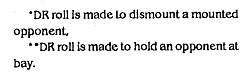

Ok, great. But what DR are you supposed to test against? A straight DR "Hard"(x1) roll? A DR derived from the relative weapon skills of the participants (in the manner of a contested K/S vs. K/S roll)? Does the guy you’re trying to do stuff to get an Avoidance roll? Are we told? Are we hell.

The footnotes to the missile weapon tables are much simpler, with only one special rule and a couple of notes on ammunition cost. But then what else did you expect regarding a series of variations on a theme of string and twigs? It's not like anyone armed with a bow was ever instrumental in winning a battle; no, not like Gary's beloved pole-arms.

Wassat? "Gunpowder weapons?" Wash your filthy mouth out!

A couple of other takeaways from the Advanced Mythus weapon tables:

  • Pike, Mancatcher and (Bill-)Guisarme(-Voulge) are slow as owt at SF 10. Enjoy your going last.
  • Rapier, Scimitar, Mancatcher and Lance practically do your fighting for you, adding 10 WP to your skill (12 if you pick up a heavy lance). Sure, coz lancing is super-easy and takes no practise at all...
  • Daggers are able to unhorse opponents. Nope, it says so right there on page one of the grand unified melee weapon table.
  • Long bows and crossbows negate the first 5 Armour whenever they hit. Some melee weapons (particularly the Renaissance-era ones: halberd, 2H sword, morningstar, pick, pike) ignore even more; anything up to 2x their inherent WP!
  • Some weapons are officially useless against armour, either doubling armour values per hit, or causing 0 damage.
  • Throwing a rock at someone? That's Hand Weapon, Missile (sub-area: darts). ¿Que?

Weapon Descriptions


As well as the four pages of tables for 120+ types of weapon, we’re also offered no less than eight pages of text defining those weapons. The weapon lists are pretty much what you'd expect of a Cold War-era militaria nerd's knowledge base: the majority of stabbinators are European or Japanese, with a scattering of notorious weapons (bolas, blowgun, shaolin shovel, cho-ko-nu, tulwar) from other cultures. I spotted no African, Amerindian, or Polynesian weapons, and very few Indian and SEAsian ones, so all you maquahuitl, tlinga, katar or chakram fans are SOL.

But fret not knife-on-a-stick fetishists! All the classic Gygaxian pole-arms are there. All. Of. Them. Because a game without glaive-guisarmes and six alternative names for the ranseur(!) is no game at all.


Each and every killtoy gets one paragraph of potted description covering such germane information as:
  • general appearance,
  • cultural origin,
  • use in combat, and
  • minimum strength requirement to wield.
The minimum strength requirements are, to put it mildly, problematic. For one thing I've no idea why this particular rules wrinkle wasn’t defined earlier and integrated into the weapon tables: it’s not like a there’s a lack of space. For another thing more than a few of the requirements seem rather over-inflated. Min PMPow (Str) of 13 to use a katana? Min Str 15-16 to use a pole-arm? In a game where normal humans have Str 10? That seems steep to someone used to RQ's 'Min Str 7/9' requirements. To cap it all there's no mention of any penalty for using a weapon that's too heavy for you, just a blanket ‘you must be this high to ride’ number. PMPow 15 and you want to use a PMPow 16 weapon? RULES SAYS NO!

Dear oh dear. That is no way to run a whelk stall...

A couple of weapons from the tables ('chopper', 'generic shield') are missing text descriptions, and there are a few other odd Easter eggs hidden among all the wordswordswords:
  • Pig feathers (a metal version of the classic sharpened stake) don’t even belong on this table; they’re an emplaced battlefield obstacle, not a weapon.
  • Manopele? An armoured sword-breaking gauntlet covered in blades and spikes. METAL as all hell.
  • A Foot Bow (Long) - or possibly a Foot (Long) Bow - is basically a giant crossbow that uses you as the body. See that wacky scene in Hero [link].
  • Get your bow wet and you lose *at least* 50% range and any bonus damage. Get your compound bow wet and its 75% likely to come unglued. Bow users: enjoy your 'hostage to a dick GM' status.

Finally we come to the all-important question of utility. Is this section useful?

Arguably not. If you've read the AD&D weapon rules you've had most of the benefit of this section, and the writing herein is the worst sort of completist, minutiae-obsessed game writing. I’m not going to take EGG to task for failing to anticipate the later prominence of Google and Wikipedia, but I know for a fact that handbooks of medieval warfare and weapons (produced either by game designers or by general interest publishers) were readily available in the 1990s. Eight pages spent defining a spear, katana or pike is naught but just needless busywork and completism.

And then there’s this particular weapon description:


Argh! the obvious! I'm blind! I’m completely blind!!!

Is that subtle self-parody, or just complete loss of proportion? I don't even know any more.

Advanced Mythus: Chaos plot?


Armour Tables and Descriptions


Just when you thought it couldn't get any fiddlier and pixel-bitchy, we finally come face-to-face with the Advanced Mythus armour rules in all their infernal glory. They're only six pages in toto*, and include rules for natural (monster) armour, for humanoid (suit) armour, for barding (animal) armour, and no less than three variations on the theme of  simplified Advanced Mythus armour. Yes, you read that right. Mythus even manages to make a meal of simplifying thing.

* Wait, did I really just write 'only six pages of armour rules'? What is this game doing to my head?! More worryingly, why are the armour rules lodged in some poor little Scottie dog?

The crux of the Mythus armour system is the Armour Categories table:


Because a dozen armour locations makes sense in a game with four hit locations.

You can only have one piece of armour per Category, but each piece of armour grants its protective bonus to all the listed Hit Location Areas. Does that make an oz of sense to you? Thankfully there are a couple of paragraphs of worked examples and rationales for the hopelessly confused. The self-awareness test is again failed with a helpful suggestion that "...it would be a good idea to create an armour sheet to help you keep track of it all."

Natural Armour

Monster armour in Advanced Mythus is weird and a bit irritating in that completely negates the benefits of multiplied damage from hit location rolls. No, seriously. Read this:


So, according to this, rolling for Hit Location on a monster is nothing but busywork.

The above conclusion is not just me interpolating meaning for dramatic effect. This textual WTFery is entirely supported by the example gratis offered as elaboration and clarification. Consider the armour schema of a Mythus monster:


Because a unified 'All Others' column would never work.

Argh! That's just stupid! A single row of 'Normal' armour and note to the effect of "deduct this from damage before multiplying for Area hit" would cut that whole over-elaborate table down one value, two modifiers, and a footnote, and all in a grand total of three lines. Watch:

Stone Golem
Armour, Non-Vital 20* (Electricity 10, Blunt 5)
* deduct from damage taken /before/ multiplying for hit location

Natural Armour? Nothing natural about it! Kill it with fire, salt the earth, and start from scratch!

Human(oid) Armour


Rules for artificial armour. Cost for bigger suits scales in a linear fashion (+100% for each +3' of height above human norm), while protective value scales not at all. So a 12' tall giant's suit of armour costs three times the human norm (no, not eight times) and blocks exactly the same damage that a human size suit does. I'll just leave that bizarre little nugget o’ Mythuslore there to enrage anyone who understands cube-square mathematics, shall I?

The introductory paragraph of madness is followed by another para' explaining the abbreviations used in the tables on the following pages (a bunch of damage types, "AP Cat" = Armour Protection Category, "SF Pen" = Speed Factor Penalty). This is delicious jargon, and we drink to it. (*gluk gluk*)

After the decompression of OMJ terms into English we're then given something that, at least in a bad light, looks a little like an armour encumbrance rule:

Running: -1 yd/BT per -1 SF penalty.
Walking: -1 yd/AT per -1 SF penalty.
Dodging: impossible in armour with SF 5+. Why SF 5 or more? Because phuque, that's why!

Whether you’ll care enough to remember something as fiddly as this in play is up to the conscience of the reader. I wouldn’t give it a second look myself.

Armour Tables


Cover pp248-249. Listings of all the information you could ever want or need for both individual items and for full suits of armour. Annoyingly there's no 'bespoke' vs. 'off the peg' organisation, everything is all mixed in together in alphabetical order. Could have been handled better IMO.


Page 2 of 2, page 1 is just more of the same.

There are several footnotes at the base of the second page, and the old Mythus crime of using both bullet points (·) and askterisks (*) in a font where there is almost nothing to distinguish them rears its head again. "Bad editing staff! No cookie for you!"

All those different numbers by damage type probably relate, in some subtle way, to the Weapon-vs.-AC tables of AD&D fame, but I'm blowed if I can tease out any correlation beyond the most obvious.

Astute observers will note that shields make a reappearance, this time giving their defensive stats rather than Speed Factor damage. A rational mind (as opposed to the mercilessly Martian logical one that actually laid out Advanced Mythus) would probably have hied the shields off into a single unified table all of their own.

Armour Descriptions


Pages 250-253 are a primer on the art of armour, from the evolution in styles of full plate right down to the subtle delights of Cuissarts, Demi-Jambarts and Tuilles. (Nope, me neither without checking) One paragraph per suit or piece of oddly shaped metal. The Speed Factor penalties from the armour tables are reproduced in the description. My cursory flick-through turned up no text/table conflicts.

Barding Descriptions


Armour for animals. Warhorses (+elephants +monsters) only. Work and riding horses are unable to wear barding. Why is not explained, they just can't. Barding of a particular type always protects per the table. I assume the listed price is to bard a horse rather than a war-elephant or something equally rock-and-roll. Nothing is said about the price of armouring other creatures. Presumably it's an "If sir has to ask, sir cannot afford" situation...


The table is pretty self-explanatory to anyone familiar with the human(oid) armour tables.

  • "SF Pen" percentage is actually a penalty to the mount's speed.
  • Chamfron and Front Plates are additional 'bolt-on' armour. Everything else is a big coat of horse reinforcement.
A textual note that creatures of Phaeree cannot wear any ferrous-metal barding (iron, steel, adamantine) and must wear bronze reveals that the latter metal offers only 70% of the protection of steel. This implies a whole other level of detail regarding non-iron weapons and armour, a world of which we (perhaps mercifully) know nothing.

Useful? Depends on how fiddly you like your tinned horse rules...

Cost of Weapons and Armour


Price of stabbers and tinbitz varies by quality.


Quality in turn affects only the amount of damage your shiny toy can take in parries. Spending 10x the normal amount on a weapon of "Unsurpassed" quality modifies its innate Weapon Points, Speed Factor penalty or encumbrance effect by precisely 0. You want a better weapon? Go kow-tow to the Heka-slinger: they have the monopoly on improving weapons.
"Silly muggle! All mundane quality is equally worthless; only magick has mechanical benefits in Mythusworld."
Price variations with no useful purpose in-game? *pffft* Seen better. Heck, written better.

Damage To And Repair Of Armour


An opening plaint on the complexity of modelling wear and tear on armour before we're informed that if a piece of armour takes maximum damage 10 times (ie: blocks damage, but some still gets through to you) it falls to bits. That drops to "5 penetrating hits = crumple" if its a buckler. Again, no variations for quality.

We do find the limits of Advanced Mythus armour fiddliness though:


Note Gary's polite use of the word 'purist'.

Averaged Armour


Most of pages 255-256 is spent in tacit admission that the default armour system of Advanced Mythus is overcomplicated to the point of absurdity. The reader who might actually want to play a game of Mythus some time before the heat death of the universe is offered three alternate system of simplified armour calculation.

The first alternative system is Average Armour, and it offers three levels of coverage (half, 3/4, full) in six remarkably familiar types.

Half armour = byrnie (coat) only
three-quarter = byrnie + greaves and gauntlets
full = the above + helm, shield, brassarts

The armour types are (stop me if you've heard this one before):


Hello old friends. What are you doing in a dump like this?

Want simpler? Pick an off-the-peg Averaged Armour, Simplified suit: all the joy of damage types with none of the number-juggling of pick'n'mix armour.

Want simpler even than that? Choose Averaged Armour, Unified Damage Types, which is basically the Mythus Prime armour system.

The numbers are run for you in one last page-spanning table:


Start simple, get more complex? Such is not the Mythus way!

-----

And that's the skinny on arms and armour in Advanced Mythus. Wasn't it both fun and infinitely useful for your nice, simple, rules-light Classic game?

...

...

"Pwa-hahahahahaha!!!"

Sorry, no. Couldn't keep a straight face there.

Seriously, some stuff here might be of interest to AD&D players, or to RuneQuesters who want a bit more mechanical fiddliness to their arms and armour rules. Almost anyone else should probably take these weapons and armour rules as a cautionary example of the dangers of excess.

I think I’m going to go and read classic super simple Brit-gamer RPG AFF: Dungeoneer until my desire to hunt down the surviving members of GDW’s editing department and make them eat pages of Dangerous Journeys: Mythus while screaming "You! You let this happen!" abates. I may be some time...

Next Time: Dazing, Permanent Damage, Shock and more. And that's just what's going on inside my head...

Pic source: Dangerous Journeys: Mythus rulebook, teh netlowubz

Monday, 2 July 2012

Lets Read Mythus pt19

Welcome again to Let's Read Mythus, our weekly trawl through the Gary Gygax's post D&D masterwork. Today we trudge into the murderous mess that is the Advanced Mythus Physical Combat rules, which may or may not be of usable salvage value to players of other games.


Physical Combat, Lethal


Week three of Combat, and we finally get to the crux of the matter: thwacking dudes with swords. And, no, that's not just me being a bloodthirsty lowbrow bogmonkey; we have it on good authority from the pen of the master his own bad self:

One of us. One of us. One of us.

One nice short paragraph saying that Lethal Combat is dangerous (No, really?) and assuring us that "Note that while these rules may seem complicated, once you get used to them they're quite easy. They are designed to simulate reality and the actual suspense which exists in combat." Ok. So the confusion, tears, pain and screaming were actually a desired outcome borne of careful attention to verisimilitude, and not just my reflexive horrified reaction.

Front and centre attention is drawn to the all-important sidebar, to which anyone daring this section will probably want to cling to like a drowning man snatching at a life ring:

This is your (war)god now!

Pages 223-230 are all just footnotes to this.

The main thing to note is that, unlike every other form of combat in Advanced Mythus, Lethal Physical Combat offers absolutely no option to do anything other than hit someone. There's no option of attacking to cripple, or blind, or disarm, or anything else. Eight pages of mechanics for hitting and hitting back. And that's it.

Oh, I tell a lie. You can parry someone else's attempt to hit you. Big whoop!

Notable new jargon:

Basic Attack Chance (BAC) -- weapon skill STEEP + modifiers for high Perception and quick reflexes
Final Attack Chance (FAC) -- This is your BAC after all modifiers; what you actually roll the die against.

Weapon Information


Pages 223-225 are full of information, tables and worked examples explaining how to determine attacks and damage with a particular weapon. It starts thus:


And, like some sort of aspie Terminator, absolutely does not stop until the end of p225. There is a lot of info here, all divided up into sub-sections corresponding to the numbered points above:

BAC
This is STEEP + Weapon Points + Bonus for Physical Perception. Each of these gets some defining blurb.

STEEP we know. That's your skill level with the weapon in question derived from the relevant Combat (HTH, Lethal, or Hand Weapon, or Hand Weapon, Missile) K/S Area sub-area. Mmmm, delicious jargon. (*gluk gluk*)

Weapon Points are a novelty. These are a seemingly ass-pulled number that a particular type of weapon adds to your BAC. I'm a bit vague on what Weapon Points represent: possibly some abstraction of reach and handiness? All weapon, except HTH, Lethal weapons like nunchaku and tai-fu, have Weapon Points. Why? No idea. Magic weapons have bonus Weapon Points over and above the norm for their type.

Bonus for Physical Perception are granted for high stats according to the following table:


Just for completeness, we're also told how to work out BAC for characters who lack the correct K/S sub-area to correctly wield their chosen stab-toy. Half-trained klutz BAC is Weapon Points + 1/2 the relevant general Combat skill (HTH Lethal, Melee or Missile). Total combat virgin BAC (for those with no relevant weapon skill) = Weapon Points only. Enjoy your sudden, messy death.

Attacks per Round
Varies by type of weapon and by skill with weapon. We're helpfully referred back to the skill descriptions, and forward to the weapon tables later in the Combat chapter. Try to enjoy the breeze as the pages flap back and forth during the orgy of cross-referencing this section requires.

Damage
A couple of tables giving bonuses to Physical damage. These are just clarifications of simple rules:
  • High STEEP damage bonus is +1 per 5 points of skill over 40. At 71+ this increase to +2 per 5 points. So +4 at 56-60, +5 at 61-65, +10 at 76-80, etc.
  • High PMPow (aka STR) damage bonus is +1 per point over 12. So +2 at 14, +3 at 15, etc.
 There is also a table of bonus damage per die for being extra HUEG:


The bonus damage per die is a nice touch not often seen outside some of the more obscure sub-rules in AD&D, but I'm not sure how often this table will actually see use. Remember that the implicit setting of the Advanced Mythus game is a rigidly humanocentric place where even the bog standard fantasy races are strictly optional: something like ogre or ice giant is definitely not a default character type in this game.

A list of damage types (previously seen in the Heka-Based Attacks section) make a re-appearance for the sake of completeness. The damage types follow the previously defined rules.

Reach or Range
One paragraph. Range for claws and martial arts is 1 yard, and longer weapons have a longer reach (given on the weapon tables). Missile weapons have the best range. Waste of a paragraph, you might as well have just written "refer to weapons tables" and been done with.

Speed Factor
Again, one paragraph. Again, could have just been a "refer to weapons tables" reference. Martial arts attacks and weapons = 3. All other weapons consult the weapon tables. Echoes of AD&D are echo-ey.

Parrying
Durability of parrying weapons, etc. Actual rules for blocking incoming objects with other objects are given elsewhere, this is just commentary on filling out your weapon description.


Shields modify the damage capacity for their quality and composition according to the last column of this table. So an average spear will be (Average quality, Combo composition) 8/20, while an average rimmed shield will be 8/30. Exactly what these numbers mean is explained later in the Combat chapter, under Parrying. Try to restrain your excitement.

Magazine
What's left in your cho-ko-nu or quiver? You must know. It is important! Yes, of course Accountancy Mythus tracks every last arrow, bolt, and sling bullet. Did you honestly expect anything different?

Congratulations. You've now filled out the relevant stats for one weapon. Now go back and do it again for all your other jabbification devices. It shouldn't take that long. It's not like you intended to spend any time role-playing or anything...

So far I'm strongly reminded of the 1d4chan entry for RoleMaster? ("An ancient classic from the Dawn Times. If you picked up this game in 1980 and started making a character immediately, then you should be almost ready to play this Friday.") Most of this stuff is just a waste of words. Two-and-a-half pages to define the qualities and characteristics of your weapon when the basic rules for using the damn thing only take a half-page sidebar is just sheer pandering to the 'no common sense' element of the readership.

Final Attack Chance (FAC)


As those who bothered to read the Physical Combat, Lethal summary boxout will already know, FAC is what you actually roll against to hit. It's calculated as the sum of your BAC +/- the scads of modifiers detailed over pages 226-227. Simple enough, right?

Modifiers to BAC differ from a lot of difficulty modifiers in Advanced Mythus in that they are linear modifiers (+/-n), rather than adjustments to Difficulty Rating multipliers. I have no idea why this exceptionalism exists, and there's nothing in the text to enlighten me. Any suggestion of a savage Mythus playtester revolt in favour of traditional percentile modifiers is naught but wildest speculation on my part. ;)


Advanced Mythus playtesters, circa 1991

Some modifiers only apply to ranged attacks; others apply to all Lethal attacks. "Hand weapons, martial arts and natural attacks use only the Attacker's Movement, Target's Movement and Position tables." This is explained in the text, rather than being marked up on the page-spanning table of modifiers where it might actually be helpful. I've taken the liberty of correcting the oversight.

Sooooo many modifiers. Soooooo much scope for clarification and simplification.

Dodging in Advanced Mythus is subsumed in this (sub-)section and takes the form of a mathematically insignificant 'always-on' modifier to FAC. Dodging bonus is available only to people with crazy-good reflexes, and is usable only when wearing light armour.


Runequest fans will be feeling some more deju vu about now.

The situation isn't as bad as it looks at first glance given that Advanced Mythus HP's Attributes are generated on 2d6+8 rather than the more traditional 3d6. So anyone with better than average (for an HP) reflexes will get at least some dodge bonus, however insignificant. And boy are dodge bonuses insignificant: +1-2% for dodging when the act of walking grants a -5% modifier is just what can reasonably be called a b*llsh*t bonus.

So that's yet another grudging, pixel-bitching, mechanically inconsequential stat modifier to keep track of. Which - I'm sure we can all agree - is a hallmark of good game design.

A couple of additional notes extracted from the dense text on FAC:
  • BAC can never be reduced to less than 10% of initial score by negative modifiers.
  • FAC is usually a DR "Hard" (x1) skill check. Judging from the worked example offered expending Joss is (seemingly) the only thing that modifies this DR, rather than playing with the percentiles.
  • By default all of a character's attacks are taken on the same initiative score.
This section has lots of wordiness and some p*ss-poor organisation of info. I'd have done it all very differently. Small mercy: at least the GDW layout chimps managed to get all FAC stuff onto one two-page spread.

Special Hits/Special Misses


Crappy layout orphans the Crits/Fumbles text from its accompanying table. The Lethal Combat Crit/Fumble rules are pretty much a rehash of the Non-Lethal ones we've already looked at:

Crit = maximum possible damage (*snore*)
Minimal Hit* = minimum possible damage
Fumble = roll d%, deduct weapon skill and 20% per Joss spent, compare to table

* a hit reduced in effect by Joss. We're even given a page reference to the rule.

The Advanced Mythus Lethal Combat Fumble table is pretty poor. How poor? Well, let's just count up the entries shall we? I know that number of entries isn't a guarantor of quality or anything, but bear with me).

"One... two...three... (fades out)"

Musical interlude

(fades in) "six... seven."

Yes, that's it. This table has a Sesame Street-worthy total of only seven (7) entries, of which one is "The attack misses, but nothing else happens."


Never has a lethal mis-step been so Dull. Dull. Dull.

I've seen rules-lite old school Fumble tables with more character and interest than this. RoleMaster would look on it with pitying contempt and even jolly old WFRP would amble over, take a shufti, and wander off chuckling. Whatever happened to the promised "...elective complexities which place this game far beyond any other"? Bad show!

Fourteen Appraisal sub-areas; seven possible combat fumbles. Do you ever get the feeling that someone had their system design priorities a little confused? If even the most allusive mention was made to 'other game systems on the market' famous for their critical hit systems I might have a little more time for this section. But no: zip, zilch, nada.

Applying Difficulty Rating to FAC


Three paragraphs confirming that - exceptional circumstances withstanding - the DR for a FAC roll is almost always of "Hard" (x1) difficulty. Waste o' words, but an excuse for more pain-numbing swiggery. (*gluk gluk*)

We're also given a table of automiss/Fumble chances for high FACs. It's more than a little reminiscent of the standard autofail/Fumble table from back in the Core Systems chapter, but it's nice to have it here for completeness.


Might be handy for a percentile game player who lacks a fumble table and feels the need of one. Otherwise c'est inutile.

Parrying

Parries in Advanced Mythus are (gamer jargon) elective interrupt actions which require you to reserve attacks. Hope you remembered to reserve some attacks when you were going nova earlier. There's no word on whether you have to declare intent to parry in advance, or simply declare it in reaction to a connecting hit. That bucket of angry eels is left in the lap of the GM, because he doesn't have enough to worry about already.

You can parry any melee or thrown missile weapon (although trying to block a sword with your hand is not recommended). Launched projectiles (arrows, bolts, etc.) can only be blocked with a shield.

We're also given a lick-and-a-promise note to the effect that:


Oh, hell no! You did not just do that!

I'm usually prepared to give Mythus the benefit of the doubt, but that is amateur bullshit in the first degree! This is not some kid's fantasy heartbreaker 'zine where "Coming soon" or "Under construction" is acceptable. Advanced Mythus is a full-on magnum opus: an inch-thick, professionally produced rulebook with a bunch of names on the colophon, playtesters galore, and a 60+ page combat chapter. There's no excuse for doing a Mearls half-assing any part of the rules and promising "Yeah, we'll do it right in some other book". That just smacks of attempting to double-dip the punters' wallets for something you should have done right first time.

Deadline-crushed amateurism, lazy design, or cynical set up for a later cash grab? You decide.

"Ma! Get me my hack whomping 2-by-4 from the shed!"


Weekly fit of frothing and moonhowling concluded, we return to the rules for parrying. Parrying in Chadpants Doofus Physical Combat is a straight roll by the Defender against their own BAC, with the DR dependent upon the weapons in play. No, a parry is not a contested roll in any way, shape or form: that would just be stupid!

Fortunately for my blood pressure the information required to perform a basic parry is actually present in the rulebook, mainly in the form of another handy table:


Actual rules for parries disposed of - in five lines and one table (which could easily have been simplified *gluk gluk*) - we move onto the related sub-rules for weapon damage from parries. No sub-section heading; just an unheralded topic shift somewhere in the depths of a textwall. You may remember the numbers from the table presented in the Parry section of Weapon Descriptions above.

Coz it would have killed you to explain that earlier.

Both sides of a successful parry roll for weapon damage.And, yes, mutual *ting ting SNAP* action is possible.

Is any of this stealable? IMO, nah. The Advanced Mythus parry rules are a half job; the sort of thing you'd expect to see in a nice, sleek two page combat system like Stormbringer, not in an ultra-complex RPG which trumpets itself as "...a quantum leap in roleplaying." You can't even riposte FFS! If you're going to nick quick-and-simple parrying rules something like Necromunda has better, and that's a toy soldiers game that uses d6s!

Strike Location


If a hit gets through without being parried (or if the players just decide to take the damage instead of broaching that particular barrel of nightsoil), then roll d% on the Strike Location Table to determine where your mighty swing hits.


No, that is not a bad joke on my part. That is the unified Advanced Mythus hit location table for any and all creatures in the game world in its entirely. Roll d%, get a damage modifier of x1-4. That's it.

Honestly, this is all a little disappointing. Given what we've already seen of this game I sure that you were expecting a hit loc' table of positively Dwarf Fortress detail and specificity: hit locations down to the metatarsal and specific internal organ. Instead we get pure functionalism: four Vulnerability Categories (*gluk*) reminiscent of the "This is where you hit him to kill quickly, or slowly, or to cripple" speech from Spartacus (the movie, not the even more homoerotic tv show). 

To add insult to injury the hit locations aren't even defined in a non-abstract way, they're nothing but damage multipliers. Would a mere dozen words expended on "Ultra-Vital = face or groin, Super-Vital = neck or guts, Vital = torso, Non-Vital = limbs" have broken the word limit, or somehow imposed crippling constraints upon EGG's creative vision? Obviously so.

And the waffley footnote that "fragile or tough creatures adjust roll by +/-5-10" is neither nowt nor sommat: a mere house rule. If WFRP 1E can expend a few lines explaining how the sole hit location table can be modified to take into account the wild variety of non-human physiologies in a fantasy world, then a game with seven types of standard physical damage which spends more than two pages on its Buffoonery skill has no excuse.

One other point to note: looking at the above table suddenly Special Hits don't seem so special any more. That rare '1/10th of skill, maximum damage' hit will be overshadowed by doing average damage but hitting in Vital or better area 40% of the time.

More than half of the Strike Location section of the Physical Combat rules is taken up by something semi-related: the mechanics for using a specific sub-area of a Weapon K/S area:

The opportunity to select one's damage multiplier? Yes, I am interested. Please go on.

Roll to hit as normal, then roll Weapons, Special Skill (Specific Target).

Success = choose your damage multiplier. ("Hurr durr. I choose x1.")
Failure = roll on the Strike Location table w. a +20 modifier. >100 = miss.

And that last disappointment disposes of Step One of the combat summary: hitting. We now move onto Step Two: hurtin'.

Applying Physical Damage


If damage isn't parried, and the person using these rules hasn't lost the will it live by now, damage is done. Armour will (probably) soak some of the pain, and the remainder hurts your HP or monster Monstrous Persona. So, that's a classic soak mechanic which is an RPG Orthodoxy at least as old as Runequest, and probably has even hoarier antecedents in wargaming.

Of course, this being Mythus it doesn't remain a simple deduction operation. There are tables to be cross-referenced of course! Each of your four Vulnerability Categories has separate armour scores for each type of physical damage. The worked example of some dude in maille and shield takes up the better part of a column.


Say it with me now:"AC5".

Yes, the negative numbers are intentional. As regular readers may recall, lightning damage is to armoured warriors in Advanced Mythus approximately what King Herod was to infant schools. So inventing some form of primitive lightning rod will probably be a priority for any tinboys who manage to drag themselves through character generation ~and~ armour calculation with an ounce of their sanity intact.

To add final insult to injury we're informed that magic armour doesn't have any of this number crunching to deal with. Magic armour - being magickqkc and thus inherently better than dirty mugglemetal - has one armour value per Vulnerability Category against all types of damage.

FFFFFFFUUUUUUUUUUU-!!!


It's at about this point a sane person would be thinking: "Hmmm, is my game perhaps too fiddly?"

Wound Level, Critical Level and TRAIT damage thresholds get name checked and defined again, along with a page reference to full rules (on p256) for the Shocked, Dazed and Permanent Damage conditions.

Shocked, dazed and permanent damage about sums up my experience of the Physical Combat, Lethal rules so far. The whole thing is just a morass of simultaneously abstract and over-complex dissociated mechanics [link] with little meaningful relation to one another.

Particular niggles:
  • You can hit the dude, and that's it.
  • FAC Modifiers could do with being simplified and rationalised.
  • Dodge bonuses are so insignificant as to be all but meaningless.
  • Rules for Crits/Fumbles during the deadly, high-stakes dance of blades are both abstract and dull.
  • There is no relationship between accuracy of hit and actual damage done. Acceptable in a game as abstract as OD&D, just insulting in a game as complex and fixated on 'realism' as Advanced Mythus.
  • There is only a single (very specialist) option for modifying hit location. An option of which effective utilisation will require more system mastery than most players will care to invest.
  • Seriously, you call that a hit location table?!
  • The parry rules are a clunky, half-done job and fill me with displeasure on many, many levels.
  • There is no option whatsoever for using Heka in Physical Combat. No one-off accuracy increase, no way to enhance dodge or parry bonus, or no damage boost: nothing.

The bulk of pages 230-231 are taken up by additional rules and notes of special cases which may apply to Physical Combat, Lethal in certain circumstances. These are: Susceptibilities, Invulnerabilities, and Exceptional Attacks.

Susceptibilities


Some creatures suffer additional Physical damage from certain substances. This is Wounding type damage, which is a new one on me. The list of magic allergens should be eminently familiar to any role-player or reader of horror fiction:
Silver, Crystal, Iron, Fire, Irridium(?!), Salt, Wood, Blessed Water

Contact: merely touching the inimical item will cause 1d3 damage (or minimum weapon damage) to the susceptible. Salt and Blessed Water cause 1d3 damage per oz, with 30-80% of possible damage being done by bulk applications.
Insinuation: stabbification causes the susceptible x2-10 normal damage after all other modifiers (Armour, Hit Location, etc.).

There are also rules for non-weapon Susceptibilities (garlic allergy?) later in the rulebook.

Invulnerabilities


These are classic D&D-style immunities to [named thing], usually balanced by a corresponding Susceptibility to [other thing]. Usually all-or-nothing, and players will usually have to puzzle out the Achilles' Heel of whatever creature they're facing.

Exceptional Attacks


These are basically rules for screwing characters over with attacks which don't do much direct damage, but still have a catastrophic effect if they take hold. Snakes and swarms of insects are the cited examples, but we're informed many other types of (undefined) attack also fall into this category.
  • Unarmoured individuals are allowed to parry such attacks and/or attempt Avoidance [link].
  • Armoured individuals either suffer automatic attacks per round (by swarms of killer bees), or have to suffer a Super- or Ultra-Vital Hit to be affected by scorpion stings, snake bites or poison blow darts.

Would I use these rules? Nah, Classic D&D does all this with exception-based rules found in the monster descriptions or with Saving Throws.

Tying It All Together


An extended worked example is spread over three pages (pp232-234). The only way it differs from any other worked example you have ever read is that the example GM is a fan of seemingly arbitrary dick moves that screw the players.

-----

In Conclusion: the Physical Combat, Lethal rules of Advanced Mythus are loosely jointed, dissociated, and all kinds of scrappy. There's very little coherence of elements into a symbiotic whole, nor is there much sense that these rules are part of the same system as the rules for Mental, Spirit, or Non-Lethal Physical Combat.

In a section which almost requires a clear, orderly progression of useful information, the characteristic Mythus sins of dense formatting and verbiage are *still* in full effect. As is often the case, a good hard proofreading and procedural precis/ing wouldn't have gone amiss.

In its entirety the Physical Combat, Lethal section reads like nothing so much as a heartbreaker version of AD&D combat written by a guy who liked Runequest but couldn't be bothered to deliver the full RoleMaster level of complexity he originally envisioned.

I cannot, in good conscience, recommend these rules to others. They are beta release quality in a world where superior finished articles already exist.

Next time: Weapons and Armour, 20 pages thereon. And, yes, there will be pole-arms.

Pic Sources: Dangerous Journeys: Mythus rulebook, the intawubl
Related Posts Plugin for WordPress, Blogger...