







Helen Harden
Helen is a former head of chemistry at an 11–18 comprehensive school. She has an in-depth understanding of the science curriculum from primary through to secondary level with a specialist focus on chemistry. Helen has developed award winning resources and currently provides curriculum consultancy and resource development services to UK-based and international organisations.
Helen was formerly the chemistry lead for the University of York's Best Evidence Science Teaching (BEST) project. Her extensive reading of the chemistry education research literature on misconceptions informs much of her work today.
Helen is an active member and former chair of the Association for Science Education. She is currently commissioning editor of ASE’s School Science Review journal. Helen is also a member of the Royal Society of Chemistry and was a member of the 11–16 Curriculum and Assessment Working Group.
 Resource
Decomposition of calcium carbonate | Johnstone’s triangle worksheets | 14–16 years
Think about reacting masses and gas volumes in the context of a decomposition reaction
 Resource
C, O and Co | Johnstone’s triangle | 11–14 years
Develop your learners’ understanding of symbols and formulas at different conceptual levels by comparing the symbolic representations of carbon monoxide and cobalt
 Resource
Reacting ratios: gas volumes | Developing understanding | 14–16 years
Connect learners’ ideas about balanced equations, the ratio of atoms and moles and the volume of reactants and products
 Resource
Symbols and formulas | Developing understanding | 11–14 years
Develop your learners’ understanding of what is represented by symbols and chemical formulas
 Resource
Excess copper oxide | Johnstone’s triangle worksheets | 14–16 years
Explore the reaction of sulfuric acid with excess reactant copper oxide at three conceptual levels with Johnstone’s triangle
 Resource
Limiting and excess reactants: quantitative | Developing understanding | 14–16 years
Develop learners quantitative understanding of limiting and excess reactants with the support of bar diagrams
 Resource
Limiting and excess reactants (qualitative) | Developing understanding | 14–16 years
Introduce limiting and excess reactants using an analogy of ice cream and ice cream cones
 Resource
Concentration of acids | Johnstone’s triangle worksheets | 14–16 years
Learners connect their understanding of dissolved ions, concentration and how chemicals are labelled with this single-page worksheet
 Resource
Determining unknown concentration | Johnstone’s triangle worksheets | 14–16 years
Guide learners to connect their thinking about calculating unknown concentrations following a titration
 Resource
Concentration and moles | Developing understanding | 14–16 years
Support learners to develop secure mental models of how concentration is measured and calculated in mol/dm3
 Resource
Màs atomig cymharol boron | Taflenni gwaith triongl Johnstone | 14–16 oed
Defnyddiwch driongl Johnstone i helpu’r dysgwyr i feddwl am fàs atomig cymharol boron
 Resource
Word equations | Developing understanding | 11–14 years
Use this worksheet to improve your learners’ understanding of writing and interpreting word equations
 Resource
Relative atomic mass of boron | Johnstone’s triangle worksheets | 14–16 years
Use Johnstone’s triangle to help learners think about relative atomic mass and the abundance of different isotopes
 Resource
Fertiliser yield | Johnstone’s triangle worksheets | 14–16 years
Help learners calculate the actual and theoretical yield of ammonium sulfate using Johnstone’s triangle
 Resource
Yield | Developing understanding | 14–16 years
Part of the Johnstone’s triangle series, this resource includes teacher notes and a student worksheet to help learners understand the difference between actual and theoretical yield
 Resource
Sodium and chlorine reaction | Johnstone’s triangle | 11–14 years
Strengthen learners’ understanding of the connection between word equations and chemical reactions
 Ideas
IdeasBuild stronger particle understanding
Three simple strategies to minimise misconceptions and solidify learners’ understanding of the particle model
 Resource
Interpreting chemical equations for ionic compounds | Developing understanding | 14–16
Help your learners develop mental models of what is represented in balanced chemical equation for ionic compounds with this resource, including teacher notes and a student worksheet
 Resource
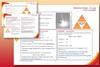
Balancing chemical equations using magnesium and oxygen | Johnstone’s triangle worksheets | 14–16 years
Introduce Johnstone’s triangle with these teacher notes and a student worksheet to help learners gain a deeper understanding of balancing chemical equations
 Resource
Moles of xenon | Johnstone’s triangle worksheets | 14–16 years
Introduce Johnstone’s triangle as a method of calculating the number of moles of xenon from a given volume of gas