

Slow down and use these approaches to set your post-16 learners on the road to success with reaction mechanisms
Reaction mechanisms is an area of chemistry that is difficult for students to grasp: there is little to no prior knowledge to build on and true mastery is required. You can’t possibly teach every combination of reactants and their ensuing transfer of electrons and yet, students need the capacity to apply what they have learned to many known and unknown syntheses.
Scaffold concrete examples
To build resilience and independence, I take a well-tested approach of providing concrete examples and then carefully removing the scaffolding as learners progress. I start with a particularly niche mechanism, but one that can be applied to others that students encounter during their course – free radical substitution.
By having the radicals and molecules visible for students, the questions they ask are more productive
I make use of PowerPoint’s cameo feature with a visualiser, allowing for seamless transition between presentation and live input. Using colour-coded molecular models, I model creating several chlorine molecules and methane molecules, breaking the bonds between the chlorine molecules to create radicals. The final termination steps are clearer to identify: with two radicals physically present, it is easier to create the three possible options. Only one teacher set is required. If you do not already have one, I highly recommend buying one.
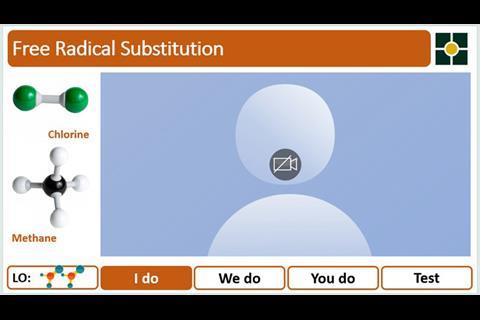


What I find works very well with this approach is the opportunity to illustrate multi-substitution. Students have asked, unprompted, but maybe not so eloquently, ‘why can’t the chlorine radical react with an already substituted chloromethane?’. To which I say that there is no reason at all and, in fact, this does happen. I have found that, by having all the various radicals and molecules visible for students, the questions they ask are more productive.This allows us to develop an extensive dialogue that can then be translated into the written word.
Use worked example problem pairs
Worked example problem pairs (WE-PP) are an effective way to optimise cognitive load, working through an example yourself and then providing a similar problem. These should be presented in the same place to avoid the split attention effect.
For this approach to be successful, you need to have many pairs prepared. Each gets more complex as you proceed, varying the reactants and the format of the equations (e.g., structural and skeletal).
Printing the pairs not only ensures students’ attention isn’t split but also allows them to work at their own pace. Some will work faster than others, giving them the opportunity to tackle more complex problems, but still with a scaffold to support them.
Once I am satisfied that learners have tried a variety of combinations and are using the correct notation, I then introduce exam questions. As we work through the WE-PP scenarios, I ask for student input to see if they are more able to sensibly suggest reaction steps.
Though I have found that it now takes longer to teach any given mechanism, the improvement of response quality in end of topic assessments is unrivalled. I also think that, if students can firmly grasp mechanisms in year 12, the organic content in year 13 is far easier to deliver and will mean less time taken up having to revisit concepts.
Look ahead
I’m now looking into whether students learn better from me modelling solving the problem or when we solve it together. For a confident practitioner, this would be something to interrogate further, but for those newer to teaching post-16 chemistry, the prepared WE-PP will work very well.
I am also applying this approach to other areas of the post-16 curriculum, such as buffer calculations, to stress-test this approach and identify any limits. I would be intrigued to hear from any teachers who use this approach, or who are already doing something similar.
More on mechanisms
- Try these tips and strategies for teaching organic mechanisms.
- Discover how using an arrows-first approach in mechanistic organic chemistry can improve your post-16s outcomes and how to end curly arrow anxiety.
- Use talk to build learners’ confidence and knowledge of organic mechanisms.
- Deepen your students’ understanding of organic mechanisms with a roleplay activity.
Daniel Ojjeh






No comments yet