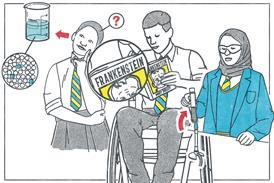


Four teacher-tested ideas to include every learner in the chemistry conversation and develop confident communicators

Who benefits from group talk in your classroom? The confident, articulate students, or those who freeze the moment they hear the word ‘talk’?
Group talk can improve pupil engagement in learning tasks, boosting academic achievement while developing communication and teamwork skills. It can even help close the attainment gap – but only if every voice is heard and respected.
Unheard voices
Getting all voices into the room is especially pressing in chemistry. Research published by the RSC in 2020 found that 25% of chemistry A-level students were from the most privileged backgrounds, higher than the 19% across all A-level subjects. Meanwhile pupils from disadvantaged families and ethnic minority girls tend to feel that they do not belong in chemistry.
Getting all voices into the room is especially pressing in chemistry. Research published by the RSC in 2020 found that 25% of chemistry A-level students were from the most privileged backgrounds, higher than the 19% across all A-level subjects (pdf: rsc.li/46mRdRz). Meanwhile pupils from disadvantaged families and ethnic minority girls tend to feel that they do not belong in chemistry.
Young people with social anxiety are another group who can struggle when expected to interact with others, regardless of their academic performance. For these learners, group discussions can trigger a blank mind and a quaking voice, leading to lower engagement than among their peers.
There is nothing better than watching a hand go up that usually stays down, its owner ready to share their ideas
When it comes to group talk in the chemistry classroom, then, it is not surprising that we don’t hear some voices. Fortunately, there are things you can do to get more voices in the room and ensure that everyone benefits.
Open up the chemistry conversation
Learners are more confident when they are familiar with the others in their group, so keep the same groupings over the year. Good relationships matter, but that doesn’t mean students should always sit with their closest friends. Consider grouping learners based on similar levels of expertise to encourage participation.
Another way to boost confident participation is to give each pupil a clear role in the discussion. Choose problems that are challenging enough to require teamwork, while still being accessible to all pupils. Here are four ideas to try with your students:
1. Design an experiment
Give each pupil one or two questions to read aloud and ask the groups to design an experiment based around the answers. Learners are more likely to speak when their voice is already out there, so this encourages full participation.
- What do we already know about this topic?
- What do we want to measure in this experiment?
- What equipment will we need?
- What variable will we change?
- What variables will we keep the same?
- What do we think will happen and why?
2. Concept cartoons
Concept cartoons show a range of ways that we might understand science ideas, often incorrectly. Reassure learners that people design concept cartoons for thinking and talking, not for testing who already knows the right answer. Assign each student within a small group a role to fulfil before open discussion begins:
- A summariser identifies links between the statements.
- A challenger states why they think one of the statements is wrong or partly wrong.
- A supporter states why they think one of the statements is correct or partly correct.
3. Debate with support
Environmental issues such as electric versus petrol vehicles lend themselves well to debating. Start by asking students to work in pairs on just one part of the debate – for example, the pros or cons from the perspective of people or the environment. Then split the pairs so that individuals join new groups to share their argument. This ensures pupils contribute only after they have had support preparing something to say.
4. Open-ended revision debate
Give pairs time to prepare one side of an open-ended revision statement before debating with a pair arguing the other side. Possible statements are ‘Chemistry is just the movement of electrons’, ‘The periodic table tells you everything you need to know about an element’ and ‘Temperature is the most important factor in rates of reaction’.
Want to keep the discussion going?
- Emphasise oracy in the classroom to equip students with the communication skills they need to succeed.
- Use extended periods of talk to improve the quality of students’ responses in chemistry.
- Try teacher-tested strategies and download the exploding questions resource to get your learners writing and talking like a scientist.
- Share with students how developing communication skills can help their future careers by highlighting Layla’s path to becoming a co-founder and machine leanring lead at her tech startup, Ignota Labs.
Crucial contributions
The confidence learners gain in small group talk can spill over into whole-class discussion. There is nothing better than watching a hand go up that usually stays down, its owner ready to share their ideas with the whole class. Over time, even the quietest voices can become confident contributors to the chemistry conversation.
Kate Comisso








No comments yet