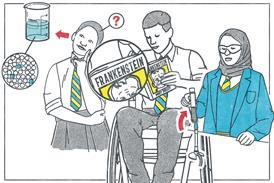


Show your 11–14 learners the essentials of separation techniques with this poster and fact sheet
Most of the naturally occurring and man-made materials that we encounter in our lives are mixtures. For example, concrete – a vital modern material – is a mixture of cement, sand and small stones.
Did you know… ?
We started making cement over 3000 years ago! Archaeological evidence shows that builders in the Middle East coated their clay homes with a damp mixture of burnt limestone. As the mixture dried, a hard protective surface – a type of early cement – formed.
By separating mixtures into their component parts, we can produce pure materials such as elements and compounds. Investigating elements and compounds helps us to understand how the material world is built and allows us to develop new materials. For example, graphene is a pure form of carbon discovered in 2004. We can use graphene to make super-strength concrete, and to make better touchscreens and longer lasting batteries for our mobile phones.
Separation techniques rely on one or more properties of the components in a mixture being different, such as size, solubility, boiling point or electrostatic charge.

View and download more infographics
Filtration

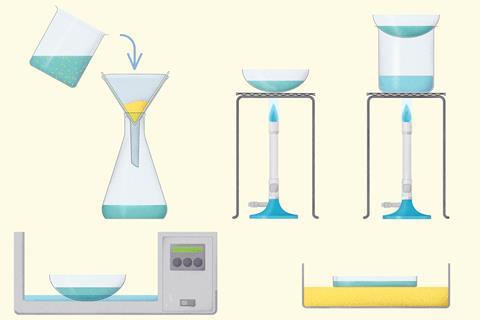
In the school chemistry laboratory, we use filter paper to separate mixtures of solids and liquids. Filter papers have very tiny holes in them that the water particles can pass though. The larger solid pieces in the mixture cannot pass through the holes.
When we filter a mixture of sand and water, the sand will stay behind, and the water will flow through. The sand is called the residue (what is left behind) and the water is called the filtrate (what is filtered through the paper).
Filter papers are usually circular pieces of paper that we fold into a cone and place inside a filter funnel. The simplest fold (in half, then into quarters) uses half the surface area of the filter paper. A more complicated fold, making a fluted filter paper, allows all the surface area to be used. This makes the filtering quicker.
Filtration tends to slow down over time as the tiny holes get blocked by the solid particles. To make filtering quicker, we can leave the mixture to settle for a couple of minutes. Larger solid pieces will drop to the bottom of the beaker. Then we can carefully pour the mixture into the funnel and filter paper, allowing the settled solids to stay at the bottom of the beaker. This is called decanting.
Did you know… ?
We use filtration in the kitchen to separate cooked pasta from the hot water. The mixture is poured into a colander, a bowl with many small holes. The water flows through the holes, keeping the larger pasta pieces inside – we have separated the water and pasta based on size.
Evaporation


If we want to separate a dissolved solid (a solute), from a solution and don’t mind about keeping the solvent, we can use evaporation. Place the solution in an evaporating dish and heat it gently from below. This setup is useful with thermally stable solutes, such as sodium chloride
For thermally unstable solutes, such as hydrated copper sulfate, place the evaporating dish on a beaker of water and gently heat it from below
Evaporating dishes are wide dishes with shallow sides, to allow a large surface area for evaporation and to stop the vapour from condensing and dripping back into the dish.
Heat can be provided by:
- a flame, for example a Bunsen burner or liquid fuel burner
- a water bath – electric or Bunsen burner-heated
- a sand or oil bath – electric-heated

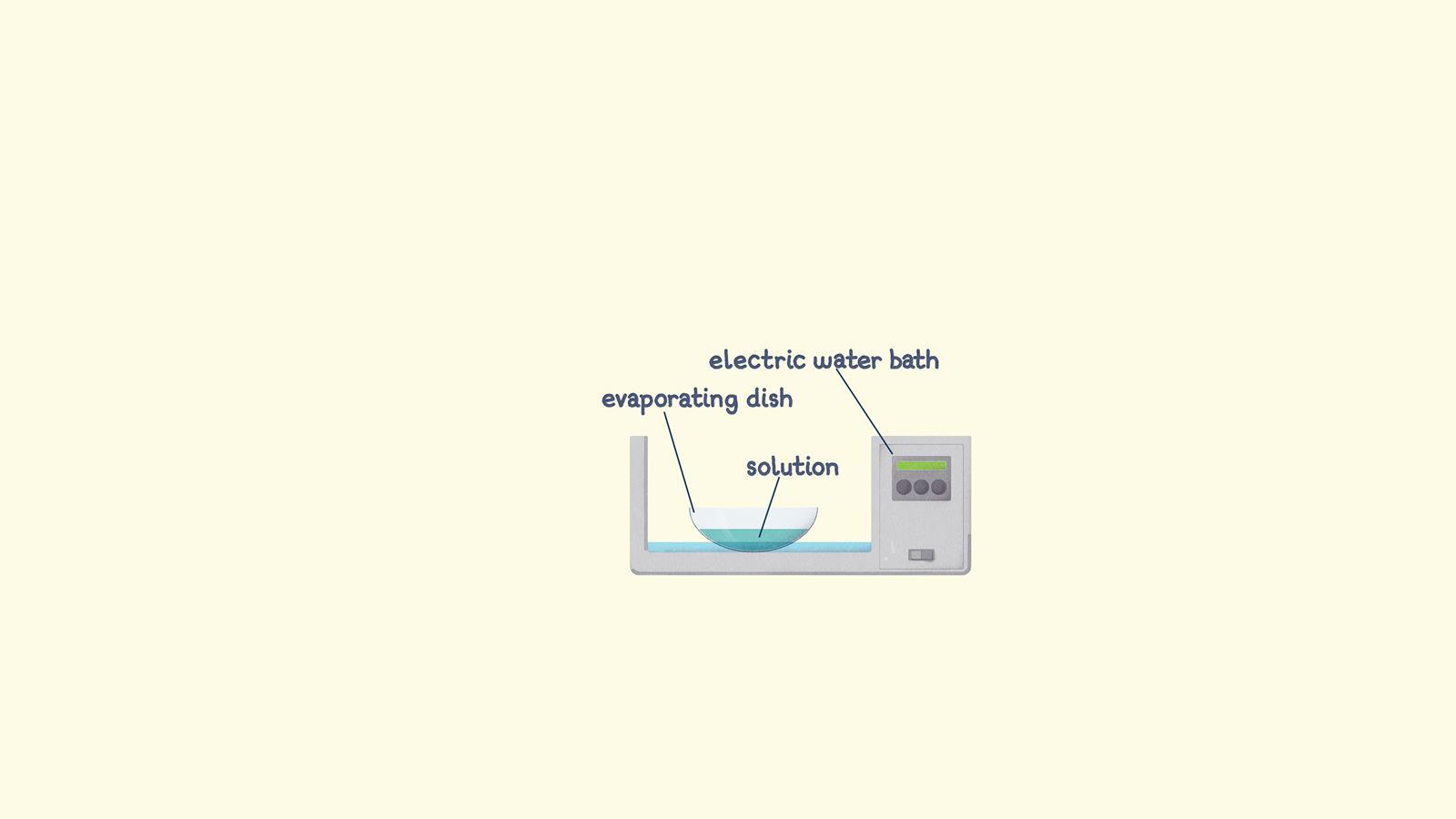
A sand bath provides more controlled heating than a flame or a water bath. It’s useful with flammable solvents, such as ethanol
When the solvent is flammable, such as ethanol, use electrical heating
As the solvent evaporates, the solution becomes increasingly concentrated. When the solvent can’t hold all the solid, solid starts to precipitate out. We see this as solid appearing around the edge of the solution. This type of solution is called a saturated solution.
Crystallisation
Depending on the substance, the solid will appear as a powder or as crystals. If crystals are formed, this process is called crystallisation and happens when the particles of the solid are arranged in a regular way.
To form larger crystals, we can evaporate a solution until the first signs of solid appear and then remove the heat source. We then leave the solution to slowly evaporate over time, allowing more time for the crystals to grow. Crystallising dishes, which are very shallow beakers, are sometimes used for this purpose.
Want more …
… posters for your 11–14 learners?
- Earth’s atmospheric pollution, atmosphere, resources and structure
- Rock cycle
- Water cycle
- Periodic table
- States of matter
… posters on separation techniques?
… a practical video with classroom resources?
Downloads
Filtration evaporation and crystallisation poster
Handout | PDF, Size 0.67 mbFiltration, evaporation and crystallisation fact sheet
Handout | PDF, Size 0.12 mbFiltration evaporation and crystallisation fact sheet
Editable handout | Word, Size 0.44 mb





No comments yet