





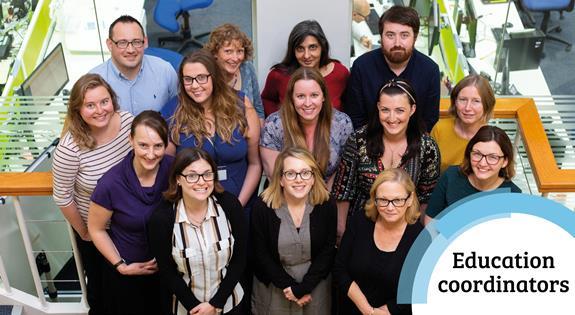
Lyn Nicholls
Lyn's teaching career has spanned 40 years and she has written numerous textbooks and teaching resources for lower secondary, GCSE and A-level. She is particularly interested in how students acquire working scientifically skills and the relevance of these skills to their everyday lives.
 Resource
Representing elements and compounds | In context | 14–16
Use the real-world contexts of the elements that are used to make mobile phones and the composition of lunar soilElements and compounds are fundamental to understanding everything from mobile phones to the moon and beyond
 Resource
Representing elements and compounds | Knowledge check | 14–16
Assess understanding of representing elements and compounds with a higher and foundation worksheet
 Resource
Chromatography | Knowledge check | 14–16
Assess learning of paper chromatography with a higher and foundation worksheet
 Resource
Chromatography and developing vaccines | In context | 14–16
Put chromatography into context with questions based on vaccine development
 Resource
Particle diagrams and coffee shops | In context | 14–16
Put particle diagrams into context and practise maths in science with a visit to a coffee shop
 Resource
Diagramau gronynnau a siopau coffi | Mewn cyd-destun | 14–16 oed
Rhoi diagramau gronynnau yn eu cyd-destun ac ymarfer mathemateg mewn gwyddoniaeth drwy ymweld â siop goffi
 Resource
Diagramau gronynnau | Gwirio gwybodaeth | 14–16 oed
Asesu’r hyn a ddysgwyd am ddiagramau gronynnau gyda thaflenni gwaith ar lefel sylfaen ac uwch
 Resource
Particle diagrams | Knowledge check | 14–16
Assess learning on particle diagrams with worksheets at foundation and higher level
 Resource
Metallic bonding in electric cars | In context | 14–16
Put metallic structure and bonding into context and practise maths in science with questions about electric cars
 Resource
Metallic bonding | Knowledge check | 14–16
Assess learning on metallic bonding with worksheets at foundation and higher level
 Resource
Ionic structure and bonding | Knowledge check | 14–16 years
Assess learning on ionic structure and bonding with higher and foundation worksheets
 Resource
Ionic structure and bonding in rubies | In context | 14–16
Put ionic bonding into context with questions about rubies, their composition and dazzling properties
 Resource
Adeiledd a bondio ïonig mewn rhuddemau | Mewn cyd-destun | 14–16 oed
Rhoi bondio ïonig yn ei gyd-destun gyda chwestiynau am ruddemau, eu cyfansoddiad a’u priodweddau disglair
 Resource
Adeiledd atomig | Gwirio gwybodaeth | 14–16
Aseswch y gwaith dysgu am adeiledd atomig gyda thaflenni gwaith sylfaen ac uwch
 Extension
Atomic structure and the Sun | Stretch and challenge | 14–16
Stretch learners’ understanding of atomic structure using the context of the Sun
 Resource
Atomic structure | Knowledge check | 14–16
Assess learning on atomic structure with a higher and foundation worksheet
 Resource
Covalent structure and bonding | Knowledge check | 14–16
Assess learning on covalent structure and bonding with two levels of worksheet
 Resource
Covalent structure and bonding in our bodies | In context | 14–16
Put covalent bonding into context with questions about the human body, its composition and the nutrition needed to support human health
 Resource
Fractional distillation and hydrocarbons | Review my learning worksheets | 14–16 years
Identify learning gaps and misconceptions with this set of worksheets offering three levels of support
 Resource
Representing elements and compounds | Review my learning worksheets | 14–16 years
Identify learning gaps and misconceptions with this set of worksheets offering three levels of support