

Machine learning aids design of superstrong adhesives that work underwater
-

Download this
Use this story and the accompanying summary slide for a real-world context when studying polymers.
Download the story as MS Word or PDF and the summary slide as MS PowerPoint or PDF.
Scientists used machine learning to develop underwater adhesives that outperform those found in nature. The adhesives take inspiration from protein glues used by barnacles and mussels to cling to wet surfaces. These glues could help close surgical wounds, support marine farming and aid deep-sea exploration.
The glues are hydrogels – soft, gelatinous polymer networks. Nature offers thousands of examples of waterproof adhesive hydrogels, such as in marine animals, bacteria, fungi and viruses. Earlier designs of the synthetic adhesives relied on trial and error and didn’t achieve the right balance between strength, flexibility and water resistance.
Harnessing machine learning
Jian Ping Gong and colleagues at Hokkaido University searched a database of 24,707 natural adhesive protein sequences for design ideas. The researchers designed, synthesised and tested 180 candidates. Using iterative machine learning, they ultimately developed three adhesives that were stronger and more stable than any natural biological glue.
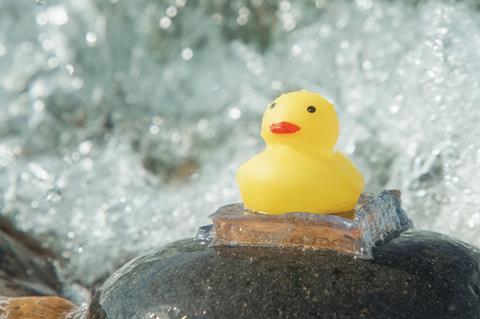
The team stuck a rubber duck to a beach rock using one of its hydrogels, where the duck stood up to salt water, continuous battering by waves and the pull of the tides. Another hydrogel sealed a high-pressure leak at the base of a three-metre tall water-filled pipe – with no leaks for over five months. All three hydrogels proved biocompatible when implanted in mice. ‘We are customising the hydrogel for use in medical adhesives, marine repairs and soft robotics,’ says team member Hailong Fan.
This article is adapted from Tim Wogan’s in Chemistry World.
Nina Notman
Reference
H Liao et al, Nature, 2025, doi.org/10.1038/s41586-025-09269-4
Download this
Summary slide with questions and the article for context when teaching 14–16 lessons on polymers: rsc.li/XXX
Downloads
Hydrogel polymer adhesive sticks rubber duck to rock student sheet
Handout | PDF, Size 0.16 mbHydrogel polymer adhesive sticks rubber duck to rock student sheet
Handout | Word, Size 0.53 mbHydrogel polymer adhesive sticks rubber duck to rock summary slide
Presentation | PDF, Size 0.18 mbHydrogel polymer adhesive sticks rubber duck to rock summary slide
Presentation | PowerPoint, Size 0.34 mb






No comments yet