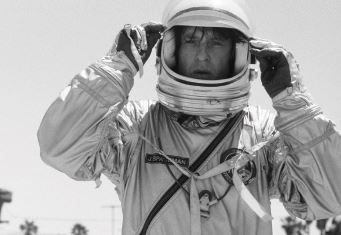
We’re lucky J Spaceman still floats among us. Not just because the image of him wandering the Mojave desert wastes in a space-suit like a forlorn Major Tom in the recent video for I’m Your Man suggests he’s aching to get the hell off this planet as soon as his Musk Mars Mission ticket arrives. Not just because he’s relatively fresh from a course of experimental chemotherapy to tackle liver disease from hepatitis C (“I managed to get myself on a medical trial and I was pretty confident that it was gonna work, and it did”). And not just because, back in 2005, a bout of double-pneumonia filled his lungs with liquid, plunged his weight to six-and-a-half stone, stopped his heart twice and had his alt.rock peers arriving to pay their respects.
“Bobby [Gillespie] came down to see me,” Jason Pierce recalls, a little life-worn
but fundamentally healthy, twisting an e-cigarette in his fingers in a beer garden in Shoreditch, London. “He said he walked out of there saying he knew I wasn’t going to go because my handshake was functioning too well. Everybody else in that room died – that was the biggest shock. You always see in movies, people are in those wards on their own, but you’re not, you’re sharing it with everybody else who’s in that situation. I remember thinking, ‘Somebody’s got to get out of here, otherwise people are going to stop believing in this hospital.’ The tiny bit
of lung that lives above your collar bone was active in both my lungs, so I was breathing
a breath a second for weeks… My girlfriend saw bereavement counsellors – they thought it was all over. But it didn’t change me like I’d read that people are changed from these things. I felt like I was the same disappointing person I was when I went in.”
No, we’re lucky to have Pierce – master architect of stately space-rock, grandiose spirituals, noise and sweeping Golden Age balladry – because the genius behind such otherworldly masterpieces as Lazer Guided Melodies (1992), Pure Phase (1995), Ladies And Gentlemen We Are Floating In Space (1997) and Let It Come Down (2001) is struggling to see a place for himself in the panoramic vista of musical legends. And seriously considering hanging up his zero-gravity moonboots for good.
“When I was younger I could play all
the music that I love and it would inspire me, it’d show me different ways to go,” Pierce explains, having previously suggested that 2012’s seventh Spiritualized album Sweet Heart Sweet Light might be his last. “Now when I play the same records or other records that I love, I’m filled with this feeling of, ‘What’s the point? Everything’s been said so beautifully and eloquently in the past, what’s the point of me contributing to that?’ With that in mind I feel this massive weight of responsibility, that if I’m going to do something, it has to be as beautiful, or it has to come from a different angle. I slip into the same obsession about that, that it shouldn’t be entered into lightly, that it has to be this huge undertaking.”
He fiddles at the sleeve of his jacket.
“I love music,” he says. “I love what music does to people. I love everything about it. But the action of making an album ruins all the enjoyment for me. It’s wilfully going into this place where I almost don’t recognise myself or, if I do recognise myself, it’s someone I don’t want to be.”
Facing the abyss once more at the end of the Sweet Heart Sweet Light cycle, Pierce did what any struggling artist with a song called The Twelve Steps in their repertoire would do: he sought help from higher powers.
“I felt that if I could just get somebody
to help me I wouldn’t fall into all the pitfalls and traps and holes that I always fall into,” he says. “If I could find a way to get help with that I could attempt it.”
He reached out to Bowie producer Tony Visconti and to The Velvet Underground’s John Cale, but neither conversation came to anything. “Because none of that worked out
I then found myself with a fully-realised concept of making another album but without that guidance and help I wanted. So I ended up holing up and almost protecting it being infected by anything, saying, ‘I’m on this alone again.’”
Having made early attempts at improvisational free jazz and “a number of other experiments”, by the time he started eighth album, And Nothing Hurt, in earnest, he’d run out of money.
“I’m not very good at handling my own money anyway, so the idea of saying, ‘Okay, keep some by to do a string quartet at the end,’ it’s never gonna happen… I’ve only just got a hold on that now because I owed so much money and I didn’t want the band to go down because of that. It seemed like a really tragic end to something so beautiful.”
His solution sounds like a job for the space-rock Ethan Hunt. Besides the drums, he would set about making an album entirely on a laptop in his bedroom, even going so far as to strum along to classical records to find the right string chord to sample and piece together into an orchestral backing.
The finished product is every bit as monolithic, expansive and staggering as Spiritualized records tend to be, marking a quantum leap in home recording, in which all limits evaporate and everything is proved possible. But Pierce is adamant that it was the mental torment of making the record, rather than the technical restraints, that drove him crazy.
“My aim wasn’t to con the listener by going, ‘Hey, where do you think this was recorded?’” he says. He does, however, have
a few laptop hang-ups. “I felt like I used
an enormous amount of my talent just making it sound adequate, where I wanted to use my talent to make it sound extraordinary.”
He sighs. “So it was always hung with this vague feeling of disappointment: ‘Why am I doing this, what am I saving this from?’ I still feel like there’s somebody out there, if they’ve got enough patience and charity, they will help me and I can find this thing really easy to do again.”
Music certainly came easier for the teenage Pierce. Brought up on his mother’s Seekers records, the very first record he bought, mesmerising him from the rack of albums in Rugby’s Boots, was The Stooges’ Raw Power.
“I hadn’t heard about Iggy,” he admits. “On the front of the rack was Iggy in his silver pants and the flip has the wild-cat picture and the weird image of him looking into the mirror with the details on it, and I was infatuated, absolutely sold on whatever this was. When I got it home I immediately felt that I’d found something precious, that was mine, totally mine.”
At Rugby Art College and on the local band circuit, Pierce fell in with a crew of like-minded sonic adventurers – Pete Kember, Pete Bain, Natty Brooker – who shared their discoveries of The Cramps, Suicide, The Gun Club, Tav Falco, T Rex, The Troggs, The Monks, Captain Beefheart, Nuggets and The Staple Singers. They’d make road trips to London, Manchester, Birmingham and Coventry to see Big Star’s Alex Chilton. Pierce’s tastes worked their way backwards, following the threads from The Stooges
and MC5 to Sun Ra, psychedelia and Thirteenth Floor Elevators.
When Pierce and Kember (aka Sonic Boom) formed Spacemen 3 in 1982, they revelled in their rawness.
“We were borne of inability,” Pierce says. “Nobody wanted to be better on guitar, nobody wanted to learn how to play faster riffs. Once you strap an electric guitar over your neck they almost play themselves, they start squealing before you even hit the thing, and when you make this chord, if you hit that chord long enough, it becomes the most important thing in the world. I still maintain that’s the way you play great guitar. It’s wild already and all you’ve got to do is hold that down. Once we started making music, it was really effortless. It wasn’t laboured over, it felt like this was something else.”
Setting themselves apart from supposed peers such as The Jesus And Mary Chain and The Cocteau Twins by dint of their disinterest in anything contemporary, Spacemen 3 produced a brace of hypnotic modern psychedelic albums (1987’s The Perfect Prescription, 1989’s Playing With Fire) and played anti-gigs: either sitting down or with their backs to half-empty venues, all 20-minute drones based on single chords and the band lost amid kaleidoscopic backdrops.
“People wrote about our band because they loved it or they found it,” Pierce says. “When Spacemen played in Coventry we played to one person, and we knew that person. So being a figurehead of something… we recognised that we had something really special, that there was something we’d tapped into that was really unique, but nobody was interested. Just as things started to pick up – we were first on the bill at Reading, or second – that’s when the band stopped. It’s almost like nobody saw it.”
The band stopped because Kember and Pierce had become bitterly estranged over songwriting credits, studio practices and Pierce’s relationship with Kate Radley, which Kember felt was impacting on Pierce’s band work. Meetings would erupt into violent arguments, and they’d travel to gigs and record separately; such was their hostility that, for their final album, Recurring (1991), Kember and Pierce took one side each.
“We just stopped getting on,” Pierce reflects. “When you argue about things it just becomes dysfunctional. I was having to argue to try and do different things in the studio. Pete was very much of the mindset that we shouldn’t do anything in the studio that you couldn’t perform as a four-piece band. By that time, I was listening to Brian Wilson and I knew how The Beatles had put themselves in a position where they couldn’t play their studio recordings live. It never bothered me, and I found myself getting into more arguments about what we should be doing
in the studio rather than just doing it and seeing. I still loathe that thing where people will discuss an idea rather than just try it,
and if it sounds great it sounds great. I see bands now that hang together because there’s a financial incentive, or they’ve been offered one to re-form. I never want to do that.
I loathe the business of music, I’ve never made music for a financial gain.”
When Spacemen 3 split, they walked away from a multi-million-dollar five-album deal with a major US label (“We walked away with some of that money, which made it palatable”), and Pierce recently turned down £2 million to re-form the band.
“Rock’n’roll is the only art form where
I can quite seriously be asked repeatedly why I don’t want to do what I was doing when
I was 20 years old,” he vents. “You wouldn’t ask a painter, ‘Can you do something more like you did when you were in your teens?’”
With Spacemen 3 disintegrating around him, Pierce reluctantly launched his Spiritualized escape pod in 1991.
“I didn’t want to,” he reveals. “I’m not confident. It was so easy in that band because Pete had every bit of confidence I lack. It wasn’t an easy thing to do. [But] it was an absolute dream scenario for me, because now
I get to try stuff and nobody’s questioning it with, ‘This is going to be impossible.’ Let’s make it as impossible as we can and then try to scale that when we get there.”
Vindication was swift. Spiritualized’s phase-washed debut album Lazer Guided Melodies, merging ambient electronica drawn from Laurie Anderson and Kraftwerk with Pierce’s hallucinatory space-rock, was lauded as an instant classic, an album drifting in a universe all its own.
“Which is nice, isn’t it?” Pierce grins.
“It didn’t sound like anyone else’s record.
It raised the bar, and when you do that you think, ‘Where can you go?’ Throughout the whole of Spiritualized there’s been this attempt to continually raise the bar.”
Indeed, the celebrated, quasi-symphonic Ladies And Gentlemen We Are Floating In Space was such an achievement that Pierce feels it overshadows equally worthy albums, such as Pure Phase and 2001’s opulent orchestral opus Let It Come Down. In fact, he is keen to emphasise that its prominence in his canon is largely down to marketing.
Much was made circa Ladies And Gentlemen…, and its damaged, melancholy tone, of Kate Radley leaving Pierce for The Verve’s Richard Ashcroft. Considering the acclaimed status of the record, and the family life he’s enjoyed since, does he look back at the split as a positive?
“Yeah,” he ventures, guardedly,
“but I’ve got a relative story. I saw Kris Kristofferson play on his birthday about three weeks ago. He’s singing all these songs and the whole audience – there must’ve been 2,500 people – are singing every word back to him. I realised those songs didn’t belong to Kris Kristofferson, they belonged to the audience. Everybody in that audience had fallen in and out of love to those songs. They become part of your life and, more importantly than that, they become part of your personality, so every time you fall in love, you have these twinkles of Patsy Kline and Little Jimmy Scott or all the things that make up love in a musical way for you.”
When I tell Pierce that Soul On Fire from 2008’s Songs In A&E was the first dance at my wedding, he’s visibly affected.
“Wonderful. Brilliant. Amazing. Thank you. That’s really moved me, that has,” he says, something in his eye. “It’s amazing that songs become part of people’s lives in a really special way.”
Full-album extravaganzas at London’s Royal Albert Hall and the Barbican, not to mention prestigious venues nationwide and internationally. Composing scores for art installations. Collaborating with free jazz groups and Yoko Ono. Ladies And Gentlemen… elevated Spiritualized to a position above indie rock, brushing high art. Pierce, however, remembers barely changing at all.
Let It Come Down, though, seemed to be Pierce’s rehab album – or rather, a celebration of failing to clean up – with its songs about diving off the wagon and 12-step techniques, after which there was a distinct tapering off
of Pierce’s lyrical drug references. Had he left the hedonistic life behind?
“No, not really,” he replies, revealingly. “When I was making Let It Come Down I was being told by my girlfriend that if I didn’t do something about falling out of bed every single night, she would kick me out. My way of dealing with that was I went and bought a mattress that would catch my fall and stop me getting beaten up every time I fell out. I had a car that I left at Abbey Road – I forgot about it. I left it at Abbey Road from the recording
of that album for four years because I just wasn’t in a fit state to get it home. I thought, in the end, it would become part of the graffiti of the Abbey Road wall. I lost another one later at the Strongroom [London studio] under the same conditions. I just wasn’t ever fit enough to get them.”
Over the course of Amazing Grace (2003), Songs In A&E and Sweet Heart Sweet Light, Pierce’s lyrical concerns broadened, exploring mortality and morality, erratic romances, insecurity, revenge and redemption. It’s a journey that culminates with And Nothing Hurt. It’s his best, and most consistent, set of retro-futurist epics since Let It Come Down, and has a euphoric sense of the freedoms and inconsistencies of growing old, from the carefree, country-flecked new single, Here It Comes (The Road) Let’s Go, to the fireside hug of Let’s Dance and the idyllic ode to fading love, A Perfect Miracle, which is essentially Rodgers And Hammerstein We Are Floating In Space.
“A kind of nostalgia, but with no regrets,” is how Pierce describes it. “I wanted to make a record that befitted my age.” And yet dare to emphasise Pierce’s significance – his status as a visionary godfather of avant-rock to rank alongside Kevin Shields, Wayne Coyne and Bobby Gillespie – and his old fears and insecurities kick back in.
“I don’t think I should be having this conversation, because it sounds sort of egotistical,” he winces. “When I play the stuff that I love, that really makes me feel like I should be trying to do stuff, it’s always people that I’ve got too much regard for, like Sam Cooke. It’s so far out of my realm, his voice is unbelievable. I’d like to sit alongside the stuff that I love, but that’s almost impossible.”
Spiritualized’s And Nothing Hurt is out
now on Bella Union.