
Radio Frequency Identification (RFID) is a form of wireless communication that incorporates the use of electromagnetic or electrostatic coupling in the radio frequency portion of the electromagnetic spectrum to uniquely identify an object or person. It uses radio frequency to search, identify, track, and communicate with items and people.
RFID (Radio Frequency Identification) is a technology that uses electromagnetic fields to automatically identify and track tags attached to objects. These tags contain electronically stored information that can be read from several meters away, without requiring direct line-of-sight. RFID is commonly used in inventory management, asset tracking, access control, and supply chain logistics due to its efficiency and accuracy in tracking and managing items.
It is a method that is used to track or identify an object by radio transmission over the web. Data is digitally encoded in an RFID tag which might be read by the reader. This device works as a tag or label during which data is read from tags that are stored in the database through the reader as compared to traditional barcodes and QR codes. It is often read outside the road of sight either passive or active RFID.

Types of RFID
There are many kinds of RFID, each with different properties, but perhaps the most fascinating aspect of RFID technology is that most RFID tags have neither an electric plug nor a battery. Instead, all of the energy needed to operate them is supplied in the form of radio waves by RFID readers. This technology is called passive RFID to distinguish it from the(less common) active RFID in which there is a power source on the tag.
- UHF RFID ( Ultra-High Frequency RFID ). It is used on shipping pallets and some driver's licenses. Readers send signals in the 902-928 MHz band. Tags communicate at distances of several meters by changing the way they reflect the reader signals; the reader is able to pick up these reflections. This way of operating is called backscatter.
- HF RFID (High-Frequency RFID ). It operates at 13.56 MHz and is likely to be in your passport, credit cards, books, and noncontact payment systems. HF RFID has a short-range, typically a meter or less because the physical mechanism is based on induction rather than backscatter.
- Passive RFID: Passive RFID tags does not have their own power source. It uses power from the reader. In this device, RF tags are not attached by a power supply and passive RF tag stored their power. When it is emitted from active antennas and the RF tag are used specific frequency like 125-134KHZ as low frequency, 13.56MHZ as a high frequency and 856MHZ to 960MHZ as ultra-high frequency.
- No need embedded power
- Tracking inventory
- Has unique identification number
- Sensitive for interference
- Semi-passive RFID
- Active RFID: In this device, RF tags are attached by a power supply that emits a signal and there is an antenna which receives the data. means, active tag uses a power source like battery. It has it's own power source, does not require power from source/reader.
- Embedded power: communication over large distance
- Has unique identifier /identification number
- Use other devices like sensors
- Better than passive tags in the presence of metal
There are also other forms of RFID using other frequencies, such as LF RFID(Low-Frequency RFID), which was developed before HF RFID and used for tracking.
Working Principle of RFID
Generally, RFID uses radio waves to perform AIDC function. AIDC stands for Automatic Identification and Data Capture technology which performs object identification and collection and mapping of the data. An antenna is an device which converts power into radio waves which are used for communication between reader and tag. RFID readers retrieve the information from RFID tag which detects the tag and reads or writes the data into the tag. It may include one processor, package, storage and transmitter and receiver unit.
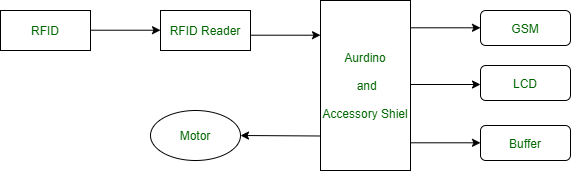
Working of RFID System
Every RFID system consists of three components: a scanning antenna, a transceiver and a transponder. When the scanning antenna and transceiver are combined, they are referred to as an RFID reader or interrogator. There are two types of RFID readers- fixed readers and mobile readers. The RFID reader is a network-connected device that can be portable or permanently attached. It uses radio waves to transmit signals that activate the tag. Once activated, the tag sends a wave back to the antenna, where it is translated into data.
The transponder is in the RFID tag itself. The read range for RFID tags varies based on factors including the type of tag, type of reader, RFID frequency and interference in the surrounding environment or from other RFID tags and readers. Tags that have a stronger power source also have a longer read range.
Types of RFID Tags
1. Passive Tags
- No built-in power source, relying on the RFID reader.
- Less expensive, longer lifespan, shorter read range (up to a few meters).
2. Active Tags
- Have their own power source (battery), allowing for a longer read range (up to hundreds of meters).
- More expensive, limited lifespan due to the battery.
3. Semi-Passive Tags
- Small battery powers the tag’s circuitry.
- Middle ground in terms of cost, range, and lifespan.
Features of RFID
- An RFID tag consists of two-part which is an microcircuit and an antenna.
- This tag is covered by protective material which acts as a shield against the outer environment effect.
- This tag may active or passive in which we mainly and widely used passive RFID.
RFID Standards
- ISO 14443
- Components operating at 13.56Mhz
- Power consumption 10mW
- Data throughput is 100 kbps
- Operates at working distance 10 cm
- ISO 15693
- Components operating at 13.56Mhz
- Operating at working distances as high as 1m
- Data throughput few kbps
Frequency Bands
RFID systems operate in different frequency bands, each with its characteristics:
- Low Frequency (LF, 125-134 kHz): Used for short-range applications (up to 10 cm). Common in animal tracking and access control.
- High Frequency (HF, 13.56 MHz): Medium range (up to 1 meter) and commonly used in smart cards, ticketing, and library systems.
- Ultra-High Frequency (UHF, 860-960 MHz): Longer range (up to 12 meters) and used in inventory management, supply chain, and logistics.
- Microwave Frequency (2.45 GHz): Used for very specific applications with ranges similar to UHF but with higher data transfer rates.
Challenges of RFID
- Cost: Higher initial setup and tag costs compared to traditional barcodes.
- Interference: Susceptible to interference from metal, liquids, and other RFID systems.
- Privacy: Concerns about unauthorized tracking and data breaches.
- Standardization: Different frequency standards and protocols can lead to compatibility issues.
- It takes longer to program RFID Devices.
- RFID intercepted easily even it is Encrypted.
- In an RFID system, there are two or three layers of ordinary household foil to dam the radio wave.
- There is privacy concern about RFID devices anybody can access information about anything.
- Active RFID can costlier due to battery.
Future of RFID
The future of RFID looks promising with advancements in technology and decreasing costs. Innovations like the integration with the Internet of Things (IoT), enhanced data analytics, and improved battery life for active tags are expected to drive wider adoption. As RFID technology continues to evolve, it will play a crucial role in the digitization and automation of various industries.
Application of RFID
RFID technology is versatile and can be applied in numerous fields:
- Inventory Management: RFID helps in tracking inventory in real-time, reducing errors, and increasing efficiency.
- Asset Tracking: Companies can monitor their assets' location and status, preventing loss and optimizing utilization.
- Supply Chain Management: Enhances visibility and accuracy in tracking products throughout the supply chain.
- Access Control: Used in security systems for granting or restricting access to buildings, rooms, or devices.
- Retail: Enables efficient stock management, theft prevention, and improved customer experience through smart shelves and automated checkouts.
- Healthcare: Used for patient tracking, equipment management, and ensuring the authenticity of medications.
Advantages of RFID
- Automation: Reduces manual intervention, minimizing errors and increasing operational efficiency.
- Accuracy: Provides precise tracking and data collection.
- Real-time Data: Enables real-time monitoring and decision-making.
- Durability: RFID tags are generally more durable and can withstand harsh environments compared to barcodes.
- Security: Enhanced data security through encryption and authentication.
- It provides data access and real-time information without taking to much time.
- RFID tags follow the instruction and store a large amount of information.
- The RFID system is non-line of sight nature of the technology.
- It improves the Efficiency, traceability of production.
- In RFID hundred of tags read in a short time.
Disadvantages of RFID
- It takes longer to program RFID Devices.
- RFID intercepted easily even it is Encrypted.
- In an RFID system, there are two or three layers of ordinary household foil to dam the radio wave.
- There is privacy concern about RFID devices anybody can access information about anything.
- Active RFID can costlier due to battery.