
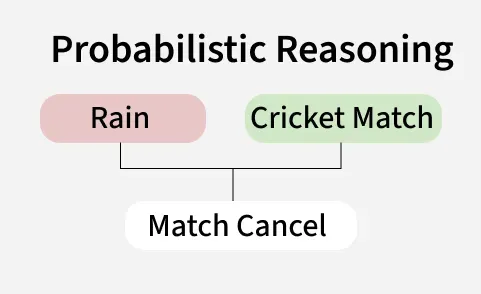
Probabilistic reasoning in Artificial Intelligence (AI) is a method that uses probability theory to manage and model uncertainty in decision-making. Unlike traditional systems that depend on precise information, it understands that real-world data is often incomplete, unclear or noisy. By giving probabilities to different possibilities, AI systems can make better decisions, predict outcomes and solve problems even when things are uncertain. This approach is important for building smart systems that can work in changing environments and make good choices in complex situations.
Need for Probabilistic Reasoning in AI
Probabilistic reasoning with artificial intelligence is important to different tasks such as:
- Machine Learning: It helps algorithms learn from incomplete or noisy data, refining predictions over time.
- Robotics: It enables robots to navigate and interact with dynamic and unpredictable environments.
- Natural Language Processing: It helps AI understand human language which is often ambiguous and depends on context.
- Decision Making: It allows AI systems to evaluate different outcomes and make better decisions by considering the likelihood of various possibilities.
Key Concepts in Probabilistic Reasoning
Probabilistic reasoning helps AI systems make decisions and predictions when they have to deal with uncertainty. It uses different ideas and models to understand how likely things are even when we don't have all the answers. Let's see some of the important concepts:
1. Probability: It is a way to measure how likely something is to happen, typically expressed as a number between 0 and 1. In AI, we use probabilities to understand and make predictions when the information we have is uncertain or incomplete.
2. Bayes' Theorem: It helps AI systems update their beliefs when they get new information. It’s like changing our mind about something based on new evidence. This is useful when we need to adjust our predictions after learning new facts.
P(A \mid B) = \frac{P(B \mid A) \cdot P(A)}{P(B)}
Where:
P(A \mid B) : Probability of A happening, given B has happened (posterior probability).P(B \mid A) : Probability of B happening, given A happened.P(A) : Prior probability of A.P(B) : Probability of observing B.
3. Conditional Probability: It is the chance of an event happening, given that something else has already happened. This helps when the outcome depends on something that happened before.
4. Random Variables: They are values that can change or vary based on uncertainty. In simple terms, these are the things AI tries to predict or estimate. The possible outcomes of these variables depend on probability.
Types of Probabilistic Models
There are different models that use these concepts to help AI systems make sense of uncertainty. Let’s see some of them:
- Bayesian Networks: They are graphs that show how different variables are connected with probabilities. Each node represents a variable and the edges show how they depend on each other. These networks help us understand how one piece of information can affect another.
- Markov Models: They predict the future state of a system based only on the present state with no regard for the past. This is known as the "memoryless" property which means the future depends only on the current situation not the history that led to it.
- Hidden Markov Models (HMMs): They extend Markov models by introducing hidden states that cannot be directly observed. These models help infer the hidden states based on observable data, using statistical techniques to estimate the likelihood of these unobservable conditions.
- Probabilistic Graphical Models: It combine the features of Bayesian networks and Hidden Markov Models, allowing more complex relationships between variables to be represented. It provide a framework for managing uncertainty in large systems where many variables are connected and interact with each other.
- Markov Decision Processes (MDPs): They are used for decision-making, particularly in reinforcement learning. It model an agent’s interaction with an environment where the agent takes actions that affect the state of the environment and receives rewards or penalties based on those actions.
Techniques in Probabilistic Reasoning
- Inference: It calculates the probability of an outcome based on known data. Exact methods like variable elimination and approximate methods like Markov Chain Monte Carlo (MCMC) are used, depending on the complexity of the system.
- Learning: It updates the parameters of probabilistic models as new data comes in, improving predictions. Techniques like maximum likelihood estimation and Bayesian estimation allow models to adapt and become more accurate over time.
- Decision Making: AI uses probabilistic reasoning to make decisions that maximize expected rewards. Partially Observable Markov Decision Processes (POMDPs) are used when some information is hidden.
How Probabilistic Reasoning Enhances AI Systems?
Probabilistic reasoning helps AI systems navigate uncertainty, enabling them to make better decisions even when information is unclear. Let's see how it works:
- Quantifying Uncertainty: Probabilistic reasoning turns uncertainty into probabilities. Instead of a simple “yes” or “no,” it provides a probability, like “there’s a 60% chance of rain tomorrow.”
- Reasoning with Evidence: As new information comes in, AI systems update their predictions. For example, if dark clouds appear, the chance of rain might rise to 80%. This continuous adjustment helps AI stay accurate.
- Learning from Past Experiences: AI systems can improve predictions by learning from historical data. For example, weather predictions become more accurate as the AI system accounts for past seasonal trends.
- Effective Decision-Making: It allows AI to make informed decisions by considering the likelihood of different outcomes. It helps AI weigh possible paths and choose the best option even when the future is uncertain.
Applications of Probabilistic Reasoning in AI
Probabilistic reasoning is applicable in a variety of domains which includes:
- Robotics: In robotics, probabilistic reasoning helps with navigation and mapping. For example, in Simultaneous Localization and Mapping, robots create maps and track their position in unknown environments.
- Healthcare: AI systems use probabilistic models to predict disease likelihood and assist in diagnosis. Bayesian networks can model medical factors like symptoms and test results to guide decisions.
- Natural Language Processing: In tasks like speech recognition and translation, models like Hidden Markov Models (HMMs) help AI understand and process ambiguous language.
- Finance: Probabilistic reasoning in finance helps predict market trends and assess risks. Techniques like Bayesian inference and Monte Carlo simulations model financial uncertainties for better decision-making.
Advantages of Probabilistic Reasoning
- Flexibility: Probabilistic models can handle different kinds of uncertainty and can be adapted to work in various fields from healthcare to robotics.
- Robustness: These models remain effective even when the data is noisy or incomplete, making them reliable in real-world scenarios where perfect data is rarely available.
- Transparency: It provides a clear framework for understanding and explaining uncertainty which helps build trust and improve the interpretability of AI decisions.
- Scalability: It can scale to handle large amounts of data and complex systems, making them suitable for applications like big data analysis and large-scale decision-making processes.
- Decision Support: These models assist in making informed decisions under uncertainty by calculating the likelihood of different outcomes, helping AI systems choose the best course of action based on expected results.
Challenges of Probabilistic Reasoning
Despite its various advantages, probabilistic reasoning in AI also has several challenges:
- Complexity: Some models such as large Bayesian networks can become computationally expensive, especially as the number of variables grows. This can slow down processing and limit scalability.
- Data Quality: Probabilistic models heavily rely on accurate and clean data. If the data is noisy, incomplete or biased, the model’s predictions can become unreliable, leading to incorrect conclusions.
- Interpretability: Understanding how probabilistic models make decisions can be tough, particularly in complex systems or deep learning models. This makes it harder to trust and explain AI decisions to non-experts.