
In Machine Learning, Regression problems can be solved in the following ways:
1. Using Optimization Algorithms - Gradient Descent
- Batch Gradient Descent.
- Stochastic Gradient Descent.
- Mini-Batch Gradient Descent
- Other Advanced Optimization Algorithms like ( Conjugate Descent ... )
2. Using the Normal Equation :
- Using the concept of Linear Algebra.
Let's consider the case for Batch Gradient Descent for Univariate Linear Regression Problem.
The cost function for this Regression Problem is :
Goal:
In order to solve this problem, we can either go for a Vectorized approach ( Using the concept of Linear Algebra ) or unvectorized approach (Using for-loop).
1. Unvectorized Approach:
Here in order to solve the below mentioned mathematical expressions, We use for loop.
The above mathematical expression is a part of Cost Function.
The above Mathematical Expression is the hypothesis.
# Import required modules.
from sklearn.datasets import make_regression
import matplotlib.pyplot as plt
import numpy as np
import time

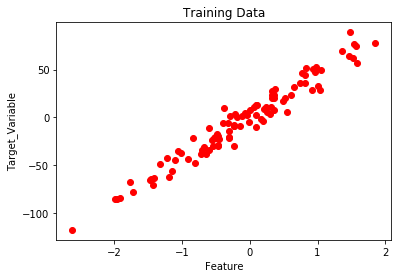
# Create and plot the data set.
x, y = make_regression(n_samples = 100, n_features = 1,
                       n_informative = 1, noise = 10, random_state = 42)

plt.scatter(x, y, c = 'red')
plt.xlabel('Feature')
plt.ylabel('Target_Variable')
plt.title('Training Data')
plt.show()

# Convert y from 1d to 2d array.
y = y.reshape(100, 1)

# Number of Iterations for Gradient Descent
num_iter = 1000

# Learning Rate
alpha = 0.01

# Number of Training samples.
m = len(x)

# Initializing Theta.
theta = np.zeros((2, 1),dtype = float)

# Variables
t0 = t1 = 0
Grad0 = Grad1 = 0

# Batch Gradient Descent.
start_time = time.time()

for i in range(num_iter):
    # To find Gradient 0.
    for j in range(m):
        Grad0 = Grad0 + (theta[0] + theta[1] * x[j]) - (y[j])

    # To find Gradient 1.
    for k in range(m):
        Grad1 = Grad1 + ((theta[0] + theta[1] * x[k]) - (y[k])) * x[k]
    t0 = theta[0] - (alpha * (1/m) * Grad0)
    t1 = theta[1] - (alpha * (1/m) * Grad1)
    theta[0] = t0
    theta[1] = t1
    Grad0 = Grad1 = 0

# Print the model parameters.
print('model parameters:',theta,sep = '\n')

# Print Time Take for Gradient Descent to Run.
print('Time Taken For Gradient Descent in Sec:',time.time()- start_time)

# Prediction on the same training set.
h = []
for i in range(m):
    h.append(theta[0] + theta[1] * x[i])

# Plot the output.
plt.plot(x,h)
plt.scatter(x,y,c = 'red')
plt.xlabel('Feature')
plt.ylabel('Target_Variable')
plt.title('Output')
Output:
model parameters:
[[ 1.15857049]
 [44.42210912]]

Time Taken For Gradient Descent in Sec: 2.482538938522339

2. Vectorized Approach:
Here in order to solve the below mentioned mathematical expressions, We use Matrix and Vectors (Linear Algebra).
The above mathematical expression is a part of Cost Function.
The above Mathematical Expression is the hypothesis.
Batch Gradient Descent :
Concept To Find Gradients Using Matrix Operations:
# Import required modules.
from sklearn.datasets import make_regression
import matplotlib.pyplot as plt
import numpy as np
import time

# Create and plot the data set.
x, y = make_regression(n_samples = 100, n_features = 1,
                       n_informative = 1, noise = 10, random_state = 42)

plt.scatter(x, y, c = 'red')
plt.xlabel('Feature')
plt.ylabel('Target_Variable')
plt.title('Training Data')
plt.show()


# Adding x0=1 column to x array.
X_New = np.array([np.ones(len(x)), x.flatten()]).T

# Convert y from 1d to 2d array.
y = y.reshape(100, 1)

# Number of Iterations for Gradient Descent
num_iter = 1000

# Learning Rate
alpha = 0.01

# Number of Training samples.
m = len(x)

# Initializing Theta.
theta = np.zeros((2, 1),dtype = float)

# Batch-Gradient Descent.
start_time = time.time()

for i in range(num_iter):
    gradients = X_New.T.dot(X_New.dot(theta)- y)
    theta = theta - (1/m) * alpha * gradients

# Print the model parameters.
print('model parameters:',theta,sep = '\n')

# Print Time Take for Gradient Descent to Run.
print('Time Taken For Gradient Descent in Sec:',time.time() - start_time)

# Hypothesis.
h = X_New.dot(theta) # Prediction on training data itself.

# Plot the Output.
plt.scatter(x, y, c = 'red')
plt.plot(x ,h)
plt.xlabel('Feature')
plt.ylabel('Target_Variable')
plt.title('Output')
Output:
model parameters:
[[ 1.15857049]
 [44.42210912]]

Time Taken For Gradient Descent in Sec: 0.019551515579223633
Observations:
- Implementing a vectorized approach decreases the time taken for execution of Gradient Descent( Efficient Code ).
- Easy to debug.