
Cash Flow Statement Overview and Exercises
Uploaded by
siddiquekhankhan14Cash Flow Statement Overview and Exercises
Uploaded by
siddiquekhankhan14- Overview of Exercises and Topics
- Descriptions of Problems and Critical Thinking Cases
- Suggested Answers to Discussion Questions
- Solutions to Brief Exercises
- Solutions to Exercises
- Problems (Sets A & B)
- Solutions to Cases
CHAPTER 13
STATEMENT OF CASH FLOWS
OVERVIEW OF BRIEF EXERCISES, EXERCISES, PROBLEMS, AND CRITICAL
THINKING CASES
Brief Learning
Exercises Topic Objectives Skills
B. Ex. 13.1 Cash flows from operations (direct) 3 Analysis
B. Ex. 13.2 Cash flows from operations (indirect) 7 Analysis
B. Ex. 13.3 Cash flows from operations (direct) 3 Analysis
B. Ex. 13.4 Cash flows from operations (indirect) 7 Analysis
B. Ex. 13.5 Cash flows from investing activities 4 Analysis
B. Ex. 13.6 Cash flows from financing activities 4 Analysis
B. Ex. 13.7 Cash payment for merchandise 3 Analysis
B. Ex. 13.8 Determining beginning cash balance 2 Analysis
B. Ex. 13.9 Reconciling net income to cash from Analysis
operations 6
B. Ex. 13.10 Prepare statement of cash flows 2 Analysis
Learning
Exercises Topic Objectives Skills
13.1 Using a cash flow statement 1, 2 Analysis, communication
13.2 Using a cash flow statement 1, 2, 6 Analysis, communication
13.3 Using noncash accounts to compute cash 4 Analysis
flows
13.4 Relationship between accrual and cash 3, 6 Analysis, communication
flows
13.5 Accrual versus cash flows 3 Analysis
13.6 Investing activities and interest revenue 3, 4 Communication
13.7 Format of a cash flow statement 2 Analysis
13.8 Cash effects of business strategies 8 Analysis,
communication,
judgment
13.9 Indirect method 6, 7 Analysis, communication
13.10 Indirect method 7 Analysis
13.11 Classification of cash flows 2 Analysis
13.12 Classification of cash flows 2 Analysis
13.13 Cash flows from operating activities 4 Analysis,
communication,
judgment
13.14 Cash flows from financing activities 4 Analysis,
communication,
judgment
13.15 Real World: Home Depot, Inc. 1, 2, 4 Analysis,
communication,
judgment, research
© The McGraw-Hill Companies, Inc., 2008
CH 13-Overview
Problems Learning
Sets A, B Topic Objectives Skills
13.1 A,B Preparing a statement of cash flows— 2–4 Analysis
direct method (short)
13.2 A,B Investing activities 4 Analysis
13.3 A,B Investing activities 4 Analysis, communication,
judgment
13.4 A,B Cash flow from operating activities— 3, 8 Analysis, communication,
direct method judgment
13.5 A,B Cash flow from operating activities— 6, 7 Analysis, communication,
indirect method judgment
13.6 A,B Preparing a statement of cash flows— 2–4, 6, 8 Analysis, communication,
direct method; comprehensive judgment
13.7 A,B Preparing a worksheet and statement 1–9 Analysis, communication,
of cash flows; evaluate the judgment
company’s liquidity-indirect method.
13.8 A,B Preparing a worksheet and statement 1–9 Analysis, communication,
of cash flows; evaluate the company’s judgment
financial position—indirect method.
Critical Thinking Cases
13.1 Using a statement of cash flows 1 Analytical, communication,
judgment
13.2 Budgeting at a personal level 1, 8 Analytical, communication,
judgment
13.3 Window dressing; effects on net 1, 4, 8 Analytical, communication,
income and net cash flow judgment
13.4 Peak pricing 8 Analytical, communication,
judgment
13.5 Improving the Statement of Cash 3 Analytical, communication,
Flows (Ethics, fraud & corporate judgment
governance)
13.6 Real World: Texas Instruments 6, 8 Analytical, communication,
Cash Management (Business Week) judgment
13.7 Real World: Coca-Cola, 2–4 Analytical, communication,
Amazon.com Cash Flow Analysis judgment, research
(Internet)
© The McGraw-Hill Companies, Inc., 2008
CH 13-Overview (p.2)
DESCRIPTIONS OF PROBLEMS AND CRITICAL THINKING CASES
Below are brief descriptions of each problem and case. These descriptions are accompanied by the
estimated time (in minutes) required for completion and by a difficulty rating. The time estimates
assume use of the partially filled-in working papers.
Problems (Sets A and B)
13.1 A,B Harris Company/Best Company 30 Medium
Prepare a statement of cash flows. Emphasis is upon format of the
statement, with computations held to a minimum. However,
sufficient computations are required to assure that students are
able to distinguish between cash flows and accrual basis
measurements. Uses the direct method.
13.2 A,B Headrick, Inc./Schmatah Fashions 25 Easy
Prepare the investing activities section of a statement of cash
flows by analyzing changes in balance sheet accounts and gains
and losses reported in the income statement.
13.3 A,B Hayes Export Co./RPZ Imports 25 Easy
Prepare the investing activities section of a statement of cash
flows. Problem demonstrates how this section of the financial
statement can be prepared by analyzing income statement amounts
and changes in balance sheet accounts.
13.4 A,B Treece, Inc./Royce Interiors, Inc. 30 Medium
Prepare the operating activities section of a statement of cash
flows from accounting records maintained using the accrual basis
of accounting. Students also are to explain how more efficient
asset management could increase cash flow provided by operating
activities. Uses the direct method. (Problem *13–5 uses the same
data but requires use of the indirect method.)
13.5 A,B Treece, Inc. (Indirect)/Royce Interiors, Inc. (Indirect) 25 Medium
Using the data provided in Problem 13.4 A,B, prepare the
operating activities section of a statement of cash flows using the
indirect method.
13.6 A,B 21st Century Technologies/Foxboro Technologies 45 Strong
A comprehensive problem covering conversion from the accrual
basis to the cash basis and preparation of a statement of cash
flows. Uses the direct method.
© The McGraw-Hill Companies, Inc., 2008
Description Problems
Problems (cont'd)
13.7 A,B Satellite 2010/LGIN 60 Strong (P13.7A)
A comprehensive problem covering all learning objectives. 40 Strong (P13.7B)
P13.7A includes a worksheet, the indirect method, and analysis of
the company’s financial position. P13.7B does not include a
worksheet and uses the direct method. We assign this to groups
and let them deal with the worksheet mechanics on their own.
13.8 A,B Miracle Tool, Inc./Extra-Ordinaire, Inc. 60 Strong
A comprehensive problem covering all learning objectives.
Includes a worksheet, the indirect method, and analysis of the
company’s financial position. We assign this to groups and let
them deal with the worksheet mechanics on their own.
© The McGraw-Hill Companies, Inc., 2008
Description Problems (p.2)
Critical Thinking Cases
13.1 Another Look at Allison Corporation 25 Strong
Students are asked to review the cash flow statement of Allison
Corporation (the company used as an example throughout the
chapter) and to evaluate the company’s ability to maintain its present
level of dividends.
13.2 Cash Budgeting for You as a Student 15 Easy
A simple case that illustrates the usefulness of cash budgeting in the
environment of a college student.
13.3 Lookin' Good? 45 Medium
An automobile manufacturer is in serious financial difficulty, and
management is considering several proposals to increase reported net
income and net cash flow. Students are asked to evaluate the probable
effects of each proposal. This case can lead into an open-ended
discussion of “window dressing” in annual statements.
13.4 Peak Pricing 15 Easy
Students are to discuss various aspects of peak pricing and discuss
how it might be applied in specific situations. Also, they are to
describe situations in which peak pricing might be considered
unethical.
13.5 Improving the Statement of Cash Flows 20 Medium
Ethics, Fraud & Corporate Governance
Students explore the website of the Securities & Exchange
Commission and locate a speech by an S.E.C. official in which
suggestions for improving the statement of cash flows are discussed.
13.6 Texas Instruments Inc.'s Cash Position 20 Medium
Business Week
Students consider the impact on a company of an economic
downturn.
13.7 Comparing Cash Flow Information from Two Companies 30 Medium
Internet
Visit a website that actually provides assistance in preparing cash
budgets and statements of cash flows.
© The McGraw-Hill Companies, Inc., 2008
Desc. of Cases
SUGGESTED ANSWERS TO DISCUSSION QUESTIONS
1. The primary purpose of a statement of cash flows is to provide information about the cash
receipts and cash payments of a business. A related purpose is to provide information about
the investing and financing activities of the business.
2. The income statement provides the better measurement of profitability, especially when the
business
business is financially sound and short-run survival is not the critical issue. The statement of
cash flows is designed for measuring solvency, not profitability. An income statement, on the
other hand, is specifically designed to measure profitability but gives little indication of
solvency.
3. Two supplementary schedules usually accompany a statement of cash flows prepared by the
direct method. One discloses the noncash aspects of financing and investing activities, such as
the purchase of land in exchange for a note payable or the conversion of preferred stock into
common shares. The other schedule itemizes the differences between net income and net cash
flow from operations.
4. Examples of cash receipts and of cash payments in the three major classifications of a cash
flow statement are shown below (two receipts and two payments required):
a. Operating activities:
Receipts:
(1) Cash received from customers.
(2) Dividends and interest received.
Payments:
(1) Cash paid to suppliers and employees.
(2) Interest paid.
(3) Income taxes paid.
b. Investing activities: c. Financing activities:
Receipts: Receipts:
(1) Sales of investments. (1) Short-term or long-term borrowing.
(2) Collecting loans. (2) Issuance of capital stock.
(3) Sales of plant assets. (3) Sales of treasury stock.
Payments: Payments:
(1) Purchases of investments. (1) Repayment of debt.
(2) Lending cash. (2) Purchase of treasury stock or retirement of
(3) Purchases of plant assets. outstanding shares.
(3) Payment of dividends.
5. Net cash flow from operating activities generally reflects the cash effects of transactions
entering into the determination of net income. Because interest revenue and interest expense
enter into the determination of net income, these items are classified as operating activities.
6. Cash equivalents are investments that are so short-term and so highly liquid that there is no
significant distinction between them and cash held on hand or in bank accounts. Examples of
cash equivalents include (1) money market funds, (2) commercial paper, and (3) Treasury
bills.
© The McGraw-Hill Companies, Inc., 2008
Q1-6
7. A money market fund is viewed as a cash equivalent. For purposes of preparing a statement of
cash flows, transfers of cash into or out of cash equivalents are not viewed as cash payments or
receipts. Therefore, the transfer of cash into a money market fund will not appear in a statement
of cash flows.
8. In the long run, it is most important for a business to have positive cash flows from operating
activities. To a large extent, the ability of a business to generate positive cash flows from
financing activities is dependent upon its ability to generate cash from operations. Investors are
reluctant to invest money in a business that does not have an operating cash flow sufficient to
assure interest and dividend payments.
Also, a business cannot sustain a positive cash flow from investing activities over the long run.
A company can only sell productive assets for a limited period of time. In fact, a successful and
growing company will often show a negative cash flow from investing activities, as the
company is increasing its investment in plant assets.
9. Among the classifications shown in the cash flow statement, a successful and growing company
is least likely to report a positive cash flow from investing activities. A growing company is
usually increasing its investment in plant assets, which generally leads to a negative cash flow
from investing activities. If the company is successful and growing, however, the cash flows
from operating activities and from financing activities usually are positive.
10. No; a statement of cash flows summarizes the effects of cash transactions, but ledger accounts
are maintained by the accrual basis of accounting. Therefore, the balances of ledger accounts
must be adjusted to the cash basis in order to determine the items and amounts appearing in a
statement of cash flows.
11. Cash collected from customers may be computed as follows:
Net sales …………………………………………………………………………. $ 925,000
Less: Increase in accounts receivable ($162,000 – $80,000) ……………………… 82,000
Cash collected from customers ……………………………………………………. $ 843,000
The logic behind this computation is that sales resulting in an increase in accounts receivable
have not been collected in cash and, therefore, do not represent cash receipts in the current
period.
12. The caption “Cash paid to suppliers and employees” includes two basic elements: (1) cash paid
(to suppliers) for purchases of merchandise, and (2) cash paid for operating expenses (expenses
other than interest and taxes), including salaries to employees.
13. Net income may differ from the net cash flows from operating activities as a result of such
factors as:
(1) Depreciation and other noncash expenses that enter into the determination of net
income.
(2) Short-term timing differences between the cash basis and accrual basis of accounting.
These include changes in the amounts of accounts receivable, inventories, prepaid
expenses, accounts payable, and accrued liabilities.
(3) Nonoperating gains and losses that, although included in the measurement of net income,
are attributable to investing or financing activities rather than to operating activities.
© The McGraw-Hill Companies, Inc., 2008
Q7-13
14. The direct method identifies the major operating sources and uses of cash, using such captions
as “Cash received from customers.” The indirect method, on the other hand, reconciles net
income to the net cash flows from operating activities by showing a series of adjustments to the
net income figure.
Both methods result in exactly the same net cash flows from operating activities.
15. Payments of accounts payable are viewed as operating activities and are included in the caption
“Cash paid to suppliers and employees.”
16. One purpose of a statement of cash flows is to provide information about all the investing and
financing activities of a business. Although the acquisition of land by issuing capital stock does
not involve a receipt or payment of cash, the transaction involves both investing and financing
activities. Therefore, these activities are disclosed in a supplementary schedule that
accompanies the statement of cash flows.
17. The credit to the Land account indicates a sale of land and, therefore, a cash receipt. However,
the $220,000 credit represents only the cost (book value) of the land that was sold. This amount
must be adjusted by any gain or loss recognized on the sale in order to reflect the amount of
cash received.
18. Credits to paid-in capital accounts usually indicate the issuance of additional shares of capital
stock. Assuming that these shares were issued for cash, the transaction would be presented in
the financing activities section of a statement of cash flows as follows:
Proceeds from issuance of capital stock ($12,000,000 + $43,500,000) ……… $ 55,500,000
19. The amount of cash dividends paid during the current year may be determined as follows:
Dividends declared during the year ……………………………………………. $ 4,300,000
Add: Decrease during the year in the liability for dividends payable
($1,500,000 - $900,000) ………………………………………………………. 600,000
Dividends paid during the year ………………………………………………… $ 4,900,000
20. Free cash flow is that portion of the net cash flow from operating activities that is available for
discretionary purposes after the basic obligations of the business have been met.
From a short-term creditor’s point of view, free cash flow is a “buffer,” indicating that the
business brings in more cash than it must have to meet recurring commitments. Long-term
creditors view free cash flow as evidence of the company’s ability to meet interest payments
and to accumulate funds for the eventual retirement of long-term debt.
From the stockholders’ viewpoint, free cash flow indicates a likelihood of future dividend
increases or, perhaps, expansion of the business, which will increase future profitability.
Management views free cash flow positively because it is available for discretionary purposes
rather than already committed to basic operations.
In summary, everyone associated with the business views free cash flow favorably—and the
more, the better.
© The McGraw-Hill Companies, Inc., 2008
Q14-20
21. A cash budget is a forecast of expected future cash flows. It usually shows the expected cash
flows of each department within the organization, month by month, for the coming year.
Budgets are useful to management in many ways. The very act of preparing a budget forces
management to plan and coordinate the activities of all departments. During the year, it advises
managers of the resources available to them and the results they are expected to achieve. It also
serves as a basis for evaluating actual performance, and provides advance warning of impending
cash shortages.
22. Peak pricing means charging higher prices in periods in which customer demand exceeds the
company’s capacity, and lower prices in “off-peak” periods. This serves the dual purposes of
increasing revenue during peak periods, and allowing the business to serve more customers by
shifting excess demand to off-peak periods.
Common examples include restaurants, which charge higher prices at dinner time, and movie
theaters, which offer low matinee prices during the daytime.
23. An effective product mix is one that generates more sales, both by attracting more customers
and inspiring customers to purchase more products.
24. Speeding up the collection of accounts receivable does not increase the total amount collected.
Rather, it merely shifts collections to an earlier time period. The only period(s) in which cash
receipts actually increase are those in which collections under both the older and newer credit
periods overlap.
© The McGraw-Hill Companies, Inc., 2008
Q21-24
SOLUTIONS TO BRIEF EXERCISES
B.Ex. 13.1
Cash flows from operating activities:
Cash received from customers $240,000
Cash received for interest and dividends 50,000
Cash paid to suppliers and employees (127,000)
Net cash provided by operating activities $163,000
B.Ex. 13.2 Net income $430,000
Adjustments to reconcile net income to net cash from operations:
Depreciation expense $67,000
Increase in accounts receivable (35,000)
Increase in accounts payable 56,000 88,000
Net cash provided by operating activities $518,000
B.Ex. 13.3
Cash flows from operating activities:
Cash received from customers $750,000
Cash paid to purchase inventory (335,000)
Cash paid to employees (230,000)
Net cash provided by operating activities $185,000
B.Ex. 13.4 Net income $666,000
Adjustments to reconcile net income to net cash from operations:
Increase in accounts receivable ($50,000)
Decrease in inventory 23,000
Decrease in accounts payable (55,000)
Increase in accrued expenses payable 14,000 (68,000)
Net cash provided by operating activities $598,000
B.Ex. 13.5
Cash used for investing activities:
Cash paid for investments $(45,000)
Cash paid for plant assets (127,000)
Cash received for plant assets 66,000
Net cash used for investing activities ($106,000)
© The McGraw-Hill Companies, Inc., 2008
BE13.1,2,3,4,5
B.Ex. 13.6
Cash provided by financing activities:
Cash received from sale of common stock $560,000
Cash received from sale of preferred stock 36,000
Cash paid to purchase treasury stock (35,000)
Cash paid for dividends (24,000)
Net cash provided by financing activities $537,000
B.Ex. 13.7 Cash payments for purchases:
Cost of goods sold $100,100
Add: Increase in merchandise inventory
($43,000 – $35,000) 8,000
Deduct: Increase in accounts payable
($30,000 – $23,000) (7,000)
Net cash provided by financing activities $101,100
B.Ex. 13.8
Cash balance at the beginning of the year:
Ending balance $155,000
Add: Cash used in investing activities 67,000
Deduct: Cash provided by operating activities $145,000
Cash provided by financing activities 10,000
$67,000
B.Ex. 13.9
Net income $56,000
Adjustments to reconcile net income to net cash from
operations:
Depreciation expense $12,000
Increase in accounts receivable (4,000)
Decrease in inventory 6,000
Increase in accounts payable 3,000
Decrease in accrued expenses payable (2,000)
Net cash provided by operating activities $71,000
B.Ex. 13.10 Watson, Inc.
Statement of Cash Flows
For year ended _____________
Cash flows provided by operating activities $136,000
Cash flows used in investing activities (56,000)
Cash flows used in financing activities (34,000)
Change in cash $46,000
Cash, beginning of year 89,000
© The McGraw-Hill Companies, Inc., 2008
BE13.6,7,8,9,10
Cash, end of year $135,000
© The McGraw-Hill Companies, Inc., 2008
BE13.6,7,8,9,10
SOLUTIONS TO EXERCISES
Ex. 13.1 a. The operating activities section generally includes the cash provided by and used
for those transactions that are included in the determination of net income. The
investing activities section includes cash provided by and used for the purchase and
disposal of assets that are not held for resale, primarily investments, and plant and
intangible assets. Financing activities generally include cash provided by and used
for debt and equity financing transactions.
b. Wallace Company's cash increased significantly in 2007, going from $75,000 to
$243,000. Operations were strong, providing $200,000 of positive cash flow. Based
on the limited information provided, interpreting the use of $120,000 for investing
activities is difficult, but one possible positive interpretation is that the company is
preparing for the future by acquiring additional plant and other assets that will be
required. The increase in cash of $88,000 from financing activities indicates that
the company is expanding its financing in some ways, probably some combination
of selling bonds or other debt securities and selling common, preferred, or treasury
stock. While the limited information presented makes substantive interpretation of
the overall cash picture highly speculative, it is clear that the company has a much
larger cash balance at the end than at the beginning of the year and that the
increase is tied directly to its success in generating cash from its ongoing, normal
operations.
Ex. 13.2 Note: All dollar figures in the following calculations are in thousands.
a. Cash from operations ……………………………………………………… $ 280
Expenditures for property and equipment ……………………………… (30)
Dividends paid ……………………………………………………………… (140)
Free cash flow ………………………………………………………………… $ 110
b. The major sources and uses of cash from financing activities during
2001 were:
Source: ……………………………………………………………………… none
Use: Dividend paid …………………………………………………………… $ 140
Use: Retirement of Debt …………………………………………………… $ 150
Financing activities resulted in a decline in cash of $290 in 2007.
c. Cash and cash equivalents decreased by $5,000 during 2007, moving the cash
balance from $50,000 to $45,000. The company paid dividends of $140,000 in 2007,
and appears to be in a relatively strong cash position should it decide to pay
dividends in the future.
d. (1) The gain on the sale of marketable securities represents a reclassification of
this item from the operating activities section of the statement of cash flows to
the investing activities section of the statement of cash flows. If a gain is
present, as in 2007, it is deducted to effectively remove the item from net
income; if a loss has been present, it would have been added to effectively
remove it from net income.
© The McGraw-Hill Companies, Inc., 2008
E13.1,2
(2) The increase in accounts receivable represents credit sales which were not
collected in 2007. In the indirect method calculation, this item is a decrease in the
amount of cash provided by net income because the sale was recognized in
determining net income, but the cash was not received in 2007.
Ex. 13.3 a. Purchases of marketable securities …………………………………… $125,000
b. Proceeds from sales of marketable securities ($140,000 book
value less $35,000 loss) …………………………………………… $105,000
Ex. 13.4 a. (1) Net sales:
Cash sales …………………………………………………… $285,000
Credit sales …………………………………………………… 460,000
Net sales reported as revenue in the income statement $745,000
(2) Cash received from collecting accounts receivable:
Credit sales …………………………………………………… $460,000
Add: Decrease in accounts receivable …………………… 32,000
Collections of accounts receivable ……………………… $492,000
(3) Cash received from customers:
Net sales (includes cash sales and credit sales) …… $745,000
Add: Decrease in accounts receivable ………………… 32,000
Cash received from customers ……………………………… $777,000
b. Cash received from customers has two elements: (1) cash sales and (2) collections
of accounts receivable. For cash sales, the amounts of sales and cash receipts are
the same. However, collections on accounts receivable differ from the amount of
credit sales. If accounts receivable increased, credit sales for the period exceeded
cash collections on these accounts. If, however, accounts receivable decreased, cash
collections of accounts receivable exceeded credit sales. Thus, cash received from
customers may be greater or less than the amount of net sales.
Ex. 13.5 Cash payments to suppliers of merchandise:
Cost of goods sold ………………………………………… $ 2,975,000
Add: Increase in inventory ($820,000 - $780,000) …………….. $40,000
Decrease in accounts payable ($500,000 - $430,000) 70,000 110,000
Cash payments to suppliers of merchandise …………… $ 3,085,000
Ex. 13.6 The new loans made ($15 million) will appear among the investing activities of the
company as a cash outflow. The $36 million collected from borrowers will be split into
two cash flows. The $30 million in interest revenue will be included among the cash
inflows from operating activities, whereas the $6 million in principal amounts collected
from borrowers ($36 million - $30 million) will appear as a cash inflow from investing
activities.
© The McGraw-Hill Companies, Inc., 2008
E13.2,3,4,5,6
Ex. 13.7 WYOMING OUTFITTERS, INC.
Statement of Cash Flows
For the Year Ended December 31, 2007
Cash flows from operating activities:
Cash received from customers ……………………… $ 795,000
Interest and dividends received ……………………… 27,000
Cash provided by operating activities …………… $ 822,000
Cash paid to suppliers and employees ………………… (635,000)
Interest paid ……………………………………………… (19,000)
Income taxes paid ………………………………………… (71,000)
Cash disbursed for operating activities ………… (725,000)
Net cash flow from operating activities $ 97,000
Cash flows from investing activities:
Loans made to borrowers …………………………… $ (5,000)
Collections on loans ……………………………………… 4,000
Cash paid to acquire plant assets ……………………… (21,000)
Proceeds from sales of plant assets ………………… 9,000
Net cash used for investing activities …………………… (13,000)
Cash flows from financing activities:
Proceeds from short-term borrowing ……………… $ 10,000
Dividends paid ……………………………………………… (55,000)
Net cash used for financing activities …………… (45,000)
Net increase in cash and cash equivalents ……………… $ 39,000
Cash and cash equivalents, beginning of year ………… 35,800
Cash and cash equivalents, end of year ………………… $ 74,800
Ex. 13.8 a. (1) Expenditures for R&D are an operating activity. In the short term,
reducing these expenditures will increase the net cash flow from operating
activities.
(2) In the long run, reducing expenditures for R&D may reduce cash flows
from operations by reducing the number of new products the company
brings to market.
b. Selling to customers using bank credit cards taps a new market of potential
customers. This should increase sales and cash receipts in both the short and
long term.
c. (1) Reducing inventory will lessen expenditures for inventory purchases
during the time that inventory levels decline. This will improve the net cash
flow from operating activities in the near term.
(2) Once inventory has stabilized at the new and lower level, monthly
expenditures will become approximately equal to the inventory used. Thus,
this strategy will not affect cash flows once inventory has stabilized.
d. (1) Deferring taxes can postpone taxes each year. For a growing business, this
can reduce annual cash outlays year after year. Thus, it can increase net
cash flows over both the short and long terms.
© The McGraw-Hill Companies, Inc., 2008
E13.7,8
(2) At some point in the future, the early deferrals will require payment,
causing the cash paid to stabilize, much like c. (2) above.
© The McGraw-Hill Companies, Inc., 2008
E13.7,8
e. Dividends are a financing activity, not an operating activity. Therefore,
discontinuing dividends has no direct effect upon the net cash flow from
operating activities. Over the long term, however, the business may increase its
cash flows by investing the cash that it retains.
Ex. 13.9 a. Added to net income. In a statement of cash flows, the insurance proceeds from a
tornado are classified as an investing activity, not an operating activity.
However, this extraordinary loss reduced the amount of net income reported in
the income statement. Therefore, this nonoperating loss is added back to net
income as a step in determining the net cash flows from operating activities.
b. Added to net income. Depreciation is a noncash expense. Although it reduces the
net income for the period, no cash outlay is required. Thus, to the extent of
noncash expenses recorded during the period, net income is less than the amount
of net cash flow.
c. Omitted from the computation. The transfer of cash from a bank account to a
money market fund has no effect on net income. Also, as a money market fund is
a cash equivalent, this transfer is not regarded as a cash transaction.
d. Deducted from net income. An increase over the year in the amount of accounts
receivable indicates that revenue recognized in the income statement (credit
sales) exceeds the collections of cash from credit customers. Therefore, net
income is reduced by the increase in receivables which has not yet been collected.
e. Omitted from the computation. Cash received from customers is a cash inflow
shown in the direct method of computing net cash flow from operating activities.
However, this cash inflow does not appear separately when the indirect method
is used.
f. Added to net income. A reduction in prepaid expenses indicates that the amounts
expiring (and, therefore, being recognized as expense) exceed cash outlays for
these items during the period. Thus, net income measured on the accrual basis is
lower than net cash flow.
g. Omitted from the computation. Declarations and payments of dividends do not
enter into the determination of either net income or net cash flows from
operating activities. Therefore, these transactions do not cause a difference
between these figures. Dividends paid are reported in the financing activities
section as a disbursement.
h. Added to net income. An increase in accounts payable means that purchases of
merchandise, measured on the accrual basis, exceed the payments during the
period made to suppliers. Thus, costs and expenses measured on the accrual
basis were greater than the actual cash payments during the period.
i. Deducted from net income. The $2 million reduction in accrued income taxes
payable means that cash payments to tax authorities exceeded by $2 million the
income tax expense of the current year. Therefore, cash outlays exceeded the
expenses shown in the income statement, and net cash flow from operating
activities is smaller than net income.
© The McGraw-Hill Companies, Inc., 2008
E13.9
Ex. 13.10 KEANER MACHINERY, INC.
Partial Statement of Cash Flows
For the Year Ended December 31, 2007
Cash flows from operating activities:
Net income ……………………………………………… $ 385,000
Add: Depreciation expense ………………………… $125,000
Amortization of intangible assets … 40,000
Nonoperating loss on sale of investments ……. 35,000
Decrease in accounts receivable ……… 45,000
Decrease in inventory ……………………… 72,000
Increase in accrued expenses payable 25,000 342,000
Subtotal …………………………………………………… $ 727,000
Less: Nonoperating gain on sale of plant assets……. $90,000
Increase in prepaid expenses ………… $12,000
Decrease in accounts payable …………… 31,000 133,000
Net cash flow from operating activities … $ 594,000
© The McGraw-Hill Companies, Inc., 2008
E13.10
Ex. 13.11
a. Operating activity
b. Financing activity
c. Operating activity
d. Financing activity
e. Operating activity
f. Operating activity
g. Not included in the statement of cash flows. A money market fund is viewed as a cash
equivalent. Therefore, transfers between bank accounts and money market funds are not
viewed as cash receipts or cash payments.
h. Investing activity
i. Not included in a statement of cash flows prepared by the direct method. Amortization is a
noncash expense; recording amortization does not require any cash outlay within the
accounting period.
j. Operating activity
k. Financing activity
l. Operating activity
m. Operating activity
n. Investing activity
o. Not included in the statement of cash flows. Transfers between cash equivalents and other
forms of cash are not regarded as cash receipts or cash payments.
© The McGraw-Hill Companies, Inc., 2008
E13.11
Ex. 13.12
1. Operating activity
2. Financing activity
3. Operating activity
4. Financing activity
5. Operating activity
6. Operating activity
7. Not included in the statement of cash flows. A money market fund is viewed as a cash
equivalent. Therefore, transfers between bank accounts and money market funds are not
viewed as cash receipts or cash payments.
8. Investing activity
9. Not included in a statement of cash flows prepared by the direct method. Depreciation is a
noncash expense; recording depreciation does not require any cash outlay within the
accounting period.
10. Operating activity
11. Financing activity
12. Operating activity
13. Operating activity
14. Investing activity
15. Not included in the statement of cash flows. Transfers between cash equivalents and other
forms of cash are not regarded as cash receipts or cash payments.
© The McGraw-Hill Companies, Inc., 2008
E13.12
Ex. 13.13 a. Cash provided by investing activities: $156,000
Sale of equipment 160,000
Sale of land (178,000)
Purchase of equipment $138,000
b. The amount of gain or loss is reflected in the cash receipts figure. For example,
equipment that was sold for $156,000 at a $34,000 loss had a book value (cost,
less accumulated depreciation) at the time of sale of $190,000:
Cost, less accumulated depreciation $190,000
Cash received from sale (156,000)
Loss on sale $34,000
Similarly, land that was sold for $160,000 and which resulted in a $50,000 gain
had a cost of $110,000:
Cash received from sale $160,000
Cost (100,000)
Gain on sale $50,000
Using the amount of cash received in the calculation of cash provided by investing
activities automatically incorporates the gain or loss on the sale.
c. The following items were excluded because they are financing activities, not
investing activities:
● Cash receipts from sale of common stock
● Cash payments to purchase treasury stock, retire debt, and pay dividends
on preferred and common stock
© The McGraw-Hill Companies, Inc., 2008
E13.13
Ex. 13.14 a. Cash
Sale of bonds $400,000
Sale of treasury stock 34,000
Dividends on common stock (60,000)
Purchase of treasury stock (20,000)
Net cash provided by financing activities $354,000
b. The following items were excluded from the above calculations because they are
classified as indicated below in the statement of cash flows:
Classified as operating activities:
● Cash received from customers
● Cash received from interest and dividends
● received
Cash paid to employees
● Cash paid to purchase inventory
● Cash paid for interest expense
Classified as investing activities:
● Cash received from sale of equipment
c. While an argument could be made that interest expense should be classified as a
financing activity in the statement of cash flows, the Financial Accounting
Standards Board has ruled that interest expense should be in the operating
activities category. The primary justification for this classification is that interest
expense is an ordinary cost of doing business and is included in the determination
of net income.
© The McGraw-Hill Companies, Inc., 2008
E13.14
Ex. 13.15
a. Net earnings for 2005 were $5,838 million, compared with $6,484 million cash
provided by operations. The primary cause of the difference is depreciation and
amortization, which accounts for $1,579 million of the difference. The majority
of the remaining difference is attributed to changes in current assets and current
liabilities, including receivables, merchandise inventory, accounts payable,
accrued liabilities, deferred revenues, income taxes payable, and deferred income
taxes.
b. The major uses of cash, other than operations, are as follows:
From investing activities: capital expenditures (i.e., purchases of property, plant
and equipment) acquiring other businesses, and purchases of investments.
From financing activities: repurchase of (common) treasury stock and payment
of dividends to stockholders.
c. Negative cash flows from investing and financing activities do not necessarily
lead to a negative interpretation of a company's cash position. In Home
Depot's case in 2004-2006, strong positive operating cash flows have been
invested in heavy capital expenditures (which represent growth and future
strength), as well as heavy reacquisition of outstanding common stock and
the payment of dividends to stockholders. In fact, the company's cash position
appears quite strong.
d. Free cash flow for the three years is determined as follows (in millions):
2005 2004 2003
Net cash from operations $ 6,484 $ 6,904 $ 6,545
Cash invested in property,
plant, and equipment (3,881) (3,948) (3,508)
Cash paid for dividends (857) (719) (595)
$ 1,746 $ 2,237 $ 2,442
While the general trend is negative, the three primary elements in the free cash
flow calculation are positive-steady cash provided by operations, strong (and
growing) investment in new assets, and steady and increasing dividends to
stockholders. In general, the company appears to be in a strong cash position.
© The McGraw-Hill Companies, Inc., 2008
E13.15
30 Minutes, Medium PROBLEM 13.1A
HARRIS COMPANY
a.
HARRIS COMPANY
Statement of Cash Flows
For the Year Ended December 31, 2007
Cash flows from operating activities:
Cash received from customers (1) $ 3,000,000
Interest and dividends received 100,000
Cash provided by operating activities $ 3,100,000
Cash paid to suppliers and employees (2) $ (2,550,000)
Interest paid (180,000)
Income taxes paid (95,000)
Cash disbursed for operating activities (2,825,000)
Net cash flow from operating activities $ 275,000
Cash flows from investing activities:
Loans made to borrowers (500,000)
Collections on loans 260,000
Cash paid to acquire plant assets (3,100,000)
Proceeds from sales of plant assets (3) 580,000
Net cash used in investing activities: (2,760,000)
Cash flows from financing activities:
Proceeds from issuing bonds payable $ 2,500,000
Dividends paid (120,000)
Net cash provided by financing activities 2,380,000
Net increase (decrease) in cash and cash equivalents (105,000)
Cash and cash equivalents, beginning of year 489,000
Cash and cash equivalents, end of year $ 384,000
Supporting computations:
(1) Cash received from customers:
Cash sales $ 800,000
Collections on accounts receivable 2,200,000
Cash received from customers $ 3,000,000
(2) Cash paid to suppliers and employees:
Payments on accounts payable to
merchandise suppliers
merchandise suppliers $ 1,500,000
Cash payments for operating expenses 1,050,000
Cash paid to suppliers and employees $ 2,550,000
(3) Proceeds from sales of plant assets:
Book value of plant assets sold $ 660,000
Less: Loss on sales of plant assets 80,000
Proceeds from sales of plant assets $ 580,000
© The McGraw-Hill Companies, Inc., 2008
P13.1A
Note to instructor: The transfer from the money market fund to the general bank account is not
considered a cash receipt because a money market fund is a cash equivalent.
© The McGraw-Hill Companies, Inc., 2008
P13.1A
25 Minutes, Easy PROBLEM 13.2A
HEADRICK, INC.
a.
HEADRICK, INC.
Partial Statement of Cash Flows
For the Year Ended December 31, 2007
Cash flows from investing activities:
Purchases of marketable securities $ (75,000)
Proceeds from sales of marketable securities (1) 132,000
Loans made to borrowers (210,000)
Collections on loans 162,000
Cash paid to acquire plant assets (see part b) (60,000)
Proceeds from sales of plant assets (2) 12,000
Net cash used for investing activities $ (39,000)
Supporting computations:
(1) Proceeds from sales of marketable securities:
Cost of securities sold (credit entries to
Marketable Securities account) $ 90,000
Add: Gain on sales of marketable securities 42,000
Proceeds from sales of marketable securities $ 132,000
(2) Proceeds from sales of plant assets:
Cost of plant assets sold or retired $ 120,000
Less: Accumulated depreciation on plant assets
sold or retired 75,000
Book value of plant assets sold or retired $ 45,000
Less: Loss on sales of plant assets 33,000
Proceeds from sales of plant assets $ 12,000
b.
Schedule of noncash investing and financing activities:
Purchases of plant assets $ 196,000
Less: Portion financed through issuance of long-term debt 136,000
Cash paid to acquire plant assets 60,000
c. Cash must be generated to cover the company’s investment needs through operating or
financing activities. Ideally, cash to support investing activities should come from normal
operations. If this places undue strain on the company’s operations, however, financing via
borrowing and/or sale of capital stock are alternatives the company should consider.
© The McGraw-Hill Companies, Inc., 2008
P13.2A
25 Minutes, Easy PROBLEM 13.3A
HAYES EXPORT CO.
a.
HAYES EXPORT CO.
Partial Statement of Cash Flows
For the Year Ended December 31, 2007
Cash flows from investing activities:
Purchases of marketable securities $ (78,000)
Proceeds from sales of marketable securities (1) 46,000
Loans made to borrowers (55,000)
Collections on loans 60,000
Cash paid to acquire plant assets (see part b) (50,000)
Proceeds from sales of plant assets (2) 52,000
Net cash used in investing activities $ (25,000)
Supporting computations:
(1) Proceeds from sales of marketable securities:
Cost of securities sold (credit entries to
Marketable Securities account) $ 62,000
Less: Loss on sales of marketable securities 16,000
Proceeds from sales of marketable securities $ 46,000
(2) Proceeds from sales of plant assets:
Cost of plant assets sold or retired $ 140,000
Less: Accumulated depreciation on plant assets
sold or retired 100,000
Book value of plant assets sold or retired $ 40,000
Add: Gain on sales of plant assets 12,000
Proceeds from sales of plant assets $ 52,000
b.
Schedule of noncash investing and financing activities:
Purchases of plant assets $ 150,000
Less: Portion financed through issuance of long-term debt 100,000
Cash paid to acquire plant assets $ 50,000
c. Management has more control over the timing and amount of outlays for investing activities
than for operating activities. Many of the outlays for operating activities are contractual,
reflecting payroll agreements, purchase invoices, taxes, and monthly bills. Most investing
activities, in contrast, are discretionary—both as to timing and dollar amount.
© The McGraw-Hill Companies, Inc., 2008
P13.3A
30 Minutes, Medium PROBLEM 13.4A
TREECE, INC.
a.
TREECE, INC.
Partial Statement of Cash Flows
For the Year Ended December 31, 2007
Cash flows from operating activities:
Cash received from customers (1) $ 2,920,000
Interest and dividends received (2) 171,000
Cash provided by operating activities $ 3,091,000
Cash paid to suppliers and employees (3) $ (2,476,000)
Interest paid (4) (176,000)
Income taxes paid (5) (103,000)
Cash disbursed for operating activities (2,755,000)
Net cash flow from operating activities $ 336,000
(1) Cash received from customers:
Net sales $ 2,850,000
Add: Decrease in accounts receivable 70,000
Cash received from customers $ 2,920,000
(2) Interest and dividends received:
Dividend income (cash basis) $ 104,000
Interest income 70,000
Subtotal $ 174,000
Less: Increase in accrued interest receivable 3,000
Interest and dividends received $ 171,000
(3) Cash paid to suppliers and employees:
Cash paid to suppliers of merchandise:
Cost of goods sold $ 1,550,000
Add: Increase in inventories 35,000
Net purchases $ 1,585,000
Less: Increase in accounts payable to suppliers 8,000
Cash paid to suppliers of merchandise $ 1,577,000
Cash paid for operating expenses:
Operating expenses $ 980,000
Less: Depreciation expense 115,000
Subtotal $ 865,000
Add: Increase in short-term prepayments 5,000
Add: Decrease in accrued operating expenses payable 29,000
899,000
Cash paid to suppliers and employees $ 2,476,000
(4) Interest paid:
Interest expense $ 185,000
Less: Increase in accrued interest payable 9,000
Interest paid $ 176,000
(5) Income taxes paid:
Income tax expense $ 90,000
Add: Decrease in accrued income taxes payabl 13,000
Income taxes paid $ 103,000
© The McGraw-Hill Companies, Inc., 2008
P13.4A
© The McGraw-Hill Companies, Inc., 2008
P13.4A
PROBLEM 13.4A
TREECE, INC. (concluded)
b. In addition to more aggressive collection of accounts receivable, management could increase
cash flows from operations by (only two required):
· Reducing the amount of inventories being held.
· Reducing the amount of short-term prepayments of expenses.
· Taking greater advantage of accounts payable as a short-term means of financing
purchases of goods and services.
© The McGraw-Hill Companies, Inc., 2008
P13.4A (p.2)
25 Minutes, Medium PROBLEM 13.5A
TREECE, INC. (INDIRECT)
TREECE, INC.
Partial Statement of Cash Flows
For the Year Ended December 31, 2007
Cash flows from operating activities:
Net income $ 223,000
Add: Depreciation expense $ 115,000
Decrease in accounts receivable 70,000
Increase in accounts payable to suppliers 8,000
Increase in accrued interest payable 9,000 202,000
Subtotal $ 425,000
Less: Increase in accrued interest receivable $ 3,000
Increase in inventories 35,000
Increase in short-term prepayments 5,000
Decrease in accrued operating expenses payab 29,000
Decrease in accrued income taxes payable 13,000
Gain on sales of marketable securities 4,000 89,000
Net cash flow from operating activities $ 336,000
Credit sales cause receivables to increase, while collections cause them to decline. If receivables
decline over the year, collections during the year must have exceeded credit sales for the year.
Thus, cash receipts exceed revenue measured on the accrual basis.
© The McGraw-Hill Companies, Inc., 2008
P13.5A
45 Minutes, Strong PROBLEM 13.6A
21st CENTURY TECHNOLOGIES
a.
21st CENTURY TECHNOLOGIES
Statement of Cash Flows
For the Year Ended December 31, 2007
Cash flows from operating activities:
Cash received from customers (1) $ 3,140,000
Interest received (2) 42,000
Cash provided by operating activities 3,182,000
Cash paid to suppliers and employees (3) $ (2,680,000)
Interest paid (4) (38,000)
Income taxes paid (5) (114,000)
Cash disbursed for operating activities (2,832,000)
Net cash flow from operating activities $ 350,000
Cash flows from investing activities:
Purchases of marketable securities $ (60,000)
Proceeds from sales of marketable securities (6) 72,000
Loans made to borrowers (44,000)
Collections on loans 28,000
Cash paid to acquire plant assets (500,000)
Proceeds from sales of plant assets (7) 24,000
Net cash used in investing activities: (480,000)
Cash flows from financing activities:
Proceeds from short-term borrowing $ 82,000
Payments to settle short-term debts (92,000)
Proceeds from issuing common stock (8) 180,000
Dividends paid (120,000)
Net cash provided for financing activities 50,000
Net increase (decrease) in cash and cash equivalents $ (80,000)
Cash and cash equivalents, beginning of year 244,000
Cash and cash equivalents, end of year $ 164,000
Supporting computations:
(1) Cash received from customers
Net sales $ 3,200,000
Less: increase in accounts receivable 60,000
Cash received from customers $ 3,140,000
(2) Interest received:
Interest revenue $ 40,000
Add: Decrease in accrued interest receivable 2,000
Interest received $ 42,000
© The McGraw-Hill Companies, Inc., 2008
P13.6A
© The McGraw-Hill Companies, Inc., 2008
P13.6A
PROBLEM 13.6A
21st CENTURY TECHNOLOGIES
a. (continued)
(3) Cash paid to suppliers and employees:
Cash paid for purchases of merchandise:
Cost of goods sold $ 1,620,000
Less: Decrease in inventory 60,000
Net purchases 1,560,000
Add: Decrease in accounts payable to suppliers 16,000
Cash paid for purchases of merchandise $ 1,576,000
Cash paid for operating expenses:
Operating expenses $ 1,240,000
Less: Depreciation (a noncash expense) 150,000
Subtotal 1,090,000
Add: Increase in prepayments 6,000
Add: Decrease in accrued liab. for operating expenses 8,000
Cash paid for operating expenses 1,104,000
Cash paid to suppliers and employees
($1,576,000 + $1,104,000) $ 2,680,000
(4) Interest paid:
Interest expense $ 42,000
Less: Increase in accrued interest payable 4,000
Interest paid $ 38,000
(5) Income taxes paid:
Income tax expense $ 100,000
Add: Decrease in income taxes payable 14,000
Income taxes paid $ 114,000
(6) Proceeds from sales of marketable securities:
Cost of marketable securities sold (credit entries
to the Marketable Securities account) $ 38,000
Add: Gain reported on sales of marketable securities 34,000
Proceeds from sales of marketable securities $ 72,000
(7) Proceeds from sales of plant assets:
Book value of plant assets sold (paragraph 8) $ 36,000
Less: Loss reported on sales of plant assets 12,000
Proceeds from sales of plant assets $ 24,000
(8) Proceeds from issuing capital stock:
Amounts credited to Capital Stock account $ 20,000
Add: Amounts credited to Additional Paid-in
Capital account 160,000
Proceeds from issuing capital stock $ 180,000
© The McGraw-Hill Companies, Inc., 2008
P13.6A (p.2)
© The McGraw-Hill Companies, Inc., 2008
P13.6A (p.2)
PROBLEM 13.6A
21st CENTURY TECHNOLOGIES (concluded)
b. (1) The primary reason why cash provided by operating activities substantially exceeded net
income was the company’s $150,000 in depreciation expense. Depreciation reduces net
income, but does not affect the cash flows from operating activities.
(2) The primary reason for the net decrease in cash was the large cash outlays for investing
activities—specifically, the cash paid to acquire plant assets.
c. To the extent that receivables increase, the company has not yet collected cash from its
customers. Thus, if the growth in receivables had been limited to $10,000, instead of $60,000,
the company would have collected an additional $50,000 from its customers. Thus, the net
decrease in cash (and cash equivalents) would have been $30,000, instead of $80,000.
© The McGraw-Hill Companies, Inc., 2008
P13.6A (p.3)
60 Minutes, Strong PROBLEM 13.7A
SATELLITE 2010
a.
SATELLITE 2010
Worksheet for a Statement of Cash Flows
For the Year Ended December 31, 2007
Balance sheet effects: Effect of Transactions
Beginning Debit Credit Ending
Balance Changes Changes Balance
Assets
Cash and cash equivalents 80,000 (x) 43,000 37,000
Accounts receivable 100,000 (3) 750,000 850,000
Plant and equipment (net of
accumulated depreciation) 600,000 (6) 2,200,000 (2) 147,000 2,653,000
Totals 780,000 3,540,000
Liabilities & Owners' Equity
Notes payable (short-term) 0 (7) 1,450,000 1,450,000
Accounts payable 30,000 (4) 33,000 63,000
Accrued expenses payable 45,000 (5) 13,000 32,000
Notes payable (long-term) 390,000 (6) 350,000 740,000
Capital stock (no par) 200,000 (8) 500,000 700,000
Retained earnings 115,000 (1) 440,000 555,000
Totals 780,000
=SUM(f10.f18) 2,963,000 2,963,000 3,540,000
Cash effects: Sources Uses
Operating activities:
Net income (1) 440,000
Depreciation expense (2) 147,000
Increase in accounts receivable (3) 750,000
Increase in accounts payable (4) 33,000
Decrease in accrued
expenses payable (5) 13,000
Investing activities:
Cash paid for plant assets (6) 1,850,000
Financing activities:
Short-term borrowing (7) 1,450,000
Issuance of capital stock (8) 500,000
Subtotals 2,570,000 2,613,000
Net decrease in cash (x) 43,000
Totals 2,613,000 2,613,000
© The McGraw-Hill Companies, Inc., 2008
P13.7A
PROBLEM 13.7A
SATELLITE 2010 (continued)
b.
SATELLITE 2010
Statement of Cash Flows
For the Year Ended December 31, 2007
Cash flows from operating activities:
Net income $ 440,000
Add: Depreciation expense 147,000
Increase in accounts payable 33,000
Subtotal $ 620,000
Less: Increase in accounts receivable $ 750,000
Decrease in accrued expenses payable 13,000 763,000
Net cash provided by (used in) operating activities $ (143,000)
Cash flows from investing activities:
Cash paid to acquire plants assets (see schedule) $ 1,850,000
Net cash used for investing activities (1,850,000)
Cash flows from financing activities:
Short-term borrowing from bank $ 1,450,000
Issuance of capital stock 500,000
Net cash provided by financing activities 1,950,000
Net increase (decrease) in cash $ (43,000)
Cash and cash equivalents, Dec. 31, 2006 80,000
Cash and cash equivalents, Dec. 31, 2007 $ 37,000
Supplementary Schedule: Noncash Investing and Financing Activities
Purchase of plant assets $ 2,200,000
Less: Portion financed by issuing long-term notes payable 350,000
Cash paid to acquire plant assets $ 1,850,000
© The McGraw-Hill Companies, Inc., 2008
P13.7A (p.2)
© The McGraw-Hill Companies, Inc., 2008
P13.7A (p.2)
PROBLEM 13.7A
SATELLITE 2010 (concluded)
c. Satellite 2010’s credit sales resulted in $750,000 in new receivables, which were uncollected
as of year-end. These credit sales all were included in the computation of net income, but
those that remained uncollected at year-end do not represent cash receipts. Therefore, the
cash flow from operating activities was substantially below the amount of net income
measured on the accrual basis.
Note to instructor: It is not uncommon for cash flows to lag behind a rising net income figure in a
growing business. This is why many rapidly growing businesses find themselves “strapped for
cash” to finance their growth.
d. Satellite 2010 does not appear headed for insolvency. First, the company has a $6 million
line of credit, against which it has drawn only $1,450,000. This gives the company
considerable debt-paying ability. Next, if Satellite 2010’s rapid growth continues, the
company should not have difficulty issuing additional capital stock to investors as a means
of raising cash. If a company is obviously successful, it usually is able to raise the cash
necessary to finance expanding operations.
© The McGraw-Hill Companies, Inc., 2008
P13.7A(p.3)
60 Minutes, Strong PROBLEM 13.8A
MIRACLE TOOL, INC.
a.
MIRACLE TOOL, INC.
Worksheet for a Statement of Cash Flows
For the Year Ended December 31, 2007
Balance sheet effects:
Beginning Debit Credit Ending
Balance Changes Changes Balance
Assets
Cash and cash equivalents 10,000 (x) 50,000 60,000
Marketable securities 20,000 (8) 15,000 5,000
Accounts receivable 40,000 (4) 17,000 23,000
Inventories 120,000 (5) 2,000 122,000
Plant and equipment (net of
accumulated depreciation) 300,000 (9) 20,000 (3) 35,000 285,000
Totals 490,000 495,000
Liabilities & Owners' Equity
Accounts payable 50,000 (6) 23,000 73,000
Accrued expenses payable 17,000 (7) 3,000 14,000
Notes payable 245,000 (10) 10,000 (9) 18,000 253,000
Capital stock 120,000 (11) 15,000 135,000
Retained earnings 58,000 (1) 34,000 20,000
(2) 4,000
Totals 490,000 123,000 $ 123,000 495,000
Cash effects: Sources Uses
Operating activities:
Net loss (1) 34,000
Depreciation expense (3) 35,000
Decrease in accounts receivable (4) 17,000
Increase in inventory (5) 2,000
Increase in accounts payable (6) 23,000
Decrease in accrued (7) 3,000
expenses payable
Loss on sale of marketable
securities (8) 1,000
Investing activities:
Proceeds from sale of
marketable securities (8) 14,000
Cash paid for plant assets (9) 2,000
Financing activities
Dividends paid (2) 4,000
Payment of note payable (10) 10,000
Issuance of capital stock (11) 15,000
Subtotals 105,000 55,000
Net increase in cash (x) 50,000
Totals 105,000 105,000
© The McGraw-Hill Companies, Inc., 2008
P13.8A
© The McGraw-Hill Companies, Inc., 2008
P13.8A
PROBLEM 13.8A
MIRACLE TOOL, INC. (continued)
b.
MIRACLE TOOL, INC.
Statement of Cash Flows
For the Year Ended December 31, 2007
Cash flows from operating activities:
Net loss $ (34,000)
Add: Depreciation expense 35,000
Decrease in accounts receivable 17,000
Increase in accounts payable 23,000
Loss on sale of marketable securities 1,000
Subtotal $ 42,000
Less: Increase in inventory $ 2,000
Decrease in accrued expenses 3,000 5,000
Net cash provided by operating activities $ 37,000
Cash flows from investing activities:
Proceeds from sale of marketable securities $ 14,000
Cash paid to acquire plants assets (see supplementary sc (2,000)
Net cash used in investing activities 12,000
Cash flows from financing activities:
Dividends paid $ (4,000)
Payment of note payable (10,000)
issuance of capital stock 15,000
Net cash provided for financing activities 1,000
Net increase (decrease) in cash $ 50,000
Cash and cash equivalents, Dec. 31, 2006 10,000
Cash and cash equivalents, Dec. 31, 2007 $ 60,000
Supplementary Schedule: Noncash Investing and Financing Activities
Purchase of plant assets $ 20,000
Less: Portion financed through issuance of long-term debt 18,000
Cash paid to acquire plant assets $ 2,000
© The McGraw-Hill Companies, Inc., 2008
P13.8A (p.2)
© The McGraw-Hill Companies, Inc., 2008
P13.8A (p.2)
PROBLEM 13.8A
MIRACLE TOOL, INC. (continued)
c. Miracle Tool, Inc. achieved its positive cash flow from operating activities basically by
liquidating assets and by not paying its bills. It has converted most of its accounts
receivable into cash, which probably means that credit sales have declined substantially
over the past several months. A decrease in sales shows up in the
income statement immediately, but may take months before its effects appear in a
statement of cash flows.
Miracle Tool, Inc. is not replacing plant assets as quickly as these assets are being
depreciated. In any given year, this may not be significant. But on the other hand, this
relationship certainly indicates that the business is not expanding, and it may indicate
that the company is deferring replacements of plant assets in an effort to conserve
cash.
Miracle Tool, Inc. is allowing its accounts payable to rise much more quickly than it is
increasing inventory. This indicates that the company is not paying its bills as quickly
as it used to. While this conserves cash, the “savings” are temporary. Also, if the
company’s credit rating is damaged, this strategy may reduce both earnings and cash
flows in the near future.
d. Miracle Tool, Inc. has substantially more cash than it did a year ago. Nonetheless, the
company’s financial position appears to be deteriorating. Its marketable securities—a
highly liquid asset—are almost gone. Its accounts payable are rising rapidly, and
substantially exceed the amount of cash on hand. Most importantly, sales and accounts
receivable both are falling, which impairs the company’s ability to generate cash from
operating activities in the future. Also, the liquidity of the company’s inventory is
questionable in light of the declining sales.
e. This company is contracting its operations. Its investment in marketable securities,
receivables, and plant assets all are declining. Further, the income statement shows that
operations are eroding the owners’ equity in the business. The decline in sales—already
apparent in the income statement—soon will reduce the cash collected from customers,
which is the principal factor contributing to a positive cash flow from operating activities.
In summary, this company appears to be in real trouble.
f. The company’s principal revenue source—sales of tools—appears to be collapsing. If
nothing is done, it is likely that the annual net losses will increase, and that operating cash
flows soon will turn negative. Thus, management’s first decision is whether to attempt to
revive the company, or liquidate it.
If the company is to be liquidated, this should be done quickly to avoid future operating
losses. Information should be gathered to determine whether it would be best to sell the
company as a going concern or whether management should sell the assets individually. In
either event, management should stop purchasing tools. Assuming that sales continue to
decline, the company’s current inventory appears to be approximately a one-year supply.
© The McGraw-Hill Companies, Inc., 2008
P13.8A(p.3)
PROBLEM 13.8A
MIRACLE TOOL, INC. (concluded)
If management decides to continue business operations, it should take the following actions:
• Expand the company’s product lines! The combination tool alone can no longer support
profitable operations. Also, dependency upon a single product—especially a faddish
product with a limited market potential—is not a sound long-term strategy.
• Stop buying the combination tool—at least until the current inventory is sold. This will not
improve profitability, but will help cash flows. (As explained above, the company’s current
inventory appears about equal to next year’s potential sales.)
• Look for ways to reduce operating expenses. In 2007, sales declined by 30%, but the
company was able to reduce operating expenses by only about 6.5% ($17,000 decline from
a level of $260,000).
• Stop paying dividends. The company has no cash to spare. As sales continue to fall,
the net cash flow from operating activities is likely to turn negative. Collecting
existing receivables and letting payables go unpaid can only bolster net cash flow for a
limited period of time.
• Develop forecasts of future operations and cash flows. If a turnaround does not appear
realistic, management should reconsider the option of liquidating the company.
© The McGraw-Hill Companies, Inc., 2008
P13.8A(p.4)
30 Minutes, Medium PROBLEM 13.1B
BEST COMPANY
a.
BEST COMPANY
Statement of Cash Flows
For the Year Ended December 31, 2007
Cash flows from operating activities:
Cash received from customers (1) $ 3,040,000
Interest and dividends received 40,000
Cash provided by operating activities $ 3,080,000
Cash paid to suppliers and employees (2) $ (2,150,000)
Interest paid (130,000)
Income taxes paid (65,000)
Cash disbursed for operating activities (2,345,000)
Net cash flow from operating activities $ 735,000
Cash flows from investing activities:
Loans made to borrowers $ (690,000)
Collections on loans 300,000
Cash paid to acquire plant assets (1,700,000)
Proceeds from sales of plant assets (3) 490,000
Net cash used for investing activities: (1,600,000)
Cash flows from financing activities:
Proceeds from issuing bonds payable $ 2,000,000
Dividends paid (250,000)
Net cash provided by financing activities 1,750,000
Net increase (decrease) in cash and cash equivalents $ 885,000
Cash and cash equivalents, beginning of year 115,000
Cash and cash equivalents, end of year $ 1,000,000
Supporting computations:
(1) Cash received from customers:
Cash sales $ 230,000
Collections on accounts receivable 2,810,000
Cash received from customers $ 3,040,000
(2) Cash paid to suppliers and employees:
Payments on accounts payable to
merchandise suppliers
merchandise suppliers $ 1,220,000
Cash payments for operating expenses 930,000
Cash paid to suppliers and employees $ 2,150,000
(3) Proceeds from sales of plant assets:
Book value of plant assets sold $ 520,000
Less: Loss on sales of plant assets 30,000
Proceeds from sales of plant assets $ 490,000
© The McGraw-Hill Companies, Inc., 2008
P13.1B
Note to instructor: The transfer from the money market fund to the general bank account is not
considered a cash receipt because a money market fund is a cash equivalent.
© The McGraw-Hill Companies, Inc., 2008
P13.1B
25 Minutes, Easy PROBLEM 13.2B
SCHMATAH FASHIONS
a.
SCHMATAH FASHIONS
Partial Statement of Cash Flows
For the Year Ended December 31, 2007
Cash flows from investing activities:
Purchases of marketable securities $ (65,000)
Proceeds from sales of marketable securities (1) 89,000
Loans made to borrowers (175,000)
Collections on loans 50,000
Cash paid to acquire plant assets (see part b) (70,000)
Proceeds from sales of plant assets (2) 80,000
Net cash used for investing activities $ (91,000)
Supporting computations:
(1) Proceeds from sales of marketable securities:
Cost of securities sold (credit entries to
Marketable Securities account) $ 74,000
Add: Gain on sales of marketable securities 15,000
Proceeds from sales of marketable securities $ 89,000
(2) Proceeds from sales of plant assets:
Cost of plant assets sold or retired $ 150,000
Less: Accumulated depreciation on plant assets
sold or retired $ 60,000
Book value of plant assets sold or retired $ 90,000
Less: Loss on sales of plant assets 10,000
Proceeds from sales of plant assets $ 80,000
b.
Schedule of noncash investing and financing activities:
Purchases of plant assets $ 220,000
Less: Portion financed through issuance of long-term debt 150,000
Cash paid to acquire plant assets $ 70,000
c. Cash must be generated to cover the company’s investment needs through operating or
financing activities. Ideally, cash to support investing activities should come from normal
operations. If this places undue strain on the company’s operations, however, financing via
borrowing and/or sale of capital stock are alternatives the company should consider.
© The McGraw-Hill Companies, Inc., 2008
P13.2B
25 Minutes, Easy PROBLEM 13.3B
RPZ IMPORTS
a.
RPZ IMPORTS
Partial Statement of Cash Flows
For the Year Ended December 31, 2007
Cash flows from investing activities:
Purchases of marketable securities $ (59,000)
Proceeds from sales of marketable securities (1) 52,000
Loans made to borrowers (40,000)
Collections on loans 31,000
Cash paid to acquire plant assets (see part b) (50,000)
Proceeds from sales of plant assets (2) 31,000
Net cash used for investing activities $ (35,000)
Supporting computations:
(1) Proceeds from sales of marketable securities:
Cost of securities sold (credit entries to
Marketable Securities account) $ 60,000
Less: Loss on sales of marketable securities 8,000
Proceeds from sales of marketable securities $ 52,000
(2) Proceeds from sales of plant assets:
Cost of plant assets sold or retired $ 100,000
Less: Accumulated depreciation on plant assets
sold or retired $ 75,000
Book value of plant assets sold or retired $ 25,000
Plus: Gain on sales of plant assets 6,000
Proceeds from sales of plant assets $ 31,000
b.
Schedule of noncash investing and financing activities:
Purchases of plant assets $ 140,000
Less: Portion financed through issuance of long-term debt 90,000
Cash paid to acquire plant assets $ 50,000
c. Management has more control over the timing and amount of outlays for investing activities
than for operating activities. Many of the outlays for operating activities are contractual,
reflecting payroll agreements, purchase invoices, taxes, and monthly bills. Most investing
activities, in contrast, are discretionary—both as to timing and dollar amount.
© The McGraw-Hill Companies, Inc., 2008
P13.3B
30 Minutes, Medium PROBLEM 13.4B
ROYCE INTERIORS, INC.
a.
ROYCE INTERIORS, INC.
Partial Statement of Cash Flows
For the Year Ended December 31, 2007
Cash flows from operating activities:
Cash received from customers (1) $ 2,590,000
Interest and dividends received (2) 91,000
Cash provided by operating activities $ 2,681,000
Cash paid to suppliers and employees (3) (1,576,000)
Interest paid (4) (58,000)
Income taxes paid (5) (112,000)
Cash disbursed for operating activities (1,746,000)
Net cash flow from operating activities $ 935,000
(1) Cash received from customers:
Net sales $ 2,600,000
Less: Increase in accounts receivable 10,000
Cash received from customers $ 2,590,000
(2) Interest and dividends received:
Dividend income $ 55,000
Interest income 40,000
Subtotal $ 95,000
Less: Increase in accrued interest receivable 4,000
Interest and dividends received $ 91,000
(3) Cash paid to suppliers and employees:
Cash paid to suppliers of merchandise:
Cost of goods sold $ 1,300,000
Add: Increase in inventories 25,000
Net purchases $ 1,325,000
Less: Increase in accounts payable to suppliers 5,000
Cash paid to suppliers of merchandise $ 1,320,000
Cash paid for operating expenses:
Operating expenses $ 300,000
Less: Depreciation expense 49,000
Subtotal $ 251,000
Add: Increase in short-term prepayments 1,000
Add: Decrease in accrued operating expenses payable 4,000
256,000
Cash paid to suppliers and employees $ 1,576,000
(4) Interest paid:
Interest expense $ 60,000
Less: Increase in accrued interest payable 2,000
Interest paid $ 58,000
(5) Income taxes paid:
Income tax expense $ 110,000
Add: Decrease in accrued income taxes payabl 2,000
Income taxes paid $ 112,000
© The McGraw-Hill Companies, Inc., 2008
P13.4B
© The McGraw-Hill Companies, Inc., 2008
P13.4B
PROBLEM 13.4B
ROYCE INTERIORS, INC. (concluded)
b. Management could increase cash flows from operations by (only two required):
· Reducing the amount of inventories being held.
· Reducing the amount of short-term prepayments of expenses.
· Taking greater advantage of accounts payable as a short-term means of financing
purchases of goods and services.
· More aggressive collection of accounts receivable.
© The McGraw-Hill Companies, Inc., 2008
P13.4B (p.2)
25 Minutes, Medium PROBLEM 13.5B
ROYCE INTERIORS, INC.
(INDIRECT)
a.
ROYCE INTERIORS, INC.
Partial Statement of Cash Flows
For the Year Ended December 31, 2007
Cash flows from operating activities:
Net income $ 928,000
Add: Depreciation expense $ 49,000
Increase in accounts payable to suppliers 5,000
Increase in accrued interest payable 2,000 56,000
Subtotal $ 984,000
Less: Increase in accounts receivable $ 10,000
Increase in accrued interest receivable 4,000
Increase in inventories 25,000
Increase in short-term prepayments 1,000
Decrease in accrued operating expenses payab 4,000
Decrease in accrued income taxes payable 2,000
Gain on sales of marketable securities 3,000 49,000
Net cash flow from operating activities $ 935,000
Credit sales cause receivables to increase, while collections cause them to decline. If receivables
increase over the year, collections during the year must have been less than credit sales for the
year. Thus, cash receipts were less than revenue measured on the accrual basis.
© The McGraw-Hill Companies, Inc., 2008
P13.5B
45 Minutes, Strong PROBLEM 13.6B
FOXBORO TECHNOLOGIES
a.
FOXBORO TECHNOLOGIES
Statement of Cash Flows
For the Year Ended December 31, 2007
Cash flows from operating activities:
Cash received from customers (1) $ 3,340,000
Interest received (2) 65,000
Cash provided by operating activities 3,405,000
Cash paid to suppliers and employees (3) $ (2,334,000)
Interest paid (4) (23,000)
Income taxes paid (5) (125,000)
Cash disbursed for operating activities (2,482,000)
Net cash flow from operating activities $ 923,000
Cash flows from investing activities:
Purchases of marketable securities $ (50,000)
Proceeds from sales of marketable securities (6) 65,000
Loans made to borrowers (30,000)
Collections on loans 27,000
Cash paid to acquire plant assets (350,000)
Proceeds from sales of plant assets (7) 22,000
Net cash used for investing activities: (316,000)
Cash flows from financing activities:
Proceeds from short-term borrowing $ 56,000
Payments to settle short-term debts (70,000)
Proceeds from issuing common stock (8) 160,000
Dividends paid (300,000)
Net cash provided by financing activities (154,000)
Net increase (decrease) in cash and cash equivalents $ 453,000
Cash and cash equivalents, beginning of year 20,000
Cash and cash equivalents, end of year $ 473,000
Supporting computations:
(1) Cash received from customers
Net sales $ 3,400,000
Less: increase in accounts receivable 60,000
Cash received from customers $ 3,340,000
(2) Interest received:
Interest income $ 60,000
Add: Decrease in accrued interest receivable 5,000
Interest received $ 65,000
© The McGraw-Hill Companies, Inc., 2008
P13.6B
© The McGraw-Hill Companies, Inc., 2008
P13.6B
PROBLEM 13.6B
FOXBORO TECHNOLOGIES
(continued)
(3) Cash paid to suppliers and employees:
Cash paid for purchases of merchandise:
Cost of goods sold $ 1,500,000
Less: Decrease in inventory 30,000
Net purchases $ 1,470,000
Add: Decrease in accounts payable to suppliers 22,000
Cash paid for purchases of merchandise $ 1,492,000
Cash paid for operating expenses:
Operating expenses $ 900,000
Less: Depreciation (a noncash expense) 75,000
Subtotal $ 825,000
Add: Increase in prepayments 8,000
Add: Decrease in accrued liab. for operating expenses 9,000
Cash paid for operating expenses 842,000
Cash paid to suppliers and employees $ 2,334,000
(4) Interest paid:
Interest expense $ 27,000
Less: Increase in accrued interest payable 4,000
Interest paid $ 23,000
(5) Income taxes paid:
Income tax expense $ 115,000
Add: Decrease in income taxes payable 10,000
Income taxes paid $ 125,000
(6) Proceeds from sales of marketable securities:
Cost of marketable securities sold (credit entries
to the Marketable Securities account) $ 40,000
Add: Gain reported on sales of marketable securities 25,000
Proceeds from sales of marketable securities $ 65,000
(7) Proceeds from sales of plant assets:
Book value of plant assets sold (paragraph 8) $ 30,000
Less: Loss reported on sales of plant assets 8,000
Proceeds from sales of plant assets $ 22,000
(8) Proceeds from issuing capital stock:
Amounts credited to Capital Stock account $ 60,000
Add: Amounts credited to Additional Paid-in
Capital account 100,000
Proceeds from issuing capital stock $ 160,000
© The McGraw-Hill Companies, Inc., 2008
P13.6B (p.2)
© The McGraw-Hill Companies, Inc., 2008
P13.6B (p.2)
PROBLEM 13.6B
FOXBORO TECHNOLOGIES (concluded)
b. Cash paid to suppliers, presented in the operating activities section of the statement of cash
flows, totaled $2,330,000. Cost of goods sold, presented in the income statement, was only
$1,500,000. The primary reasons for the difference are as follows:
● In addition to cost of goods sold, operating expenses required the payment of a
significant amount of cash which accounts for much of the difference.
● Adjustments to the amount of cost of goods sold plus the amount of operating expenses
were required as a result of the following:
--Decrease in inventory
--Decrease in accounts payable
--Depreciation expenses (which did not require cash payment)
--Increase in prepaid operating expenses
--Decrease in accrued liabilities for operating expenses
c. On the contrary, the fact that cash flows from investing and financing activities are negative
attests to the strength of the cash position of the company. The amount of cash increased
significantly during the year, going from a beginning balance of $20,000 to $473,000. Cash
flows from operating activities were a significant positive amount, $923,000. In addition, the
company was able to purchase marketable securities and plant assets and make loans to
borrowers (all investing activities) and retire debt and pay dividends (financing activities).
© The McGraw-Hill Companies, Inc., 2008
P13.6B (p.3)
40 Minutes, Strong PROBLEM 13.7B
LGIN
a.
LGIN
Statement of Cash Flows
For the Year Ended December 31, 2007
Cash flows from operating activities:
Net income $ 562,000
Add: Depreciation expense 125,000
Increase in accounts payable 37,000
Subtotal $ 724,000
Less: Increase in accounts receivable $ 865,000
Decrease in accrued expenses payable 17,000 882,000
Net cash provided by (used in) operating activities $ (158,000)
Cash flows from investing activities:
Cash paid to acquire plants assets (see schedule) $ (2,000,000)
Net cash used for investing activities (2,000,000)
Cash flows from financing activities:
Short-term borrowing from bank $ 1,490,000
Issuance of capital stock 665,000
Net cash provided by financing activities 2,155,000
Net increase (decrease) in cash $ (3,000)
Cash and cash equivalents, Dec. 31, 2006 45,000
Cash and cash equivalents, Dec. 31, 2007 $ 42,000
Supplementary Schedule: Noncash Investing and Financing Activities
Purchase of plant assets $ 2,585,000
Less: Portion financed by issuing long-term notes payable 585,000
Cash paid to acquire plant assets $ 2,000,000
© The McGraw-Hill Companies, Inc., 2008
P13.7B
© The McGraw-Hill Companies, Inc., 2008
P13.7B
PROBLEM 13.7B
LGIN (concluded)
b. LGIN’s credit sales resulted in $865,000 in new receivables, which were uncollected as of
year-end. These credit sales all were included in the computation of net income, but those
that remained uncollected at year-end do not represent cash receipts. Therefore, the cash
flow from operating activities was substantially below the amount of net income measured
on the accrual basis.
Note to instructor: It is not uncommon for cash flows to lag behind a rising net income figure in a
growing business. This is why many rapidly growing businesses find themselves “strapped for
cash” to finance their growth.
c. LGIN does not appear headed for insolvency. First, the company has a $5 million line of
credit, against which it has drawn only $1,490,000. This gives the company considerable
debt-paying ability. Next, if LGIN’s rapid growth continues, the company should not have
difficulty issuing additional capital stock to investors as a means of raising cash. If a
company is obviously successful, it usually is able to raise the cash necessary to finance
expanding operations.
© The McGraw-Hill Companies, Inc., 2008
P13.7B(p.2)
60 Minutes, Strong PROBLEM 13.8B
EXTRA-ORDINAIRE, INC.
a.
EXTRA-ORDINAIRE, INC.
Worksheet for a Statement of Cash Flows
For the Year Ended December 31, 2007
Balance sheet effects:
Beginning Debit Credit Ending
Balance Changes Changes Balance
Assets
Cash and cash equivalents 22,000 (x) 38,000 60,000
Marketable securities 27,000 (8) 15,000 12,000
Accounts receivable 40,000 (4) 5,000 35,000
Inventory 120,000 (5) 8,000 128,000
Plant and equipment (net of
accumulated depreciation) 250,000 (9) 20,000 (3) 29,000 241,000
459,000 476,000
Liabilities & Owners' Equity
Accounts payable 50,000 (6) 20,000 70,000
Accrued expenses payable 16,000 (7) 2,000 14,000
Notes payable 235,000 (10) 10,000 (9) 12,000 237,000
Capital stock (no par value) 108,000 (11) 35,000 143,000
Retained Earnings 50,000 (1) 34,000 12,000
(2) 4,000
Totals 459,000 116,000 116,000 476,000
Cash effects: Sources Uses
Operating activities:
Net loss (1) 34,000
Depreciation expense (3) 29,000
Decrease in accounts rec. (4) 5,000
Increase in inventory (5) 8,000
Increase in accounts pay. (6) 20,000
Decrease in accrued
expenses payable (7) 2,000
Loss on sale of marketable
securities (8) 4,000
Investing activities:
Proceeds from sale of
marketable securities (8) 11,000
Cash paid for plant assets (9) 8,000
Financing activities
Dividends paid (2) 4,000
Payment of notes payable (10) 10,000
Sale of capital stock (11) 35,000
Net increase in cash (x) 38,000
© The McGraw-Hill Companies, Inc., 2008
P13.8B
Totals 104,000 104,000
© The McGraw-Hill Companies, Inc., 2008
P13.8B
PROBLEM 13.8B
EXTRA-ORDINAIRE, INC.
(continued)
b.
EXTRA-ORDINAIRE, INC.
Statement of Cash Flows
For the Year Ended December 31, 2007
Cash flows from operating activities:
Net loss $ (34,000)
Add: Depreciation expense 29,000
Decrease in accounts receivable 5,000
Increase in accounts payable 20,000
Loss on sales of marketable securities 4,000
Subtotal $ 24,000
Less: Increase in inventory $ 8,000
Decrease in accrued expenses 2,000 10,000
Net cash provided by operating activities $ 14,000
Cash flows from investing activities:
Proceeds from sales of marketable securities $ 11,000
Cash paid to acquire plants assets (see supplementary sc (8,000)
Net cash provided by investing activities 3,000
Cash flows from financing activities:
Dividends paid $ (4,000)
Payment of note payable (10,000)
issuance of capital stock 35,000
Net cash provided by financing activities 21,000
Net increase (decrease) in cash $ 38,000
Cash and cash equivalents, Dec. 31, 2006 22,000
Cash and cash equivalents, Dec. 31, 2007 $ 60,000
Supplementary Schedule: Noncash Investing and Financing Activities
Purchase of plant assets $ 20,000
Less: Portion financed through issuance of long-term debt 12,000
Cash paid to acquire plant assets $ 8,000
© The McGraw-Hill Companies, Inc., 2008
P13.8B(p.2)
PROBLEM 13.8B
EXTRA-ORDINAIRE, INC. (continued)
c. Extra-Ordinaire, Inc. achieved its positive cash flow from operating activities basically
by liquidating assets and by not paying its bills. It has converted most of its accounts
receivable into cash, which probably means that credit sales have declined
substantially over the past several months. A decrease in sales shows up in the
income statement immediately, but may take months before its effects appear in a
statement of cash flows.
Extra-Ordinaire, Inc. is not replacing plant assets as quickly as these assets are being
depreciated. In any given year, this may not be significant. But on the other hand, this
relationship certainly indicates that the business is not expanding, and it may indicate that
the company is deferring replacements of plant assets in an effort to conserve
cash.
Extra-Ordinaire, Inc. is allowing its accounts payable to rise much more quickly than it is
increasing inventory. This indicates that the company is not paying its bills as quickly as it
used to. While this conserves cash, the “savings” are temporary. Also, if the company’s
credit rating is damaged, this strategy may reduce both earnings and cash flows in the
near future.
d. Extra-Ordinaire, Inc. has substantially more cash than it did a year ago. Nonetheless, the
company’s financial position appears to be deteriorating. Its marketable securities—a
highly liquid asset—are almost gone. Its accounts payable are rising rapidly, and
substantially exceed the amount of cash on hand. Most importantly, sales and accounts
receivable both are falling, which impairs the company’s ability to generate cash from
operating activities in the future. Also, the liquidity of the company’s inventory is
questionable in light of the declining sales.
e. This company is contracting its operations (or collapsing). Its investment in marketable
securities, receivables, and plant assets all are declining. Further, the income statement
shows that operations are eroding the owners’ equity in the business. The decline in sales
—already apparent in the income statement—soon will reduce the cash collected from
customers, which is the principal factor contributing to a positive cash flow from operating
activities.
In summary, this company appears to be in real trouble.
f. The company’s principal revenue source—sales of Pulsas—appears to be collapsing. If
nothing is done, it is likely that the annual net losses will increase, and that operating cash
flows soon will turn negative. Thus, management’s first decision is whether to attempt to
revive the company, or liquidate it.
If the company is to be liquidated, this should be done quickly to avoid future operating
losses. Information should be gathered to determine whether it would be best to sell the
company as a going concern or whether management should sell the assets individually. In
either event, management should stop purchasing Pulsas. Assuming that sales continue to
decline, the company’s current inventory appears to be approximately a one-year supply.
© The McGraw-Hill Companies, Inc., 2008
P13.8B(p.3)
PROBLEM 13.8B
EXTRA-ORDINAIRE (concluded)
If management decides to continue business operations, it should take the following actions:
• Expand the company’s product lines! The Pulsas alone can no longer support profitable
operations. Also, dependency upon a single product—especially a faddish product with a
limited market potential—is not a sound long-term strategy.
• Stop buying Pulsas—at least until the current inventory is sold. This will not improve
profitability, but will help cash flows. (As explained above, the company’s current
inventory appears about equal to next year’s potential sales.)
• Look for ways to reduce operating expenses. In 2007, sales declined by 36%, but the
company was able to reduce operating expenses by only about 3.8% ($10,000 decline from
a level of $260,000).
• Stop paying dividends. The company has no cash to spare. As sales continue to fall,
the net cash flow from operating activities is likely to turn negative. Collecting
existing receivables and letting payables go unpaid can only bolster net cash flow for a
limited period of time.
Develop forecasts of future operations and cash flows. If a turnaround does not appear
s •
realistic, management should reconsider the option of liquidating the company.
© The McGraw-Hill Companies, Inc., 2008
P13.8B(p.4)
SOLUTIONS TO CASES
25 Minutes, Strong CASE 13.1
ANOTHER LOOK AT ALLISON CORPORATION
a. Based on past performance, it does not appear that Allison Corporation can continue to
pay annual dividends of $40,000 without straining the cash position of the company. In a
typical year, Allison generates a positive cash flow from operating activities of
approximately $50,000. However, about $45,000 is required in a normal year to replace
the plant assets retired. This leaves only about $5,000 per year of the net operating cash
flow available for dividends and other purposes. If Allison is to continue paying cash
dividends of $40,000 per year, the company must raise about $35,000 from investing and
financing activities.
Over the long run, it is quite difficult for a company to continually finance its cash
dividends through increased borrowing (financing activity) or through sales of assets
(investing activity). Therefore, Allison Corporation may have to reduce its cash dividends in
future years.
b. Two of the unusual factors appearing in the current statement of cash flows should be
considered in assessing the company’s ability to pay future dividends. First, the company
spent an unusually large amount ($160,000) to purchase plant assets during the year.
This expenditure for plant assets may increase net operating cash flow above the levels
of prior years. Second, the company issued $100,000 of bonds payable and an additional
1,000 shares of capital stock. The interest on the new bonds payable will reduce future
cash flows from operations. Also, the additional shares of capital stock mean that total
dividend payments must be increased if the company is to maintain the current level of
dividends per share.
In summary, the unusual investing and financing activities will improve the company’s ability
to continue its dividends only if the new plant assets generate more cash than is needed to
meet the increased interest and dividend requirements.
© The McGraw-Hill Companies, Inc., 2008
Case 13.1
15 Minutes, Easy CASE 13.2
CASH BUDGETING FOR YOU AS A STUDENT
a. Ending cash balances:
Week 2: $20 [$(20) + $100 - $30 - $20 - $10]
Week 3: $60 ($20 + $100 - $30 - $20 - $10)
Week 4: $100 ($60 + $100 - $30 - $20 - $10)
b. In Week 1 you have two problems. The first is that you do not have enough cash to pay your
rent on Wednesday. But you will by Friday, so your payment may be a couple of days late.
(But what’s going to happen next month? Is there some “handwriting on the
wall”?)
Your second problem is that if you spend in your normal pattern, you will overdraw your
bank account by $20 (which may trigger a service charge of another $10 or more). This
problem can be solved by your foregoing any expenditures on entertainment this week—
annoying, but hardly a cash crisis.
You have a bigger problem coming up in February. You will have more difficulty paying
February’s rent than you did January’s. The sad fact is that you cannot afford rent of
$200 per month. You are earning $400 per month and spending $240 on things other than
rent. Thus, you can afford only about $160 per month for rent unless you reduce other
expenses.
To solve this problem, you might find a roommate to share the rent, move into less expensive
housing, or somehow increase your monthly cash receipts. (It does not appear practical to
trim $40 per month from your other expenses.)
© The McGraw-Hill Companies, Inc., 2008
Case 13.2
45 Minutes, Medium CASE 13.3
LOOKIN' GOOD?
Net Cash Flows from
a. Proposals Net Income Operating Activities Cash
(1) Increase No effect No effect
(2) Increase No effect No effect
(3) Increase Increase Increase
(4) No effect Increase Increase
(or decrease)* (or decrease)* (or decrease)*
(5) Decrease Increase Increase
(6) Increase Increase Increase
(7) No effect No effect Increase
*Either “no effect” or “decrease” is an acceptable answer to the probable effect of this
proposal upon net income; see discussion in paragraph (4), part b.
b. (1) If the costs of producing inventory are rising, use of the FIFO (first-in, first-out)
method assigns older and lower costs to the cost of goods sold. Thus, it results in higher
reported profits (but also in higher income taxes) than does the LIFO method. The
inventory method used by a company does not affect the price that it pays to suppliers
to purchase inventory. Thus, other than for possible tax consequences, the choice of
inventory method does not affect cash flows. (The case stated that the additional taxes
stemming from use of the FIFO method would not be paid until the following year.)
(2) Changing from an accelerated method to the straight-line method of depreciation will
(generally) reduce the amount of depreciation expense included in the income statement,
thus increasing reported net income. Lengthening estimates of useful lives has a similar
effect. Depreciation is a noncash expense; therefore, cash flows are not affected by the
choice of depreciation method or the estimate of useful lives, except to the extent that
these choices may affect income tax payments. The problem stated, however, that no
changes would be made in the depreciation claimed for tax purposes.
(3) Pressuring dealers (customers) to increase their inventories will increase General
Wheels’ sales for the year. This should increase net income and cash flows from
operating activities (collections from customers).
(4) Requiring dealers to pay more quickly will speed up cash collections from customers,
thus increasing operating cash flows and total cash. The timing of these collections has
no direct effect upon net income. However, offering shorter credit terms may have the
indirect effect of reducing net sales. Thus, one might argue that this proposal could
decrease both net income and future collections from customers.
© The McGraw-Hill Companies, Inc., 2008
Case 13.3
CASE 13.3
LOOKIN' GOOD? (concluded)
(5) Passing up cash discounts will delay many cash outlays by about 20 days. In the long run the
amount paid will be about 2% greater, but in the short run the delay should more than
offset these increased costs. (A 20-day delay in cash outlays usually amounts to over 5% of
total cash outlays for the year: 20 days/365 days = 5.5%.) While operating cash flows will
increase, net income will decline; the higher purchase costs will be reflected in the cost of
goods sold.
(6) Incurring short-term interest charges of 10% to replace long-term interest charges of 13%
will reduce interest expense and cash payments of interest. Therefore, net income, cash
flows from operating activities, and total cash flow will improve. Management’s only risks in
pursuing this proposal are that short-term rates may rise or that the company may be
unable to renew the short-term loans as they mature.
(7) Dividend payments do not enter into the determination of net income or net cash flow from
operating activities. Therefore, these two amounts will not be affected by the proposal. Cash
dividends are classified as financing activities and do affect total cash flows from operating
activities. Therefore, replacing cash dividends with stock dividends (which require no cash
payment) will increase net cash flow from all sources. However, management should be
aware that discontinuing cash dividends may adversely affect the company’s ability to raise
capital through the issuance of additional shares of capital stock.
© The McGraw-Hill Companies, Inc., 2008
Case 13.3 (p.2)
15 Minutes, Easy CASE 13.4
PEAK PRICING
a. The statement is not valid because it addresses only the peak-period aspect of a peak-pricing
strategy. It is true that during the peak period, some customers will be priced out of the
market (or at least encouraged to purchase in an off-peak period). But in off-peak periods,
prices tend to be lower than they would under a single-price strategy. Thus, peak pricing
may, in fact, allow some customers to purchase goods or services that they otherwise could
not afford.
b. The alternative to peak pricing is a single all-the-time price. In this case, excess demand is
handled on a first-come, first-served basis.
c. (1) Hotels in Palm Springs charge their highest daily rates during the sunny but
comfortable winter months. The uncomfortably hot summers are their off-season, and
they offer their rooms at greatly reduced rates.
(2) Movie theaters charge peak prices in the evenings. Daytime is the off-peak period, and
they normally offer substantially discounted matinee prices. Also, they often lower
prices on Monday and/or Tuesday evenings, which are periods of little customer
demand.
d. In the opinion of the authors, peak pricing normally is an ethical business practice. But there
are exceptions, and management should think carefully about its responsibilities.
Peak pricing may be unethical if the services are funded in whole or in part by taxpayers—
but not in every case. For example, we would consider it unethical for public schools to
provide a more convenient class schedule to students willing to pay an extra fee. But we
would not object to a museum or national park varying admission prices between peak and
off-peak periods.
Also, an ethical distinction may be drawn between peak pricing and a concept called
“profiteering.” Profiteering means exploiting customers in an emergency situation. For
example, we would view raising the price of medical supplies during a local disaster, such as
the September 11, 2001 terrorist attacks on the World Trade Center and the Pentagon, as
profiteering. (To our knowledge, this did not occur. In fact, many health-care organizations
provided goods and services at no charge during this emergency.) Other examples are
increased prices of salt and shovels in preparation for a blizzard and increased prices of
generators, pumps, bottled water, and batteries at the time of a hurricane.
But what represents an emergency situation? For example, we would not view it as unethical
for hotels to raise their room rates because the Superbowl is being played in town.
© The McGraw-Hill Companies, Inc., 2008
Case 13.4
20 Minutes, Medium CASE 13.5
IMPROVING THE STATEMENT OF CASH FLOWS
ETHICS, FRAUD & CORPORATE GOVERNANCE
The first four parts of this case have no written requirements. Part (d) requires students to write
a synopsis, based on their research in the Securities & Exchange Commission's web site, of a
speech given by SEC staff member Scott Taub, in which he makes a specific reference to the
statement of cash flows.
Following are several points that are appropriate for inclusion in the student's response to this
case:
• It is difficult for one person or a few people to make improvements in financial
reporting.
• Improvement can come by looking at reporting as a communications exercise rather
than a compliance exercise.
• Preparers of financial statements should make choices that provide more information
rather than those that minimally comply with the rules.
• Regarding the statement of cash flows, any company can improve its reporting by
voluntarily presenting cash flows by the direct rather than the indirect method.
• Users (of financial statements) indicate that they prefer the direct method information,
and FASB Statement #95 provides a framework in which to provide this information.
© The McGraw-Hill Companies, Inc., 2008
Case 13.5
20 Minutes, Medium CASE 13.6
TEXAS INSTRUMENTS, INC.'S CASH POSITION
BUSINESS WEEK
a. Cash increases (decreases) and net income (losses) are almost never equal. Net income is
determined using accrual-based accounting procedures. As a result, the cash flow associated
with revenues and expenses reported on the income statement can (and usually does) occur
in different time periods from when these items appear on the statements. Many things such
as depreciation expenses and non-operating gains and losses appear on the income
statement, but do not affect cash flows.
b. In order to keep cash from going out the door, management at Texas Instruments can:
· cut capital spending
· lay off employees
· trim inventories
· demand quicker payment from customers
· slow down payments to suppliers
· cut cash dividends
· slow or stop stock buybacks
· forego acquisitions by cash or
· defer income taxes.
c. In order to bring in fresh cash, management can:
· issue debt
· generate cash through operations
· issue securities
· practice peak pricing or
· create an effective product mix.
© The McGraw-Hill Companies, Inc., 2008
Case 13.6
30 Minutes, Medium CASE 13.7
COMPARING CASH FLOW INFORMATION
FROM TWO COMPANIES
INTERNET
a. (no solution)
b. (no solution)
c. Both Coca-Cola and Amazon.com had positive cash flows from operating activities in
each year, 2002–2005. However, Coca-Cola's cash flows from operating activities were
much larger. In 2005, Coca-Cola's cash flows from operating activities was $6,423
million (i.e., almost $6.5 billion) while Amazon.com's cash flows provided by operating
activities was a much smaller $733 million. Similarly, in 2002, Coca-Cola's figure was
$5,968 (i.e., almost $6 billion) while Amazon.com's figure was $566 million; in 2003,
the figures were $5,456 million for Coca-Cola (i.e., almost $5.5 billion) and
Amazon.com's figure was $392 million. These are quite different companies in terms
of size and stage of development, but both companies are providing significant
amounts of cash from operating activities to support their other activities. Notice, for
example, that investing and financing activities are net negative cash flow figures for
all years presented except for investing activities for Amazon.com in 2003, which is a
positive amount. This means that both companies are reinvesting cash from their
successful operations in various investing and financing activities.
d. Companies that may have negative cash flows from operations are companies that are
in the early stage of development or companies competing in new industries. High
start-up costs and marketing costs to develop the company’s business have adverse
effects on cash flows. Companies with net operating losses will often have negative
cash flows from operations.
e. Companies with established products or services in established industries will often
have large positive cash flows from operations, which result from positive operations
that result in large net income amounts.
© The McGraw-Hill Companies, Inc., 2008
Case 13.7
CASE 13.7
COMPARING CASH FLOW INFORMATION
FROM TWO COMPANIES (continued)
COCA-COLA
Consolidated Statement of Cash Flows
(in millions)
For the Year Ended December 31
2005 2004 2003
OPERATING ACTIVITIES
Net income $ 4,872 $ 4,847 $ 4,347
Depreciation and amortization 932 893 850
Stock-based compensation expense 324 345 422
Deferred income taxes (88) 162 (188)
Equity income or loss, net of dividends (446) (476) (294)
Foreign currency adjustments 47 (59) (79)
Gains on issuances of stock by equity
investees (23) (24) (8)
(Gains) losses, on sales of assets,
including bottling interests (9) (20) (5)
Other operating charges 85 480 330
Other items 299 437 249
Net change in operating assets and liabilities 430 (617) (168)
Net cash provided by operating activities 6,423 5,968 5,456
AMAZON.COM, INC.
Consolidated Statement of Cash Flows
(in millions)
For the Year Ended December 31
2005 2004 2003
OPERATING ACTIVITIES
Net income (loss) $ 359 588 35
Adjustments to reconcile net income (loss) to net cash
from operating activities:
Depreciation of fixed assets and other amort. 121 76 75
Stock-based compensation 87 58 88
Other operating expense (income) 7 (8) 3
Losses (gains) on sales of marketable securities (1) (1) (9)
Remeasurements and other (42) 1 130
Non-cash interest expense and other 5 5 13
Deferred income taxes 70 (257) 1
Cumulative effect of change in accounting princi (26) — —
Changes in operating assets and liabilities:
Inventories (104) (169) (76)
Accounts receivable, net, and other current (84) (2) 2
Accounts payable 274 286 167
Accrued expenses and other current liabilitie 60 (14) (27)
Additions to unearned revenue 156 110 102
Amortization of previously unearned revenue (149) (107) (112)
Net cash provided by (used in) operating act 733 566 392
© The McGraw-Hill Companies, Inc., 2008
Case 13.7(p.2)
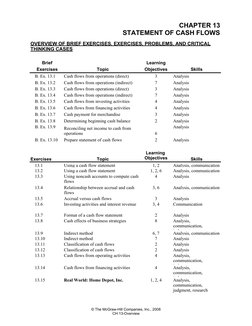


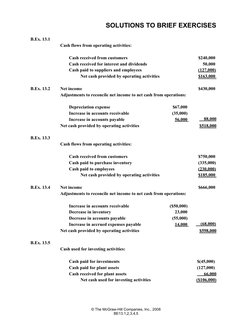
You might also like
- Cash Budget Exercises (Problems and Cases)No ratings yetCash Budget Exercises (Problems and Cases)10 pages
- Question 1: Score 0/1 Correct Response Exercise 13.3: Computing Cash Flows L.O. 4No ratings yetQuestion 1: Score 0/1 Correct Response Exercise 13.3: Computing Cash Flows L.O. 413 pages
- Industry Structure & Competitive Strategy: Keys To Profitability0% (1)Industry Structure & Competitive Strategy: Keys To Profitability15 pages
- Risk and Refinements in Capital BudgetingNo ratings yetRisk and Refinements in Capital Budgeting34 pages
- Chapter Three The Balance Sheet and Financial DisclosuresNo ratings yetChapter Three The Balance Sheet and Financial Disclosures33 pages
- Carver Industries Financial Ratio AnalysisNo ratings yetCarver Industries Financial Ratio Analysis12 pages
- FBE 421 - Financial Analysis and ValuationNo ratings yetFBE 421 - Financial Analysis and Valuation11 pages
- CASE STUDY-Financial Statement AnalysisNo ratings yetCASE STUDY-Financial Statement Analysis10 pages
- Capital Budgeting: Investment Decisions GuideNo ratings yetCapital Budgeting: Investment Decisions Guide29 pages
- Lathe Investment Analysis for Norwich ToolNo ratings yetLathe Investment Analysis for Norwich Tool1 page
- Milan Fashions Financial Analysis Case Study0% (2)Milan Fashions Financial Analysis Case Study7 pages
- Cash Flow Basics for Accounting StudentsNo ratings yetCash Flow Basics for Accounting Students23 pages
- Nestle-Organizational Behaviour With Refrence To 17 PointsNo ratings yetNestle-Organizational Behaviour With Refrence To 17 Points9 pages
- 1.1 Flexible Budgets and Performance Analysis: Part 1 - Section C Performance ManagementNo ratings yet1.1 Flexible Budgets and Performance Analysis: Part 1 - Section C Performance Management98 pages
- Working Capital and The Financing Decision: Mcgraw-Hill/IrwinNo ratings yetWorking Capital and The Financing Decision: Mcgraw-Hill/Irwin38 pages
- Ansoff's Diversification Strategies ExplainedNo ratings yetAnsoff's Diversification Strategies Explained5 pages
- Cash Flow Statement Exercises and AnalysisNo ratings yetCash Flow Statement Exercises and Analysis61 pages
- MM-SC-304 - Service Marketing (Marketing Management)No ratings yetMM-SC-304 - Service Marketing (Marketing Management)18 pages
- Bust 221 Managerial Economics Course OutlineNo ratings yetBust 221 Managerial Economics Course Outline3 pages
- Nepal International Convention Centre OverviewNo ratings yetNepal International Convention Centre Overview3 pages
- Outbound Call Center Update for P-SeriesNo ratings yetOutbound Call Center Update for P-Series25 pages
- Sanyu Classic School Chalk Business PlanNo ratings yetSanyu Classic School Chalk Business Plan18 pages
- Tourism in India: Service Sector: Case StudyNo ratings yetTourism in India: Service Sector: Case Study16 pages
- Bussiness Plan On Edible Oil and Sugar Retial TradeNo ratings yetBussiness Plan On Edible Oil and Sugar Retial Trade31 pages
- RT North America Site Visit 2024 Montreal TranscriptNo ratings yetRT North America Site Visit 2024 Montreal Transcript55 pages
- HRM Strategies for Omnichannel Retail SuccessNo ratings yetHRM Strategies for Omnichannel Retail Success17 pages
- Principles of Entrepreneurship OverviewNo ratings yetPrinciples of Entrepreneurship Overview43 pages
- Definition of Marketing. Basic Concept of Marketing & Its TermsNo ratings yetDefinition of Marketing. Basic Concept of Marketing & Its Terms32 pages
- Nigerian Business Tax Compliance ChecklistNo ratings yetNigerian Business Tax Compliance Checklist12 pages


