







Make the teaching of this topic easy with these simple steps to success, confidence and fluency

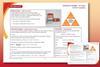
Chemists communicate what is happening in chemical reactions using symbol equations. These are more visual than word equations and give more information. Using recognised chemical symbols and formulas means that speakers of different languages can all understand the symbol equation.

View and download more infographics
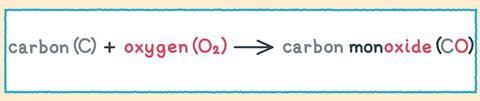
A balanced symbol equation is a concise illustration of the law of conservation of mass. The law of conservation of mass states that no atoms are made or destroyed during a chemical reaction (or physical change). Put simply, the number of atoms of each element in the reactants (on the left side of the equation) must equal the number of atoms of each element in the products (on the right side of the equation).
This equation is unbalanced:
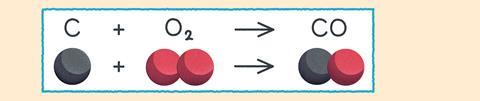
| Reactants | Products |
|---|---|
| 1x C | 1x C |
| 2x O | 1x O |
Balancing chemical equations is easy with this step-by-step approach and two simple rules. The simple rules are:
- Do add multipliers before a formula. The multiplier applies to the whole formula.
- Don’t change the formulas.
Step-by-step approach to balancing equations
This unbalanced equation shows 2 oxygen atoms (O) on the left and only 1 on the right:

Adding 2 on the right balances O. It also doubles the carbon (C) in the formula:

Adding 2 on the left in front of the C in the formula balances the equation:

All images © Dan Bright
Downloads
Balancing chemical equations poster
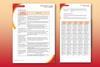
Handout | PDF, Size 0.87 mbBalancing chemical equations fact sheet
Editable handout | Word, Size 0.44 mbBalancing chemical equations fact sheet
Handout | PDF, Size 0.19 mb
- Prepare(3)
 CPD article
Teaching conservation of mass at 14–16
Help learners master the concept of conservation of mass with these hands-on teaching ideas
 Ideas
Ideas5 effective ways to teach balancing equations
Tried-and-tested approaches to build student skills and confidence
 Course
Quantitative chemistry | Self-led course
Build confidence in your quantitative chemistry knowledge and discover effective topic-specific teaching strategies
- Deliver(7)
currently reading
 Poster
How to balance chemical equations
Simple steps to success, confidence and fluency with balancing equations for 14–16 learners
 Resource
Balanced chemical equations | Structure strip | 14–16 years
Use scaffolded prompts to support learners to write about balanced chemical equations
 Resource
Interpreting chemical equations for ionic compounds | Developing understanding | 14–16
Help your learners develop mental models of what is represented in balanced chemical equation for ionic compounds with this resource, including teacher notes and a student worksheet
 Resource
Balancing chemical equations using magnesium and oxygen | Johnstone’s triangle worksheets | 14–16 years
Introduce Johnstone’s triangle with these teacher notes and a student worksheet to help learners gain a deeper understanding of balancing chemical equations
 Resource
Interpreting chemical equations | Developing understanding | 14–16 years
Deepen learners’ understanding of interpreting chemical equations by exploring the topic at different conceptual levels
 Resource
Balancing chemical equations using hydrogen and oxygen | Johnstone’s triangle worksheets | 14–16 years
Introduce Johnstone’s triangle to help learners gain a deeper understanding of balancing chemical equations
 Class experiment
The change in mass when magnesium burns
A class practical to find the formula of magnesium oxide using the change in mass when magnesium burns
- Literacy(1)
 Resource
Quantitative chemistry | Key terms support | 14–16
Language support pack for quantitative chemistry, with key terms list, accessible glossary, Frayer models and unscrambling definitions
- Assess(4)
 Resource
Balanced chemical equations and fuel | In context | 14–16
Put balancing chemical equations into context with questions based on fuels
 Resource
Balanced chemical equations | Knowledge check | 14–16
Ready-to-use worksheets to assess learning of balancing chemical equations, foundation and higher level
 Resource
Quantitative chemistry | Review my learning | 14–16 years
A set of differentiated worksheets with answers to identify learning gaps and misconceptions on the topic of quantitative chemistry
 Quiz
QuizSymbols, formulas and balanced equations | Bridging the knowledge gap | 14–16 years
Support your students with the transition to post-16 study with this quiz on symbols, formulas and balanced equations
- Enrich(2)
 Class experiment
Finding the formula of copper(II) oxide
Use this demonstration with your 14–16 learners to deduce the formula of copper(II) oxide by reducing it with methane
 News
NewsMaking ammonia production greener
Could lasers offer a more sustainable alternative to the Haber process




1 Reader's comment