


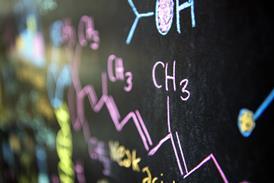





Think about sodium hydroxide (NaOH) solution at a macroscopic, sub-microscopic and symbolic level
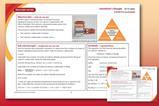
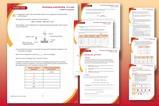
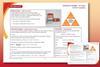
Use this resource to explore the different ways to represent and describe sodium hydroxide solution. Learners consider how the solution can be represented using particle diagrams as well as the symbolic representation of units of concentration.
-

Download this
Use this student worksheet to introduce concentration of solutions at three different conceptual levels based on learners’ observations.
View and download more Johnstone's triangle worksheets
Learning objectives
- Describe how to identify whether a beaker contains sodium hydroxide or water.
- Recognise the unit symbols used for concentration.
- Interpret particle diagrams of solutions in terms of how they represent concentration.
How to use Johnstone’s triangle
Use Johnstone’s triangle to develop learners thinking about scientific concepts at three different conceptual levels:
- Macroscopic: what we can see. Think about the properties that we can observe, measure and record.
- Sub-microscopic: smaller than we can see. Think about the particle or atomic level.
- Symbolic: representations. Think about how we represent chemical ideas including symbols and diagrams.
For learners to gain a deeper awareness of a topic, they need to understand it at all three levels.
When introducing a topic, do not try to introduce all of the levels of thinking at once. This will overload working memory. Instead complete the triangle over a series of lessons, beginning with the macroscopic level and introducing other levels, in turn, once secure.
All of the levels are interrelated, for example, learners need visual representation of the sub-microscopic in order to develop mental models of the particle or atomic level.
Further reading
Read more about how to use Johnstone’s triangle in your teaching with these articles:
- Develop deeper understanding with models
- Improve students’ understanding with Johnstone’s triangle
- Practical ideas for using Johnstone’s triangle
Norman Reid’s book The Johnstone triangle: the key to understanding chemistry provides an more in-depth overview, the first chapter is available to read online.
Scaffolding
It is important to share the structure of the triangle with learners prior to use. Tell them why you want them to use the triangle and how it will help them to develop their understanding. Use an ‘I try, we try, you try’ approach when you are introducing Johnstone’s triangle for the first time.
Next steps
To further develop learner’s thinking in all areas of Johnstone’s triangle, try our Developing understanding of concentration and mass worksheet. These worksheets include icons in the margin referring to the conceptual level of thinking needed to answer the question.
Downloads
Concentration of NaOH Johnstone's triangle student sheet
Handout | PDF, Size 0.19 mbConcentration of NaOH Johnstone's triangle teacher notes and answers
Handout | PDF, Size 0.21 mbConcentration of NaOH Johnstone's triangle student sheet
Editable handout | Word, Size 0.54 mbConcentration of NaOH Johnstone's triangle teacher notes and answers
Editable handout | Word, Size 0.54 mb
- Prepare(5)
 Ideas
Ideas5 ways to teach excess and limiting reagents to 14–16 learners
Tips for helping learners get to grips with this tricky part of quantitative chemistry
 News
NewsWhat is difficult about concentration?
Fresh insight offers tips for teaching the mathematics of moles, volume and molarity
 Ideas
Ideas5 ways to explain titration
From modelling to scaffolding, these tips will help students master this tricky topic
 Course
Quantitative chemistry | Self-led course
Build confidence in your quantitative chemistry knowledge and discover effective topic-specific teaching strategies
 CPD article
Moles and titrations
Dorothy Warren describes some of the difficulties with teaching this topic and shows how you can help your students to master aspects of quantitative chemistry
- Deliver(10)
 Resource
Concentration of solutions and titration | Structure strip | 14–16 years
Support learners to write about concentration of solutions and titration, using scaffolded writing prompts
 Lesson plan
Measuring vitamin C in fruit using a microscale titration | 14–16 years
Compare the amount of vitamin C in fruit and juices using a microscale titration in this practical lesson plan with follow-up questions
 Resource
Concentration of acids | Johnstone’s triangle worksheets | 14–16 years
Learners connect their understanding of dissolved ions, concentration and how chemicals are labelled with this single-page worksheet
 Resource
Determining unknown concentration | Johnstone’s triangle worksheets | 14–16 years
Guide learners to connect their thinking about calculating unknown concentrations following a titration
 Resource
Concentration and moles | Developing understanding | 14–16 years
Support learners to develop secure mental models of how concentration is measured and calculated in mol/dm3
 Resource
Concentration and mass | Developing understanding | 14–16 years
Encourage learners to deepen their understanding of concentration and mass from the macroscopic to sub-microscopic level
currently reading
 Resource
Concentration of sodium hydroxide | Johnstone’s triangle worksheets | 14–16 years
Think about sodium hydroxide (NaOH) solution at a macroscopic, sub-microscopic and symbolic level
 Class experiment
A microscale acid–base titration
Use microscale titration to complete an acid–base neutralisation with sodium hydroxide in this class practical. Includes kit list and safety instructions.
 Practical video
Simple titration – practical videos | 14–16 students
Video resources showing how to carry out a titration experiment and interactive resources to allow students to collect their own results.
 Class experiment
Using indigestion tablets to neutralise an acid | 14-18 years
Investigate and measure the neutralising effect of indigestion tablets (antacids) on hydrochloric acid in this class practical. Includes kit list and safety instructions.
- Literacy(1)
 Resource
Quantitative chemistry | Key terms support | 14–16
Language support pack for quantitative chemistry, with key terms list, accessible glossary, Frayer models and unscrambling definitions
- Assess(4)
 Resource
Concentration of solutions and titration | In context | 14–16
Put concentration of solutions and titration into context with questions based on acids in fruit juices
 Resource
Concentration of solutions and titration | Knowledge check | 14–16
Assess learning of concentration of solutions and titration with a higher and foundation worksheet
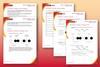 Resource
Quantitative chemistry | Review my learning | 14–16 years
A set of differentiated worksheets with answers to identify learning gaps and misconceptions on the topic of quantitative chemistry
 Quiz
QuizAmounts in solution and titrations | Bridging the knowledge gap | 14–16 years
Support your students with the transition to post-16 study with this quiz on amounts in solution and titrations
- Enrich(5)
 Lesson plan
Calculating and comparing solution concentrations | 16–18 years
Use this lesson plan to practise calculating the concentration of a solution from the mass of solute and volume of water
 Job profile
Scientist, food and pharmaceuticals
Taryn uses scientific instruments to test our food and medicines and make sure they are safe
 Class experiment
Acid–alkali conductometric titration worksheet | 14–16 years
Develop your learners’ understanding of ions and the changes in ionic concentrations in an acid-alkali neutralisation
 Job profile
Bioanalytical scientist
Claire’s work involves stress testing new medicines in various stages of drug development to ensure they are robust and reliable before being released onto the consumer market
 Resource
Titration screen experiment
Give students the opportunity to conduct their own titration experiment on a computer or tablet. This resource also includes a redox titration experiment.


No comments yet