

Get started
Watch a demonstration of this experiment and download the technician notes from the Education in Chemistry website: rsc.li/4nVBZbU
The oxides of nitrogen provide a rich reservoir from which examiners can pull questions on bonding, oxidation states, rates of reaction, acid–base chemistry, equilibria and stoichiometry. Students therefore benefit from seeing these reactions first-hand. Chemist and author Bruce Mattson’s microscale approach to producing and reacting gases is an excellent way to do this – watch his YouTube videos for more information. You can use nitrogen monoxide (NO) and oxygen (O2) to demonstrate Avogadro’s law. You can then use the nitrogen dioxide (NO2) you produce to show a counterintuitive example of equilibria chemistry.
The oxides of nitrogen provide a rich reservoir from which examiners can pull questions on bonding, oxidation states, rates of reaction, acid–base chemistry, equilibria and stoichiometry. Students therefore benefit from seeing these reactions first-hand. Chemist and author Bruce Mattson’s microscale approach to producing and reacting gases is an excellent way to do this – watch his YouTube videos for more information (bit.ly/47tDhUV). You can use nitrogen monoxide (NO) and oxygen (O2) to demonstrate Avogadro’s law. You can then use the nitrogen dioxide (NO2) you produce to show a counterintuitive example of equilibria chemistry.
Use this demonstration with your 14–16 and post-16 learners when teaching the nitrogen oxides and Avogadro’s law.
Kit
- 2 × weighing boat
- 2 × sample vial lid
- 2 × 60 cm3 plastic syringe with Luer-slip or Luer-lock tip
- 2 × syringe cap
- 3-way syringe valve, optional
- Approximately 3 cm silicone tubing with a 4 mm internal diameter
- 5 cm3 1.4 M sulfuric(VI) acid
- 0.20 g sodium nitrate(III), also known as sodium nitrite
- 1.35 g iron(II) sulfate heptahydrate
- 50 cm3 stop bath of 0.4 M sodium hydroxide
- 0.05 g potassium iodide
- 3 cm3 of 20 vol hydrogen peroxide
Health, safety and disposal
- Read our standard health and safety guidance and carry out a risk assessment before running a live demonstration.
- Wear eye protection.
- Work in an efficiently running fume cupboard.
- 1.4 M sulfuric(VI) acid is an irritant to skin and eyes. CLEAPSS members should consult HC098a.
- Sodium nitrate(III) is an eye irritant and toxic if swallowed. You should keep it away from combustible materials. CLEAPSS members should consult HC093.
- Iron(II) sulfate heptahydrate is irritating to skin and eyes and harmful if swallowed.
- 0.4 M sodium hydroxide is an irritant to skin and eyes.
- 20 vol hydrogen peroxide is an eye irritant.
- The nitrogen monoxide and nitrogen dioxide you produce are toxic, corrosive and oxidising – avoid skin contact and inhalation. CLEAPSS members should consult HC068B.
- Retain the nitrogen dioxide syringe for the Unexpected equilibrium or release it through a stop bath of 0.4 M sodium hydroxide in a fume cupboard. Dilute the contents of the stop bath and dispose of down a foul-water drain.
Health, safety and disposal
- Read our standard health and safety guidance and carry out a risk assessment before running a live demonstration (rsc.li/46ODFwT).
- Wear eye protection.
- Work in an efficiently running fume cupboard.
- 1.4 M sulfuric(VI) acid is an irritant to skin and eyes. CLEAPSS members should consult HC098a (bit.ly/46ZmQzb).
- Sodium nitrate(III) is an eye irritant and toxic if swallowed. You should keep it away from combustible materials. CLEAPSS members should consult HC093 (bit.ly/3J4HO7V).
- Iron(II) sulfate heptahydrate is irritating to skin and eyes and harmful if swallowed.
- 0.4 M sodium hydroxide is an irritant to skin and eyes.
- 20 vol hydrogen peroxide is an eye irritant.
- The nitrogen monoxide and nitrogen dioxide you produce are toxic, corrosive and oxidising – avoid skin contact and inhalation. CLEAPSS members should consult HC068B (bit.ly/3J4TJVV).
- Retain the nitrogen dioxide syringe for the Unexpected equilibrium demonstration on page 53 or release it through a stop bath of 0.4 M sodium hydroxide in a fume cupboard. Dilute the contents of the stop bath and dispose of down a foul-water drain.
Preparation
Collecting a syringe of NO
Transfer about 5 cm3 of 1.4 M sulfuric(VI) acid into a weighing boat. Weigh 0.20 g sodium nitrate(III) and 1.35 g of iron(II) sulfate heptahydrate into a sample vial lid. Ensure the syringe plunger moves freely and hold it vertically, tip down, with the plunger removed. Carefully lower the sample vial lid into the syringe so the solid sits in the lid at the tip-end of the syringe. Mattson’s floatation technique (figure 1) can assist here. Fill the syringe from a tap until nearly full, holding a finger over the tip to prevent the liquid from emptying (figure 1a). Float the sample vial in the syringe and release your finger over a flask so the emptying water gently lowers the lid (figure 1b–c). Once the lid is in place, re-insert and depress the plunger, keeping the syringe pointed down.
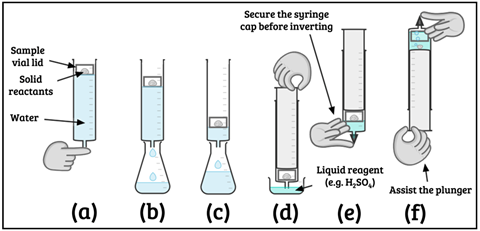
Draw up the acid, taking care not to introduce any air, and cap the syringe (figure 1d–e). Next, invert the syringe (figure 1f). The solution will turn black and produce a colourless gas. Use your other hand to help the plunger retract. The reaction (equation 1) can produce up to 72 cm3 of gas, but as some gas reacts with traces of oxygen in the syringe and dissolves, expect about 50 cm3 in practice .
Equation 1: 2NaNO2(s) + 2FeSO4(aq) + 3H2SO4(aq) → 2NO(g) + Fe2(SO4)3(aq) + 2NaHSO4(aq) + 2H2O(l)
When the reaction finishes, or you have generated sufficient NO, you can dispose of the solution in the syringe. Hold the syringe tip up in the fume cupboard, pointing away from you, and draw the plunger slightly back to ensure no liquid shoots out under pressure. Remove the syringe cap, invert the syringe again and carefully squeeze out the solution into a stop bath of 50 cm3 of 0.4 M sodium hydroxide. Cap and invert again, then transfer the gas upwards into a dry syringe fitted with either a few centimetres of silicone tubing or a three-way valve. Pull the empty syringe’s plunger as you depress the syringe of collected NO and take care not to transfer any liquid.
Collecting a syringe of O2
Many schools have an oxygen cylinder, but if not, use the Mattson technique (figure 1) to fill a syringe. Repeat the procedure above with 0.05 g potassium iodide in the sample vial lid and 2 cm3 of 20 vol hydrogen peroxide in the weighing boat. You won’t require a stop bath as the hydrogen peroxide is limiting. The reaction should generate around 40 cm3 of gas with only 20 cm3 required for the demonstration.
Transfer at least 20 cm3 of the oxygen gas to a clean, dry syringe and cap for later.
Preparing the apparatus
Swap the syringe cap on the syringe of NO for a three-way valve. Avoiding skin contact, expel excess gas through the valve until the syringe contains 40 cm3 of gaseous NO and close the tap. Depending on your three-way valve, you may require a section of tubing to fit the second syringe. If so, keep this tubing short. Remove the cap from the syringe of O2, add the tubing if required, and expel the gas until 20 cm3 remains in the syringe. Connect the two syringes via the three-way valve. From this point, you can work outside of a fume cupboard in a well-ventilated room.
If you have no three-way valve, you will need to connect the syringes in front of your audience via a short section of silicone tubing and continue to run the demonstration in a fume cupboard.
In front of the class
Show the class the two syringes and point out the volumes. If you need to connect the syringes by a short section of silicone tubing, do so now.
Open any valves and carefully depress the plunger on one syringe, assisting the transfer by pulling from the other syringe. A brown gas forms and the total volume decreases until you’re left with exactly 40 cm3 – it looks as if 20 cm3 has gone missing.
If you don’t produce 40 cm3 of NO2 , see the comments for an explanation.
Teaching goal
Many post-16 specifications cover the application of Avogadro’s law – that equal numbers of moles of gas occupy the same volumes under the same conditions. Here three moles of gas (a total of 60 cm3) become two moles (a total of 40 cm3) – see equation 2 – and a dramatic colour change occurs.
Equation 2: 2NO(g) + O2(g) → 2NO2(g)
To be able to follow the rate of reaction involving the production of NO2, your learners need to know what it looks like. Watch this demo involving the brown gas.
We updated this article on 2 December with the addition of ‘also known as sodium nitrite’ to the kit list.
To be able to follow the rate of reaction involving the production of NO2, your learners need to know what it looks like. Continue reading for a demo involving the brown gas.
Downloads
Avogadro’s law revisited technician notes
Handout | PDF, Size 0.34 mbAvogadro’s law revisited technician notes
Editable handout | Word, Size 0.58 mb








4 readers' comments