James Watson, who described himself as “not a racist in a conventional way”, has died at the age of 97. Below is a review of an obituary for Dr. James Watson published by Cold Spring Harbor Laboratory on November 7, 2025. The obituary is in black and the review comments are in red.


Jim Watson made many contributions to science, education, public service, and especially Cold Spring Harbor Laboratory (CSHL).

In the realm of science, several of the contributions James Watson took credit for were not his (see below). In terms of education, his focus was on bringing a single Eton boy every year to Cold Spring Harbor Laboratory for a research experience during the boy’s gap year after high school (the boys would frequently stay at his house). Eton, an all-boy boarding school, is Britain’s most elite school (CSHL oral history, 1997). Insofar as public service, Watson’s public record was not one of civic engagement or humanitarian contribution. His tenure as the first head of the Human Genome Project ended quickly in conflict (see below) and his public statements regarding genetics and race, gender, and intelligence was widely condemned (source: Amy Harmon, 2019)

As a scientist, his and Francis Crick’s determination of the structure of DNA, based on data from Rosalind Franklin, Maurice Wilkins and their colleagues at King’s College London, was a pivotal moment in the life sciences.

Franklin did not just provide data that enabled Crick and Watson to determine the structure of DNA. Yes, with her student Raymond Gosling she generated high-quality X-ray images of DNA, most famously Photo 51, which provided clear evidence that DNA forms a helical structure. But Franklin did much more and was an equal scientific contributor to the elucidation of DNA’s structure, whose experimental rigor and insights were central to solving the double helix. Franklin’s X-ray diffraction work distinguished the A and B forms of DNA, resolving confusion. Her measurements revealed that DNA’s unit cell was huge and had a C2 symmetry, implying two antiparallel sugar-phosphate strands. She confirmed the 34 Å helical repeat in the B form and identified the phosphate backbone’s exterior location. Though she did not derive complementary base pairing, her late-stage notes show that she recognized DNA could encode biological specificity through any sequence of bases, anticipating the idea of informational coding (Cobb and Comfort, Nature, 2023).

Watson, along with Crick and Wilkins were awarded the 1962 Nobel Prize in Physiology or Medicine. Watson also received the Presidential Medal of Freedom from President Gerald Ford and the National Medal of Science from President Bill Clinton, among many other awards and prizes.

It is true that Watson received these awards. Coincidentally, William Shockley was also awarded the Nobel Prize around the same time as Watson (physics, 1956) and he promoted racist eugenics, arguing that people of African Ancestry posed a “dysgenic risk”, as well as advocating for sterilization. He used his Nobel prestige to advance his malicious and scientifically bankrupt ideas (source: Scott Rosenberg, 2017)

While at Cambridge, Watson also carried out pioneering research on the structure of small viruses. At Harvard, Watson’s laboratory demonstrated the existence of mRNA, in parallel with a group at Cambridge, UK, led by Sydney Brenner.

One of his colleagues at Harvard, E. O. Wilson, once called James Watson “the most unpleasant human being I have ever met” (source: Amanda Gefter, 2009).

His laboratory also discovered important bacterial proteins that control gene expression and contributed to understanding how mRNA is translated into proteins.

The discovery of important proteins that control gene expression in bacteria, notably the lac repressor, was made by Francois Jacob and Jaques Monod.

As an author, Watson wrote two books at Harvard that were and remain best sellers. The textbook Molecular Biology of the Gene, published in 1965 (7th edition, 2020), changed the nature of science textbooks, and its style was widely emulated.

In this textbook Watson got the central dogma wrong, presenting it in a profoundly misleading way. (source: Matthew Cobb, 2024).

The Double Helix (1968) was a sensation at the time of publication. Watson’s account of the events that resulted in the elucidation of the structure of DNA remains controversial, but still widely read.

Prior to the publication of The Double Helix, Francis Crick wrote that “If you publish your book now, in the teeth of my opposition, history will condemn you”. Watson published the book anyway (source: letter by Francis Crick, 1967) .

As a public servant, Watson successfully guided the first years of the Human Genome Project, persuading scientists to take part and politicians to provide funding.

Watson resigned from the Human Genome Project due to conflicts of interest related to holdings of his in biotechnology companies and due to his insistence that cDNA should not be sequenced leading to conflicts with NIH director Bernadine Healy, with whom he also clashed on patenting of expressed sequence tags (source: Christopher Anderson, 1992). Fortunately, thanks to the vision of Bernadine Healy, who was the first female director of the NIH, cDNA technology was pursued and led to RNA-seq which, along with DNA-seq, is today the most widely used genomics assay. 

He created the Ethical, Legal and Social Issues (ELSI) program because of his concerns about misuse of the fruits of the project.

Watson reportedly configured ELSI so as to undermine its ability to interfere with the human genome project: “I wanted a group that would talk and talk and never get anything done and if they did do something, I wanted them to get it wrong. I wanted as its head Shirley Temple Black” (source: Lori Andrews, 1999, Dolan et al., 2022). 

Watson’s association with Cold Spring Harbor Laboratory began in 1947 when he came as a graduate student with his supervisor, Salvador Luria. Luria, with Max Delbruck, was teaching the legendary Phage Course. Watson returned repeatedly to CSHL, most notably in 1953 when he gave the first public presentation of the DNA double helix at that year’s annual Symposium. He became a CSHL trustee in 1965.

James Watson did not credit Rosalind Franklin in his presentation of the DNA double helix; he did not even mention Rosalind Franklin in his Nobel, although he did admit that people found him unbearable (source: Nobel Banquet speech, 1962).

CSHL was created in 1964 by the merger of two institutes that existed in Cold Spring Harbor since 1890 and 1904, respectively. In 1968, Watson became the second director when he was 40 years old. John Cairns, the first director, had begun to revive the institute but it was still not far short of being destitute when Watson took charge. He immediately showed his great skills in choosing important topics for research, selecting scientists and raising funds.

On the matter of selecting scientists, Watson once remarked “Whenever you interview fat people, you feel bad, because you know you’re not going to hire them” (source: Tom Abate, 2000). On the matter of raising funds, it seems that James Watson’s network included Jeffrey Epstein, with whom he reportedly met within two years before Epstein’s arrest in 2019 (source: Business Insider).

Also in 1968, Watson married Elizabeth (Liz) Lewis, and they have lived on the CSHL campus their entire lives together. Jim and Liz have two sons, Rufus and Duncan. As with the former Directors, they fostered close relationships with the local Cold Spring Harbor community.

In 1969, Watson focused research at CSHL on cancer, specifically on DNA viruses that cause cancer. The study of these viruses resulted in many fundamental discoveries of important biological processes, including the Nobel prize-winning discovery of RNA splicing. Watson was the first Director of CSHL’s National Cancer Institute-designated Cancer Center, which remains today.

On the matter of cancer, James Watson delivered a lecture at UC Berkeley in 2000 where he talked about an experiment to protect against skin cancer. He claimed that in an experiment by scientists at the University of Arizona, who injected male patients with an extract of melanin to test whether they could chemically darken the men’s skin as a skin cancer protection, they observed an unusual side effect, namely that the men developed sustained and unprovoked erections (source: Tom Abate, 2000).

Watson was passionate about science education and promoting research through meetings and courses. Meetings began at CSHL in 1933 with the Symposium series, and the modern advanced courses started with the Phage course in 1945. Watson greatly expanded both programs, making CSHL the leading venue for learning the latest research in the life sciences. Publishing also increased, notably of laboratory manuals, epitomized by Molecular Cloning, and several journals began, led by Genes & Development and later Genome Research. He encouraged the creation of the DNA Learning Center, unique in providing hands-on genetic education for high-school students. There are now DNA Learning Centers throughout the world.

The DNA learning center page on Rosalind Franklin statesThe X-ray crystallographic expert, hired for her skills, and known to be methodical. Don’t call her Rosy!” (source: DNA learning center)`

Through a substantial gift to CSHL in 1973 by Charles Robertson, Watson started the Banbury Center on the Robertsons’ 54-acre estate in nearby Lloyd Harbor. Today, this center functions as an important “think tank” for advancing research and policies on many issues related to life and medical sciences.

The Banbury Center was founded as an old boys club. Meetings are invitation only, with invites by the old boys for other old boys. I attended a meeting in 2004 on functional genomics which consisted of 33 invitees of which 33 were men, despite the fact that many of the leading genomics scientists at the time were women. At the meeting I had dinner with James Watson, during which he took the opportunity to denigrate Rosalind Franklin and the Irish (source: Banbury Center, 2004). 

Watson remained in leadership roles at CSHL until 2000, and then continued as a member of the faculty. However, his remarks on race and IQ in 2008 led the CSHL Board of Trustees to remove him from all administrative roles and his appointment as a CSHL Trustee. When he made similar statements in 2020, the board revoked his Emeritus status and severed all connections with him.

Watson made racist and sexist remarks not only in 2008 and 2020 but throughout his life (source: James Watson in his own words).

Watson’s extraordinary contributions to Cold Spring Harbor Laboratory during his long tenure transformed a small, but important laboratory on the North Shore of Long Island into one of the world’s leading research institutes.

Watson was the director of CSHL from 1968 – 1994 but there have been many other individuals who were key in establishing CSHL as a leading research institute: Barbara McClintock (discovered transposons) was at Cold Spring Harbor from 1941 until her death in 1992 (source: Wikipedia). She was recruited by Milislav Demerec (director 1941 – 1960). Bruce Stillman (director since 1994) has been instrumental in establishing the CSHL graduate program, the Genome Research Center, and under his watch it became a top-10 biomedical research center (source: Wikipedia).
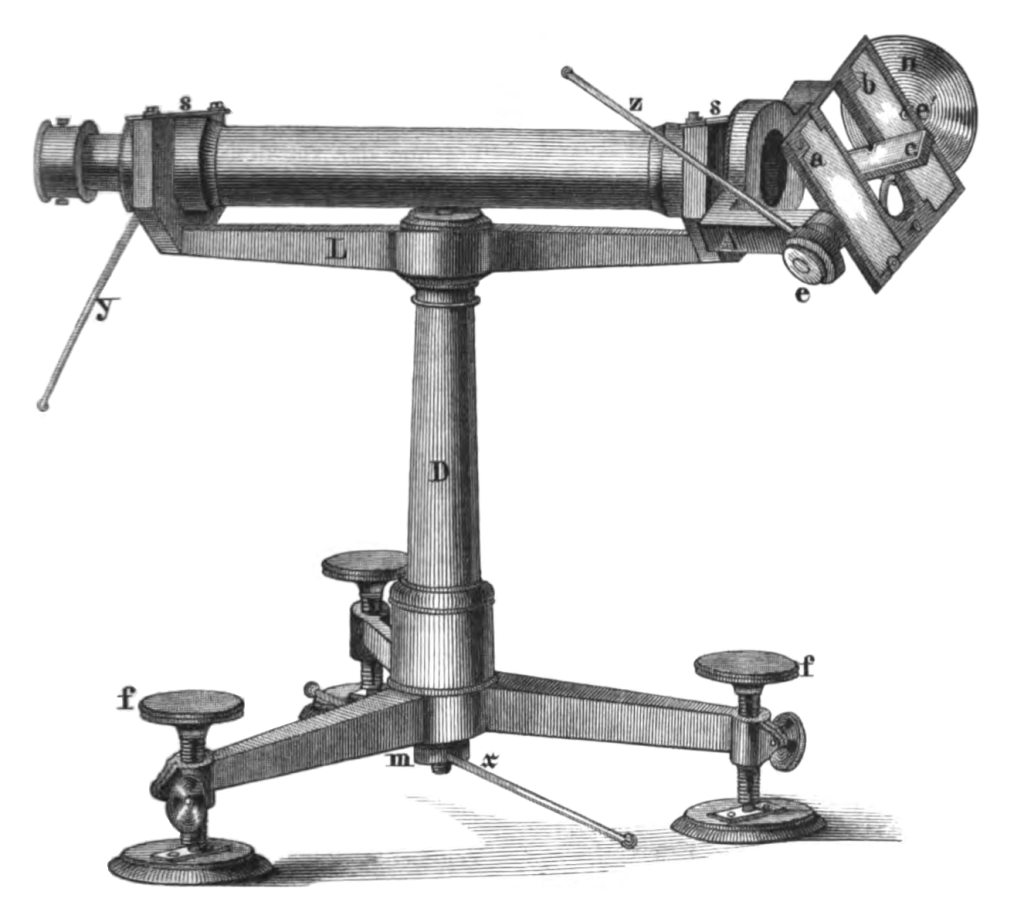
The mathematician Carl Friedrich Gauss invented the heliotrope for long-distance surveying in 1821. Just a year later, he proved that least squares regression provided the BLUE estimator for data with uncorrelated Gaussian errors (with mean zero and equal variance). The heliotrope tool and the least squares method allowed Gauss to perform a geodetic survey of the Kingdom of Hanover by triangulation between 1821 and 1825, an unprecedented accomplishment at the time.

Gauss’ heliotrope (source: Wikipedia)

Gauss’ approach was scaled up massively by Friedrich Wilhelm Bessel, who in 1838 published an epic triangulation based survey of East Prussia and parts of Russia in Gradmessung in Ostpreußen und ihre Verbindung mit Preußischen und Russischen Dreiecksketten. His work included understanding for the first time how to calculate the standard error of the mean (which led him to introduce Bessel’s correction), providing an important assessment of how errors in individual measurements during triangulation contributed to overall errors from the least squares procedure. The scale of his survey (~3x Hanover) was arguably also the first use of statistics for big data. Bessel may have been the first ̶m̶a̶c̶h̶i̶n̶e̶ ̶l̶e̶a̶r̶n̶i̶n̶g̶ AI disruptor in history. And he did it not from silicon valley but from Königsberg (now Kaliningrad).

Survey maps of Prussia ca. 1895 (source: Wikipedia)

Bessel’s work enabled the completion of the first cross-country rail line linking a Western European capital to an Eastern European capital. The rail line, between Berlin and Warsaw, was completed in 1848 and was a quantum leap after the first national long-distance rail between Leipzig and Dresden in the Kingdom of Saxony was completed in 1839. At ~500km, Berlin-Warsaw was much longer than any previous international crossings. The distance was long enough that Bessel was able to use his triangulation to show that the earth is an oblate spheroid (the method dates to 1825) and in 1841 he established the ellipsoid major and minor axes a = 6377397.155 m, b = 6356078.962822 m. His accuracy was amazing; the WGS84 modern world geodetic system from 1984 is almost the same with a = 6378137.0 m, b = 6356752.30 m. As of 2010 the Bessel ellipsoid was still the geodetic system of choice in Germany, Austria, and the Czech Republic.

Locomotive, 1848 (source: Wikipedia)

The Berlin-Warsaw line of 1848 crossed the Prussian-Russian border near the Prosna river, west of the town of Łowicz, which is just under 100km west of Warsaw. Warsaw at the time was part of Congress Poland formed at the Congress of Vienna in 1815, although by the mid 19th century the territory was fully under Russian administration ruled directly by the Tsar. The border moved in 1919 as a result of the Treaty of Versailles after World War I, when a new Polish Republic was established. At that time the border crossing on the Berlin-Warsaw rail line shifted to the town of Zbąszyń (a medieval Polish name for the town, which the Germans had renamed to Bentschen when the town came under Prussian control in 1793).

Zbąszyń monument to Polish nationalism in 1918-1919 and World War II (source: photograph by me, taken September 13, 2025)

In the 19th century Zbąszyń was what today we might today call a “multicultural town”. Out of a population of ~1,300 in 1833, there were 336 Jews (~25%), about 35% Germans, and approximately 40% Poles. In other words, there were more Poles than Germans, but Poles were a minority with respect to Jews and Germans. The percent Jewish population in Zbąszyń, which dates back to at least 1437 when it is known that a Jew named Palto sued a nobleman for failure of repaying a loan, peaked in the early 19th century. The reasons for a decline in Jewish population over a century were manifold, but a major factor was antisemitism, including regular blood libels and pogroms in neighboring cities of which a partial list is the “forgotten” Warsaw pogrom in 1805, pogroms in Gdańsk in 1819 and 1821, the Kalisz pogrom of 1878, the Warsaw pogrom of 1881, the Łódź pogrom of 1892, the Częstochowa pogrom in 1902, and the Białystok and Siedlce pogroms in 1906. Many Jews, including in Zbąszyń, fled west, or even abroad. By 1919 when Zbąszyń became part of the Polish Republic (it was deemed Polish in the Versailles treaty on the basis of a majority Polish population), the Jewish population had declined to under 10%, part of a mass migration from Eastern Europe totaling around 3 million Jews.

The Zbąszyń synagogue built in 1851 (source: Zbąszyń museum archive)

One couple that emigrated was Zindel Grynszpan and Rivka Grynszpan, who lived in Dmenin near Radomsko just south of Łódź, and moved to the city of Hanover in the Kingdom of Hanover, Prussia in 1911. The Grynszpans started a family in Hanover and eventually had six children, although only three survived into adulthood. The youngest was a boy named Herschel Feibel born in 1921. The Grynszpans were never German citizens; after the Polish Republic was established in 1919 they were recognized as Polish citizens, since they had been born in what was deemed in 1919 to be Polish territory (although in the 19th century Radomsko was part of the Russian empire). Herschel was born in Hanover, but due to the jus sanguinis principle of the German Citizenship Law which came into effect in 1914 (citizenship by descent, not birthplace), he was a Polish, not German, citizen.

The house where Herschel Grynszpan was born (source: Historical Museum of Hanover)

On the 28th of October, 1938, the members of the Grynszpan family, along with thousands of other Polish Jews living in Germany, were deported via train to Zbąszyń, the town that happened to be the border town on the Berlin-Warsaw line.

Zindel Grynszpan’s name on a list of deportees to Zbąszyń (source: Joint Distribution Committee)

The conditions of this deportation were horrific. Deportation notices technically gave 24 hours to leave but many individuals were deported minutes after receiving a knock on the door, and were not allowed to bring much more than the clothes on their back. How this came about is a sad and sordid story. On March 31, 1938, a Polish law came into effect that revoked the citizenship of Poles who had lived abroad for more than five years. This law was enacted specifically to prevent Jewish Poles from returning to Poland after the Anschluss, i.e. the German annexation of Austria on March 12, 1938. On the 9th of October Polish authorities added a regulation that required passports issued outside of Poland to receive a special consular stamp in order to be valid. In other words, Polish Jews were being stripped of their citizenship. This served as a pretext for German authorities to kick Polish Ostjuden (eastern Jews) out of Germany, and in what has come to be termed “Polenaktion”, they proceeded to dump Polish Jews, many of whom had just been rendered stateless, at Zbąszyń. Below are two first-hand accounts of what the deportation and arrival in Zbąszyń was like:

Your parents were Ost Juden [East European Jews]. Was your family involved in the expulsion to Zbąszyń?

I am so surprised that nobody mentions this, which happened on the 28th of October, 1938, ten days before the pogrom. In our Jewish school the boys were praying in the morning. The girls didn’t have to, but they had to prepare breakfast for the boys to eat after praying. It was the turn of my friend and I to make the tea and we had to be at school at 7:00 instead of 8:00. I was already dressed and ready to leave the house when I heard knocking at our door. When I opened the door, two tall policemen were standing at the door. They asked, “Where are your parents?” I told them they were asleep. “Wake them up, you are going to Poland.” I answered, “What? What do I have to do with Poland? I was born in Germany.” He said, “Take me to the bedroom of your parents.” They both went into their bedroom and put on the light and said, “Get up. You are going to Poland.” My mother thought it was a bad dream. They said, “Don’t ask questions, you are going to Poland.”

My father thought there was a problem with his income tax returns. My mother told me to wake up my 16-year-old brother. My parents asked why they were going to Poland – could they take something with them? The policemen said, “You are going to such a cultural land.” (When Germans talked about Poland they said “dirty Poles”). “No,” he said, “don’t take anything with you.” My father phoned his brother and asked him to take the keys to our apartment. He asked my father, “What have you done?” My father answered, “Nothing.” My aunt came and took the keys but when she got home, the police were in her house, and they really were sent immediately to Poland.

I will never forget my neighbor. She was a widow. She was wearing her nightgown, had hastily put on her overcoat and was carrying a little handbag. When I asked her why she wasn’t dressed, she told me the police didn’t give her time.

We were taken and crammed in to the gymnastics hall of the Jewish school. We saw all the people we knew from the neighborhood who were of Polish origin. My father had very high blood pressure and he couldn’t breathe. He called a doctor who said, “This man has to go hospital, he can’t be transported.” My brother said, “We will never see you again. We will be in Poland and you will be in Germany.” Every half hour a bus came to take the people to the railway station. My mother didn’t want to push, so we took the next bus and as we got in people were pushed in with us. We were all standing and that way we arrived at the Leipzig railway station. On the way, one woman became crazy. They took us to a siding where they take animals, horses and cows. There were soldiers with bayonets standing every ten meters to make sure we didn’t run away. So you see, at 7:00 in the morning I was a student, and at 5:00, I was a criminal. It was terrible (source: Yad Vashem interview with Miriam Ron)

My dear ones!

You have probably already heard of my fate from Cilli. On October 27 of this year, on a Thursday evening at 9 o’clock, two men came from the Crime Police, demanded my passport, and then placed a deportation document before me to sign and ordered me to accompany them immediately. Cilli and Bernd were already in bed. I had just finished my work and was sitting down to eat, but had to get dressed immediately and go with them. I was so upset I could scarcely speak a word. In all my life I will never forget this moment. I was then immediately locked up in the Castle prison like a criminal. It was a bad night for me. On Friday at 4 o’clock in the afternoon we were taken to the main station under strict guard by Police and SS. Everybody was given two loaves of bread and margarine and was then loaded on the freight cars. It was a cruel picture. Weeping women and children, heart-breaking scenes. We were then taken to the border in sealed cars and under the strictest police guard. When we reached the border at 5 o’clock on Saturday afternoon we were put across. A new terrible scene was revealed here. We spent three days on the platform and in the waiting rooms, 8,000 people. Women and children fainted, went mad, people died, faces as yellow as wax. It was like a cemetery full of dead people. I was also among those who fainted. There was nothing to eat except the dry prison bread, without anything to drink. I never slept at all, for two nights on the platform and one in the waiting room, where I collapsed. There was no room even to stand. The air was pestilential. Women and children were half dead. On the fourth day help at last arrived. Doctors, nurses with medicine, butter and bread from the Jewish Committee in Warsaw. Then we were taken to barracks (military stables) where there was straw on the floor on which we could lie down….

H.J. Fliedner, Die Judenverfolgung in Mannheim 1933-1945 (“The Persecution of the Jews in Mannheim 1933-1945”), II, Stuttgart, 1971, pp. 72-73 (source: Yad Vashem).

Jews arriving in Zbąszyń, 1938 (source: Yad Vashem)

In total, around 17,000 Polish Jews living in Germany were deported and left stateless on the Polish border; about 8,000 of those arrived in Zbąszyń. Herschel Grynzspan was not with the rest of his family when they arrived in Zbąszyń, as he had left for Paris in 1936. The story of how Herschel arrived in Paris is briefly as follows: his family had intended for him to emigrate to British Mandate Palestine, but he was refused entry by the British for being too young. His parents therefore decided that he ought to emigrate to Paris instead, where they expected he could find refuge with an uncle and aunt (he was 14 in 1935). He eventually left for Paris, albeit his entry to France was illegal because he had no financial support and it was illegal for Jews to take money out of Germany by the mid 1930s.

On the 3rd of November, 1938, just five days after the arrival of his family in Zbąszyń, Herschel received a postcard from his sister Berta detailing their plight. While the Germans had discarded thousands of Jews in Zbaszyn, Poland was unwilling to accept them into the country. The Jews at the border were therefore effectively stateless and unwanted, squeezed into a border town where they were dumped in horse stables, a flour mill, military barracks, or left to sleep outside in fields. Emanuel Ringer, a social worker who went to Zbąszyń to help wrote the following on December 6, 1938 (full letter here):

“Jews were humiliated to the level of lepers, to citizens of the third class, and as a result we are all visited by terrible tragedy. Zbąszyń was a heavy moral blow against the Jewish population of Poland. And it is for this reason that all the threads lead from the Jewish masses to Zbąszyń and to the Jews who suffer there.”

The text in the postcard from Berta to her brother Herschel is reproduced below (source: Federal Archives, Berlin, R 55/20991, letters to and from Herschel Grynszpan):

Dear Hermann [German rendering of Herschel]!

You will surely have heard of our great misfortune. Let me describe what happened. On Thursday evening, rumours were circulating that all Polish Jews were to be expelled from a city. Even so, we found them difficult to believe. On Thursday evening at 9, a policeman came to us and told us that we should go to the police station with our passports. All together, as we were, we went to the police station accompanied by the policeman. We found almost our entire district gathered there. A police car immediately took us to the city hall. Everyone was taken there. No-one told us what was going on. However, we could see what they had in mind.

Each one of us was handed an expulsion order. We were told we had to leave Germany before the 29th. We were no longer allowed to return home. I begged them to allow me to go home to at least collect a few things. I then left for home, accompanied by a policeman, and packed the most important items of clothing in a suitcase. That’s all that I was able to save.

We don’t have a single penny on us. […] I’ll tell you more next time

Love and kisses from us all

Berta

Zbąszyń, 2nd barracks, Grynszpan

Jews being housed in horse stables in Zbąszyń (photo by Roman Vishniac, source: ICP)

The letter left Herschel distraught and desperate, and his first instinct was to send all his savings to his family. He ended up arguing with his uncle over this plan, and he was persuaded not to do it, due to the low likelihood that the money would make it to his family. Just two days later, on the 6th of November, Herschel departed his uncle’s house announcing he would not return, slept in a hotel, and the next morning, at 9:30am on November 7th, 1938, managed to enter the German embassy in Paris by pretending to have to deliver an important message. Upon entering the office of diplomat Ernst vom Rath, he shot him. He had bought the gun that morning on his way to the embassy.

Photo of Herschel Grynzspan, age 17, taken in Paris, France on November 7, 1938, after his arrest for shooting Ernst vom Rath (source: United States Holocaust Museum)

Two days later, on November 9, 1938, vom Rath died of his wounds. At his funeral he was declared a “blood witness” (Blutzeuge), i.e. a martyr who shed blood for the Nazi cause. In his funeral oration, Joachim von Ribbentrop declared “We understand the challenge, and we accept it.”

Hitler at Ernst vom Rath’s funeral in Düsseldorf (source: Hitler Archive)

The same evening that vom Rath died, the 9th of November, 1938, Joseph Goebbels gave a speech inciting violence against Jews and instructing party officials not to to restrict anti-Jewish riots. Later that night, Reinhard Heydrich sent a teletype from Berlin to Gestapo and police office instructing police not to interfere with demonstrators acting against Jews, telling them to target only Jewish businesses and synagogues, ordering the seizure of Jewish property and instructing fire brigades to let synagogues burn.

That night and the following day More than 1,200 synagogues and prayer halls were burned and/or destroyed across Germany and two hundred or so more in Austria. Jewish cemeteries and schools were desecrated. Thousands of Jewish businesses were looted and sacked. Around 30,000 Jewish men were sent to concentration camps. 91 Jews were murdered. The next day Goebbels wrote in his diary “This is one dead man who is costing the Jews dear. Our darling Jews will think twice in the future before simply gunning down German diplomats.”

The Eisenach synagogue right after Kristallnacht (source: Eisenach city archives)

Below is an example of what remains now of one of the destroyed synagogues (the one in Eisenach, Germany, shown smoldering after Kristallnacht above). This site and others like it are marked on Google Maps these days as “ehemalige Synagoge” (one time synagogue).

The synagogue in Eisenach, Germany prior to its burning and destruction on the night of November 9, 1938 (left, source: Eisenach city archives) and the site on April 22, 2023 (right, photo taken by me).

In Zbąszyń, the 1851 synagogue (see photos above) is now gone and in its stead there is an apartment building:

The site of the destroyed synagogue in Zbąszyń where an apartment building stands today (source: photograph taken by me, September 13, 2025)

The Jewish cemetery in Zbąszyń is today a patch of grass. It was desecrated in 1939, although some of the grave remnants were still there at the end of World War II. Those remains were razed to the ground and liquidated completely in the 1970s. Now, a small memorial stone from 1992 commemorates what the lawn once was. It asks that one honor the site. I visited the place last week on September 13, 2025 and found it to be littered with broken glass bottles and beer cans. While cleaning up the trash I wondered about the futility of the act.

The grave of Louis Kwilecki in the Jewish cemetery in Zbąszyń photographed in 1911 (left, photo by C. Sikorski) and the Jewish cemetery today (right, photograph by me taken on September 13, 2025).

The Gryzbowski brothers were Jews who owned a flour mill in Zbąszyń that they used to house some of the Polenaktion Jews. Two Stolper stones mark the last place they lived in the town. The Polish inscription underneath Rafał Grzybowski’s name translates to “helped the deported during the Polenaktion, deported to the Kutno-Konstancja camp, murdered”.

Stolpersteine commemorating Jakub and Rafał Grzybowski, Jewish brothers who owned a flour mill (left) in front of their last place of residence (right). Both photographs taken by me on September 14, 2025

In 1939, several months after their internment, some of the Jews in Zbąszyń started to be allowed to leave farther east into Poland. Like Rafał Grzybowski, the vast majority of them were almost certainly murdered. Kristallnacht was a prelude to the holocaust, which was a genocide in many acts with many actors. The Nazis found eager partners among the Poles, as evident already in the Białystock and Jedwabne pogroms of 1941 (this history is being erased today). 90% of the Jews in Poland were murdered in the holocaust, amounting to 3 million souls.


The Nazis relied on the high-precision geodetic surveys they had throughout the war. When US Army Major Floyd Hough entered Aachen, the first German city to fall to the Allies, on October 21st, 1944, he found a treasure trove of German maps bundled for evacuation, evidently left behind by German soldiers as they undertook a hasty retreat. The surveys were immediately useful to the Allies, helping artillery units on the front improve their targeting.

German geodetic survey maps (source: National Archives)

But it was the Red Army that liberated Zbąszyń during the Vistula-Oder offensive in January 1945. By the time they arrived there was no longer a Jewish community in Zbąszyń and there has not been one since. More than five centuries of a Jewish community erased by the German-Polish antisemitic vise that squeezed its Jews to death.

This building served as a temporary house of prayer (a bóżnica) for Polenaktion Jews prior to their expulsion from Zbąszyń in 1939. The circular window at the top, a common motif in European synagogues, is still visible. The building is now a pizzeria (source: the photograph was taken by me on September 13, 2025)

In the Nature paper “Spatial transcriptomics reveal neuron–astrocyte synergy in long-term memory” published on March 14th, 2024, authors Sun et al. claimed to identify cell-type specific transcriptional signatures of memory in mouse basolateral amygdala. These claims were refuted in a “Matters Arising” reply published on June 4th, 2025 by Eran Mukamel and Zhaoxia Yu titled “False positives in study of memory-related gene expression” in which Mukamel and Yu point out numerous errors in statistical methodology by Sun et al. The way that Nature handles post-publication critiques of papers is to allow the authors of the critiqued paper to reply, and that reply is published contemporaneously with the Matters Arising. Thus, along with the Mukamel and Yu’s Matters Arising, on June 4th, 2025 Nature also published “Reply to: False positives in the study of memory-related gene expression” by Wenfei Sun, Zhihui Liu, Xian Jiang, Michelle B. Chen, Hua Dong, Jonathan Liu, Thomas C. Südhof1 and Stephen R. Quake2, in which Sun et al. defend the methodology in their paper. The Sun et al. “Reply to:” paper is rife with false claims. In only two pages containing 2,235 words the authors state 11 untruths, which are quoted below in red (and one truth, which is quoted below in purple), each followed by an explanation and reply:

“Third, to ensure biological significance, we further restricted the analysis to DEGs that were expressed in at least one-quarter of the cells and with a biologically meaningful regulation (for example, a fold change of at least 1.75). These procedures are not “post hoc criteria”, as fold change and memory-specific filtering are not an adjustment or reinterpretation of prior statistical analyses.” Yes, these procedures are post-hoc criteria. Applying a log-fold change filter of at least 1.75 as Sun et al. did after seeing the data prior to performing multiple-testing correction constitutes application of a post-hoc filtering criterion. The paragraph by Sun et al. should state: “Third, to ensure statistical significance, we further restricted the analysis to DEGs …”

“This approach resulted in a list of 56 putative DEGs in Gpr88 engram neurons (Fig. 2e of our Article2) that were evaluated statistically with the Mann–Whitney–Wilcoxon test, a method that is well-suited for differential gene expression analysis in single-cell RNA-sequencing data5. This non-parametric method is robust to outliers and is effective with small sample sizes. It resulted in 32 DEGs that were predicted to be statistically significant. This statistical approach has been adopted in many papers6–10.” The “statistical approach” described here, namely of filtering the list of genes to be tested to 56 prior to performing statistical testing, and then not applying multiple testing correction is not an approach that has been adopted “in many papers”. I reviewed references 6-10 and none of them adopted this approach: Wang, B. et al., 2023 (reference 6) did not apply post-hoc filtering and also applied the Bonferroni correction. Wang, F. et al., 2023 (Reference 7) used the Seurat FindAllMakers function which performs Bonferroni correction. In the case of Yeo et al., 2022 (Reference 8) the Methods description is poor so it is unclear if multiple testing correction was performed for selecting markers (although it was performed for their GO analysis), but it is clear that there was no selection prior to testing (effect sizes were examined after testing). Ma et al., 2020 (Reference 9) presents a method called iDEA for joint DE and GSE analysis and has no relevance for the claim of Sun et al. McFarland et al., 2020 (Reference 10) performed multiple testing correction using the Benjamini-Hochberg method, and did not select based on fold-change prior to testing. The only relevance of these papers to Sun et al. is that they utilized the Wilcoxon test at some point, but it is not true that “[The Sun et al.] statistical approach has been adopted in many papers.”

“Given the application of 56 statistical tests, we calculated that approximately 5% (or 2.8 genes) could be false positives.” The statement, as written, does not even make sense. The percent of false positives resulting from a hypothesis test will depend on the significance thresholds applied, the test used, and on the number of instances derived from the null vs. the alternative. Sun et al. seem to have misunderstood that that while it’s true that in a hypothesis testing framework, under the null hypothesis the expected fraction of p-values less than some threshold X will be X, the nature of type I (false positive) error in a particular test is not just “5%”. Moreover, Sun et al. performed post-hoc filtering (see above) so Sun et al. were not operating in the standard hypothesis testing framework.

“Mukamel and Yu1 argue that the false discovery rate (FDR) is a standard practice and should be applied to all genomics data. However, this perspective has been debated3,4,…” Again, as pointed out above, references 3 and 4 were written in 1990 prior to the genomics era and the availability of genomics data. The first organism to be sequenced was the bacteria H. influenzae in 1995. Mukamel and Yu are correct that control of the FDR is standard practice in hypothesis testing in the context of genomics.

“Nonetheless, in pursuing the suggestion by Mukamel and Yu, we have now also applied the q-value test and Benjamini–Hochberg correction to these 56 genes (Fig. 1b,c). The q-value method is more appropriate for genomics data than the FDR test using the Benjamini–Hochberg correction11, which can be overly conservative and result in a substantial loss of power.” There is no such thing as an “FDR test”. The Benjamini-Hochberg correction is a multiple testing correction for controlling the FDR, not a test. There is also no such thing as “the q-value test”; it doesn’t exist. I recommend Storey and Tibshirani’s classic paper on q-values to understand how q-values relate to the Benjamini-Hochberg correction.

“Moreover, Mukamel and Yu1 suggest that our engram single-cell data should be analysed as pseudobulk expression profiles for each individual animal—that is, that the statistical n value should refer not the cell but to the animal. This question has long been debated in the field. Although the vast majority of papers published in the field12–14 use the cell as the statistical n, it has also been argued that pseudobulk approaches are preferable15.” The question of whether it is legitimate to use the cell as the statistical n has not “long been debated in the field”. It’s incorrect to use individual cells as a proxy for biological, experimental replicates. The authors know this. Here is an excerpt from the Tabula Sapiens preprint posted on December 4, 2024, authored by Stephen R Quake and The Tabula Sapiens Consortium: “To assess differential gene expression between male and female samples at the tissue-cell type level, we employed a pseudo-bulk approach with edgeR (v-4.0.1)149,150, which has been recommended as an effective method to prevent false discoveries in datasets with covariates151” Proposed reading: Zimmerman et al., 2021.

“Nevertheless, we have reanalysed our data treating the number of mice as n and found that several of the most important genes investigated in our paper also show nominal statistical significance, including Penk, Ramp1, Egr1, Hnrnph1 and Aptx (Fig. 1d,e).” In this sentence the phrase “nominal statistical significance” just means that in Fig. 1d,e, Sun et al. are reporting the uncorrected raw p-values. Amazingly, they barely pass the p = 0.05 statistical significance threshold, which means they likely do not pass the significance threshold after multiple testing correction.

“Finally, although statistical methods are powerful tools for interpreting results, independent measurements to validate findings are often the strongest evidence for ground truth.” This is true.

Addendum

The paper “Reply to: False positives in the study of memory-related gene expression” by Sun et al., 2025 appears to violate parts of the Stanford biosciences affirmation:

It also appears to violate elements of the Inclusion and Ethics declaration in the Sun et al. paper:

Moreover, this is not the first time problems have been identified in a paper of senior co-corresponding author Thomas Südhof. His Wikipedia page states that “Südhof retracted [the] Lin et al. 2023 research paper published in PNAS from his lab due to falsified data, and since mid-2022, PubPeer[7] commenters including Elisabeth Bik have flagged 46 of Südhof’s papers, which explore how neurons communicate across synapses.[8]” . The Südhof lab maintains a website where they claim to “discuss these [PubPeer] comments transparently“. This is what the Südhof lab has to say about the PubPeer comment linking to the Mukamel and Yu critique in its preprint form:

Accusation: None – simply cites an unreviewed preprint that alleges that our study is ‘unlikely to replicate in future’ because the authors of that preprint did not agree with some of the statistical analyses in our paper.

Resolution: It is impossible to respond to a reference to an unpublished paper, except to say that this post obviously ‘questions’ yet another of our papers to add to the success list of PubPeer claiming to have identified ‘questionable’ papers from our lab. However, we applaud the BioRxiv paper authors for initiating an open scientific discussion in which we will engage instead of the anonymous PubPeer allegations that are impossible to discuss fairly.

I have highlighted in red the statements that are false. It is possible to respond to a BioRxiv preprint; in fact Stephen Quake, one of the two senior co-corresponding authors of the Sun et al. paper disagrees with his coauthor. He has been very vocal and supportive of preprints, stating that “… people have to agree to use BiorXiv or a preprint server to share results… and the hope is that this is going to accelerate science because you’ll learn about things sooner and be able to work on them.” Furthermore, it is possible to discuss PubPeer allegations fairly; authors can respond to any comment about one of their papers via the PubPeer website. Finally, the “accusation” characterization misrepresents the allegations in the Mukamel and Yu critique, in which they stated clearly in their abstract that “This [the Mukamel and Yu analysis] suggests the [Sun et al.] data do not support the author’s claim to have identified cell type-specific transcriptional signatures of memory in the mouse basolateral amygdala.”

Code availability

Code to reproduce the results in this blogpost is available as a Google Colaboratory notebook here.

  1. Professor of Molecular and Cellular Physiology at Stanford University. Senior co-corresponding author ↩︎
  2. Professor of Bioengineering and Professor of Applied Physics at Stanford University. Senior co-corresponding author ↩︎

Earlier this year I came across this interesting post by mathematician Daniel Litt, where he pondered how many intrinsically true results in mathematics have been published with erroneous proofs:

Does it even matter if a proof is erroneous when the result is true? Does someone reading a wrong proof of a true theorem truly know the result? One line of thought, going back to Plato, is that as long as the (wrong) proof (1) provides justified true belief in the theorem (i.e., there is some justification for believing it is true), (2) that the reader believes the theorem, and (3) that the theorem is indeed intrinsically true, then yes, the reader knows the result. This is the justified-true-belief (JTB) tripartite analysis of knowledge. In a landmark 1963 paper philosopher Edmund Gettier disagreed. He provided two thought experiments that he argued show that while JTB analysis may be necessary for knowledge, it is not sufficient. In particular, Gettier’s examples implied that if belief in a theorem stems from a falsehood, then the theorem is not known. This is not the only issue raised by Gettier’s counterexamples, but it is the one that Litt’s question implicitly touches on.

So how many true results in mathematics are currently believed to be true based on false proofs? I thinking about this question, I think it’s helpful to discuss an example of such an instance from my own work. In 2007, in a paper with Radu Mihaescu and Dan Levy, we settled a conjecture in phylogenetics, known as Atteson’s conjecture, in the affirmative:

Atteson’s Conjecture (1999): Let T be a phylogenetic tree with tree metric D_T and let \hat{D} be an estimated dissimilarity map. Let \ell(e) be the length of an internal edge e \text{ in } T. Then if |\hat{D} - D_T|_\infty < \frac{\ell(e)}{4}, the edge e is recovered by the Neighbor-Joining algorithm.

Our proof of Atteson’s conjecture follows from Theorem 25 in our paper Mihaescu, Levy, Pachter, 2005. In fact, Theorem 25 proves a stronger result. But our paper also established something else, namely that another “proof” of Atteson’s conjecture, in the paper Dai, Xu, and Zhu, 2005, was false. In our Theorem 34 we showed that the Dai et al. paper contained an argument that is fundamentally flawed. Thus, while Atteson’s conjecture is true, i.e. it is a theorem, belief in its truth prior to our work was based on an erroneous proof. This is a single, yet compelling example, of Litt’s concern.

We considered whether it is worthwhile, or important, to correct the literature, i.e. to ask the journal Theroetical Computer Science, where Dai et al. published their work, to post a note explaining that the Dai et al. proof was incorrect. At the end we decided that it is important to correct the literature, because proof techniques can in some cases turn out to be more valuable than the results they are used for. And we thought we could reduce noise in mathematics so that a future mathematician would not be led astray using the arguments of Dai et al. So we wrote a note to the journal (Theoretical Computer Science) asking to publish the following erratum (reproduced below in its entirety):

=======

ERRATUM TO “ON THE EDGE \ell^\infty RADIUS OF SAITOU AND NEI’S METHOD FOR PHYLOGENETIC RECONSTRUCTION” [Theoret. Comput. Sci. 369(1–3) (2006) 448–455]

Radu Mihaescu, Dan Levy, and Lior Pachter

Theorem 2 of [2], which claims to settle Atteson’s edge radius conjecture [1], is invalidly proven. The argument in [2] is inductive, and is based on the assumption that if initially

|\hat{D} - D_T|_\infty < \frac{\ell(e)}{4}

then as the algorithm proceeds, the intermediate distance matrices obtained by agglomeration are within \ell^\infty distance \frac{\ell(e)}{4} from some tree metric (this point is in fact not explicitly stated in [2]).

Such a result holds in the case where one is proving the standard radius bound (Lemma 7 in [1]), since in that case there is a guarantee of only collapsing pairs of nodes forming a cherry in the correct model tree.

However, the analysis fails for the edge radius argument because the agglomerated leaves at any step may not form a cherry. In this case, it is not at all obvious how to find a reduced model topology T' that is consistent in some weak sense with the initial model tree and that allows the continuation of the induction argument by satisfying

|\hat{D}' - D_{T'}|_\infty < \frac{\ell(e)}{4}

(where D' is the result of the collapsing step on the distance matrix D' ). In fact, in Theorem 34 in [3] we provide an example in which such a tree does not exist. Our example shows that the intermediate distance matrices may be further than \frac{\ell(e)}{4} from any tree metric. This presents a problem not only for the proof of Theorem 2 of [2], but also for Theorem 4 of [4].

The edge radius theorem can be proved inductively by relaxing the hypothesis, as is done in Theorem 25 of [3].

References

[1] K. Atteson, The performance of neighbor-joining methods of phylogenetic reconstruction, Algorithmica 25 (1999), 251–278.
[2] W. Dai, Y. Xu, and B. Zhu, On the edge \ell^\infty radius of Saitou and Nei’s method for phylogenetic reconstruction, Theor. Comput. Sci. 369 (2006), no. 1–3, 448–455.
[3] R. Mihaescu, D. Levy, and L. Pachter, Why neighbor-joining works, Algorithmica, in press.
[4] Y. Xu, W. Dai, and B. Zhu, A lower bound on the edge \ell^\infty radius of Saitou and Nei’s method for phylogenetic reconstruction, Information Processing Letters 94 (2005), 225–230.

Department of Mathematics and Computer Science, UC Berkeley
E-mail address: {mihaescu,levyd,lpachter}@math.berkeley.edu

=======

The journal editor at the time sent our note to the authors of the Dai et al. manuscript, who said that they disagreed with us and refused to do anything about it. The journal didn’t publish our erratum. I sent a follow up email a few years later asking again that the erratum be published (although frankly the Dai et al. paper should have been retracted in its entirety). The editor of Theoretical Computer Science refused again.

The Gettier problem above highlights an epistemic failure of epistemic failure: the following two points are rarely acknowledged and not well understood (including by scientists!):

  1. Neither being right for the wrong reason nor wrong for the right reason constitutes knowledge. As discussed above, knowledge requires more than just truth, and more than justified true belief.
  2. In science being wrong for the right reason does frequently constitute progress, whereas being right for the wrong reason rarely does. Yet, it is common for science to be hailed as fundamentally flawed when results are shown to be wrong and for it to be hailed as successful when beliefs held for wrong reasons turn out to be right.

For instance, Newton’s theory of gravity is incomplete in the sense that while it holds in many regimes of physics, it has limitations. However, Newton’s derivation of his laws were based on right reasoning, which is why they were successful in explaining many physical phenomena, such as Kepler’s laws of planetary motion. Indeed, Newton’s theory constituted progress, and played a direct role in our current more complete picture of gravity described by the theory of general relativity. Similarly, in biology, the initial characterization of the DSCAM gene (Yamakawa et al., 1998) was incomplete; it took place at a time when biology was understood through the lens of the one gene, one protein, one function theory. The characterization had its limitations (Schmucker et al., 2000). But the discovery of DSCAM was based on right reasoning. And its discovery constituted progress: we now have a more complete picture of the tremendous isoform diversity of genes, which has forced us to revisit the one gene, one protein, one function paradigm. The word “wrong” is often used to describe scientific work that is better characterized as “incomplete”.

In regards to erroneous proofs of true statements in mathematics, I doubt they are common and disagree with Litt that they constitute a “not insubstantial portion of the literature”. The example of Atteson’s conjecture was, in my opinion, a rare case brought about partly due to mathematical phylogenetics being a small field and not as well-trodden as mainstream fields of mathematics. The typical trajectory for erroneous proofs of true theorems is perhaps better exemplified by the Fundamental Theorem of Algebra. The true theorem with initially published with incomplete and non-rigorous proofs, but revisited frequently, until it was eventually formalized properly (first by Jean Robert Argand).

In other words, most published research results are true and replete with correct proofs and/or evidence of their truth. Sometimes published results are incomplete, or even wrong, and it is certainly a worthwhile endeavor to work on correcting the scientific record. I’ve spent a not insubstantial portion of my career doing exactly that. However, even when published results are wrong, they usually turn out to be useful.

by Laura Luebbert and Lior Pachter

Background (by LL)

Four years ago, during the first year of my PhD at Caltech, I participated in a journal club organized by the lab I was rotating in. I was assigned two classic papers on the honeybee waggle dance: “Visually Mediated Odometry in Honeybees”  (Srinivasan et al., JEB 1997)1 and “Honeybee Navigation: Nature and Calibration of the ‘Odometer’” (Srinivasan et al., Science 2000)2. Since I was not familiar with honeybee behavior, I decided to expand my literature review to other papers on the topic, including “Honeybee Navigation En Route to the Goal: Visual Flight Control and Odometry”  (Srinivasan et al., JEB 1996)3 and “How honeybees make grazing landings on flat surfaces” (Srinivasan et al., Biological Cybernetics 2000)4. While reading these papers, I sensed something strange; I had the feeling that I was looking at the same data over and over again.

I decided to examine the figures and results in the papers carefully, and upon further examination,  I found inconsistencies in the results and instances of identical data being reported for different experiments in distinct papers. I was deeply concerned by these findings and presented them at the journal club meeting using animations and overlays to show that the data was indeed identical; the original slides from my journal club presentation on April 9, 2020 are shown below for one example of identical data reported for different experimental conditions and replicate numbers in (Srinivasan et al., JEB 1997)1.

I had imagined that the response to my presentation would be concern and advice on how to report my findings. Instead, both within and outside of Caltech, the response amounted to little more than a collective shrug.

My rotation advisor, a tenured professor, told me that they did not know what to do, so I turned to the instructor of a class I had just finished on “Responsible Conduct of Research”—a required class for first-year PhD students at Caltech. They told me that “it is a question of how you want to spend your time” and “a lot of the scientific literature has problems […], science is an imperfect process”. What was an aspiring scientist supposed to take away from this? I had assumed that ensuring scientific integrity would be a top priority for scientists, not an afterthought. 

Eventually, on May 28, 2020, I took my frustrations to Twitter, hoping that someone would follow up on my discovery. After help from Dr. Elisabeth Bik, I ended up posting two PubPeer articles, available here and here. However, both posts have been ignored by journal editors and authors for the past four years. 

I was thinking about the collective silence that afflicts scientists when uncomfortable allegations of misconduct are brought forth when, earlier this year, Bill Ackman’s plagiarism accusations against Prof. Claudine Gay were seized upon not only by academics but the public at large. Why is it that accusations of misconduct against men are routinely dismissed as inconsequential while a high-standing female academic missing citations for sub-sentences in the methods and acknowledgments of her PhD thesis is worthy of a New York Times article?

As I regained some faith in scientific integrity, I decided to revisit the honeybee waggle dance papers, and I ended up writing a detailed report in collaboration with my advisor, Lior Pachter. The report, titled “The miscalibration of the honeybee odometer” is now posted on the arXiv. We discuss its implications below.

The miscalibration of the honeybee odometer (by LL and LP)

After reading several papers on honeybee navigation coauthored by Srinivasan, we determined that there were numerous instances of apparent misconduct in addition to the cases of data duplication first presented by Laura in the journal club four years ago. In our report, we discuss numerous papers published over the course of a decade, that are part of the foundation of the field of honeybee behavior, and continue to be cited today. We provide clear evidence that several of these papers contained erroneous information, and many of them contain duplicated and manipulated data. Importantly, the report became a critique not of a single paper, but of a large body of work. We decided it was of the utmost importance for researchers working on honeybee navigation to learn that classic experiments on which the field was based ought to be repeated to verify that the claims made are correct. However, we soon found that there was no medium to publish our manuscript.

We started with bioRxiv, which promptly rejected the manuscript on screening, telling us that we should “reformat it as a research paper presenting new results along with appropriate methods used, rather than simply a critique of existing literature.” Moreover, we were told that our manuscript contained “content with ad hominem attacks,” even though it was merely a factual report of the issues we observed with appropriate citations of the affected papers, with no attack on any people or specific persons.

Faced with rejection from bioRxiv, we decided to submit the manuscript to the Journal of Experimental Biology (JEB), which had published several of the problematic papers. JEB rejected our manuscript for publication but told us they were “investigating the issues raised.” They also said that they “can only investigate issues on papers published in our journals, so you will also need to contact individually each of the other journals that published the papers with which you have concerns.” (Note the use of the word “you“, which we interpreted as an abdication of responsibility by the journal to ensure scientific integrity at large.) Again, we found ourselves without a venue in which to describe problematic results across several papers. We also felt that contacting individual journals for corrections would not serve the community well. Our point was about an entire body of work, not nitpicks regarding individual articles. 

The importance of reporting the problems at large across papers is exemplified by the Expressions of Concern published by JEB on June 25, 2024, in response to our manuscript submission to their journal, which can be found here and here. In their Expressions of Concern, JEB states that “the 1996 paper is likely to contain the correct values of the width of the narrow tunnel (11 cm)”, “It appears that Fig. 7 does not contain the correct graph for the searching distribution with the landmark positioned at Unit 9,” and “M. V. Srinivasan believes that the length of the tunnel was not 3.35 m as reported in the 1996 paper, but 3.20 m as indicated in Srinivasan et al. (1997).” Readers are supposed to rest assured that these “issues do not alter the overall results and conclusions of the paper.” We were surprised that the bar for publication at JEB is “belief” and that results are only “likely” to be correct.

Perhaps, if the issues in the two JEB papers were the only issues with this body of work, one could excuse them as human error—which should still cast doubt on the conclusions of the paper. However, JEB was made aware of the issues with this body of work at large, which includes many more instances of data duplication and apparent manipulation across a total of six papers (as far as we found), yet JEB still decided to dismiss their occurrence in their papers. JEB stated in their Expressions of Concern that they “are publishing this Expression of Concern to make readers aware of the issues and our efforts to resolve them,” though no such efforts are described in either Expression, and readers are misled by JEB’s failure to mention that these are not isolated instances pertaining only to the two papers in question. We found the response from “the leading primary research journal in comparative physiology” to be disappointing.

We finally submitted our manuscript to the arXiv, where it was published after being placed on hold for two weeks without any explanation. All of our findings regarding the scientific misconduct in honeybee papers are described in detail here5: https://arxiv.org/pdf/2405.12998 Notably, JEB failed to cite our arXiv manuscript in their Expressions of Concern (our manuscript appeared on May 8, 2024—over a month before their Expressions) and instead mentions only the limited PubPeer articles from 2020, which they had ignored for four years.

Leaving aside the specifics of honeybee, our experience with correcting the literature made us realize that there seems to be no venue right now for critiquing a body of work by an author. Comments on PubPeer are great; and corrections or retractions in journals are useful, but neither serve to alert a community to problematic behavior across numerous articles by an author. We think that our paper would have benefitted from peer review and a mechanism for commentary. For the latter, we decided to write this blog post. For the former, we suggest a Journal of Scientific Integrity.

References

1. Srinivasan, M., Zhang, S. & Bidwell, N. Visually mediated odometry in honeybees. J. Exp. Biol. 200, 2513–2522 (1997).

2. Srinivasan, M. V., Zhang, S., Altwein, M. & Tautz, J. Honeybee navigation: nature and calibration of the ‘odometer’. Science vol. 287 851–853 (2000).

3. Srinivasan, M., Zhang, S., Lehrer, M. & Collett, T. Honeybee navigation en route to the goal: visual flight control and odometry. J. Exp. Biol. 199, 237–244 (1996). [article currently removed from journal website, so the link is to PubMed]

4. Srinivasan, M. V., Zhang, S. W., Chahl, J. S., Barth, E. & Venkatesh, S. How honeybees make grazing landings on flat surfaces. Biol. Cybern. 83, 171–183 (2000).

5. Luebbert, L. & Pachter, L. The miscalibration of the honeybee odometer. arXiv [q-bio.OT] (2024).

In a Tablet Magazine article titled “How the Gaza Ministry of Health Fakes Casualty Numbers” posted on March 6, 2024, Professor of Statistics and Data Science Abraham Wyner from the Wharton School at the University of Pennsylvania argues that statistical analysis of the casualty numbers reported by the Gaza Ministry of Health is “highly suggestive that a process unconnected or loosely connected to reality was used to report the numbers”.

In the post, he shows the following plot

which he describes as revealing “an extremely regular increase in casualties over the period” and from which he concludes that “this regularity is almost surely not real.”

Wyner’s plot shows cumulative reported deaths over a period of 15 days from October 26, 2023 to November 10, 2023. The individual reported deaths per day are plotted below. These numbers have a mean of 270 and a standard deviation of 42.25:

The coefficient of determination for the points in this plot is R2 = 0.233. However, the coefficient of determination for the points shown in Wyner’s plot is R2 = 0.999. Why does the same data look “extremely regular” one way, and much less regular another way?

If we denote the deaths per day by x_1,\ldots,x_{15}, then the plot Wyner shows is of the cumulative deaths y_1=x_1,y_2=x_1+x_2,y_3 = x_1+x_2+x_3,\ldots, y_n=x_1+\cdots+x_n. The coefficient of determination R2, which is the proportion of variation in the dependent variable (reported deaths) predictable from the independent variable (day), is formally defined as R^2 =  1 - \frac{SS_{\mbox{res}}}{SS_{\mbox{tot}}} where SS_{\mbox{res}} is the sum of squares of the residuals and and SS_{\mbox{tot}} is the variance of the dependent variable. Intuitively, R2 is a numerical proxy for what one perceives as “regular increase”.

In the plots above, the SS_{\mbox{res}} are roughly the same, however SS_{\mbox{tot}} is much, much, higher for the yi in comparison to the xi. This is always true when transforming data into cumulative sums, and is such a strong effect, that simulating reported deaths with a mean of 270 but increasing the variance ten-fold to 17,850, still yields an “extremely regular increase”, with R2 = 0.99:

The All of Us Research Program, whose mission is to “to accelerate health research and medical breakthroughs, enabling individualized prevention, treatment, and care for all of us”, recently published a flagship paper in Nature on “Genomic Data in the All of Us Research Program“. This is a review of Figure 2 from the paper (referred to below as AoURFig2).

Background

The first U.S. Census that commenced on August 2, 1790 included a record of the race of individuals. It used three categories: “free whites”, “all other free persons”, and “slaves”. Since that time, racial categories as defined for the U.S. Census have been a recurring controversial topic, with categories changing many times over the years. The category “Mulatto”, which was introduced in 1850, shockingly remained in place until 1930. Mulatto, which comes from the Spanish word for mule (the hybrid offspring of a horse and a donkey), was used for multiracial individuals of African and European descent. In the most recent decennial census in 2020, the race categories used were determined by the Office of Management and Budget (OMB) and were “White”, “Black or African American”, “American Indian or Alaska Native”, “Asian”, “Native Hawaiian” or “Other Pacific Islander”, and a sixth category “Some Other Race” for people who do not identify with any of the aforementioned five races. Separately, the 2020 census included standards for ethnicity which were first introduced in 1977 as part of OMB Directive No. 15. Two ethnicity categories were introduced: “Hispanic or Latino” and “Not Hispanic or Latino”. The OMB was specific that race and ethnicity are distinct concepts: an ethnically Hispanic or Latino person can be of any race.

While race and ethnicity are social constructs, ancestry is defined in terms of geography, genealogy, or genetics. The relationship between these three types of ancestry is complex, and can be nonintuitive. Graham Coop has a great series of blog posts illustrating the subtleties around the different types of ancestry. For example, in “How many genetic ancestors do I have?” he illustrates the distinction between the number of genetic vs. genealogical ancestors:

AoURFig2 utilizes the concept of genetic ancestry groups. These do not have a precise accepted definition, but analysis of how the term is used reveals that genetic ancestries labels such as “European” are based on genetic similarity between present day individuals. This is explained carefully and clearly in an important paper by Coop: Genetic similarity versus genetic ancestry groups in as sample descriptors in human genetics.

In AoURFig2 the ancestry groups used are “African”, “East Asian”, “South Asian”, “West Asian”, “European” and “American”. In their Methods section, the authors claim these are based on labels used for the Human Genome Diversity Project, and 1000 Genomes, which specifically they explain in the methods are: African, East Asian, European, Middle Eastern, Latino/admixed American and South Asian (in the figure legend they have renamed “Latino/admixed American” as “American” and “Middle Eastern” as “West Asian”). For each of these labels, obtained via self identified race and ethnicity by participants in the 1000 genomes project, the authors collated their genetic data to obtain genetic ancestry groups. Inherent in these groupings is an assumption of homogeneity, which is of course not true, because the individuals may vary in their genetics and their self identified race and ethnicity may be based on genealogy or geography, which could be at odds with their genetic relatedness to other individuals in their artificially constructed “genetic ancestry group”. Coop makes this point eloquently in his summarizing a key point of his paper:

In summary, there are three notions crucial to understanding AoURFig2: race, ethnicity, and genetic ancestry, each of which is distinct from the others. Individuals who self identify with a particular ethnicity, for example Hispanic or Latino, can self identify with any race. Individuals self identifying with a specific race, e.g. “Black or African American” can be genetically related to a different extent with the six groups of genetic ancestry, and a genetic ancestry group is neither a race nor an ethnicity, but rather a genetic average computed over a set of (mostly genetically similar but also somewhat arbitrarily defined) individuals.

AoURFig2 is shown below. In the following sections we discuss each of the panels in detail.

The figure legend

We begin with the figure legend, which lists Race, Ethnicity and Ancestry. Race and Ethnicity refer to the self identified race choices for participants (based on the OMB categories). Ancestry refers to the genetic ancestry groups discussed above. While these three concepts are distinct, the Ancestry colors are the same as some of the Race and Ethnicity colors:

This is problematic because the coloring suggests a 1-1 identification between certain races and ethnicities, and genetic ancestry groups. In reality, there is no such clear cut relationship, as shown in the admixture panels in AoURFig2 (more on this below). Ideally, the distinct nature of the concepts of race, ethnicity, and genetic ancestry, would be represented by distinct color palettes. The authors may have been confused on this point, because in the paper they write “Of the participants with genomic data in All of Us, 45.92% self-identified as a non-European race or ethnicity.” This makes no sense, because none of the race categories are “European”, and “European” is also not an ethnicity category. Therefore “non-European” does not make sense as either a race or ethnicity category. The authors seem to have assumed that White = European as indicated by their color scheme, and therefore “non-European race” is non-“White”. But by that logic “Hispanic or Latino” = “American” would mean that “Hispanic or Latino” is not “European” which implies that “Hispanic or Latino” is not White, contradicting the specific definition of race and ethnicity categories by the OMB. An individual’s ethnic self identification is independent of their race self identification, and someone may self identify as White and Hispanic or Latino. Clearly the authors would benefit from reading the NASEM report on the use of population descriptors in genetics and genomics research and the NIH style guide on race and national origin.

The ancestry analysis

Panel c) of AoURFig2 presents an ancestry analysis consisting of running a program called Rye on to assign, to each individual, a fraction of each of the genetic ancestry groups. The panel with its subfigures is shown below:

There are several problems with this figure. First, it has no x- or y- axes. The caption describes it as showing “Proportion of genetic ancestry per individual in six distinct and coherent ancestry groups defined by Human Genome Diversity Project and 1000 Genomes samples” from which it can be inferred that each row in each panel corresponds to an individual, and the horizontal axis divides an interval (width of the plot) into proportions of the six ancestry groups. In principle the panels could be in the transpose, with columns corresponding to individuals, but a clue that this is not the case is, for example, the ancestry assignment for Black or African American individuals, presumably none of which turn out to have an assignment 100% to European. That’s just a guess though. It’s best to label axes.

A second problem with the figure is that the height of each panel is the same, thereby not reflecting the number of individuals of each self-reported race and ethnicity. For instance, there are only 237 Native Hawaiian or Other Pacific Islander individuals versus 125,843 Whites. The numbers are there, but the height of the panels suggest otherwise. Below is a bar plot showing the number of people self identifying with each race in the data used for panel c) of AoURFig2:

The All of Us Research Program (henceforth referred to as All of Us) lists as a Diversity and Inclusion goal: “Health care is more effective when people from all backgrounds are part of health research. All of Us is committed to recruiting a diverse participant pool that includes members of groups that have been left out of research in the past.” That is an admirable goal, and while All of Us is to be commended on the relatively large number of self identifying Black or African American participants recruited in comparison to previous cohorts, it’s worth noting that in this analysis White still wins (by a lot).

A third problem with the figure is the placement of the “Hispanic or Latino” ethnicity in the middle of panels assigning ancestry groups to individuals by race. As discussed previously, self identification of ethnicity is orthogonal to race. There is therefore ambiguity in the figure, namely it is unclear whether some of the individuals represented in the Hispanic or Latino plot appear in other panels corresponding to race. The juxtaposition of an ethnicity category with race categories also muddles the distinction between the two.

The ancestry analysis is based on a program called Rye, which was published in Conley et al., 2023. The point of Rye is runtime performance: unlike previous tools, the software scales to UK Biobank sized projects. Indeed, it’s runtime performance is impressive when compared to the standard in the field, the program ADMIXTURE:

However, while Rye is faster than ADMIXTURE, its results differ considerably from those of ADMIXTURE, as shown in Supplementary Figure S5 of the paper:

I haven’t benchmarked these programs myself, but geneticists have some experience with ADMIXTURE which was published in 2009 and has been cited more than 7,000 times. The Rye program, from two groups associated with All of Us, has been cited twice (both times by the authors of Rye who are members of the All of Us consortium; one of the two citations is the paper being discussed here). Of course, one shouldn’t judge the quality of a paper by the number of citations. A paper cited twice could be describing a method superior to a paper cited more than 7,000 times. But I was discomfited by the repeated appearance of a p-value = 0 in the paper (see below for one example among many). It reminded me of pondering p-values before breakfast.

Also R2 is the wrong measure here. The correct assessment is to examine the concordance correlation coefficient. Finally, and importantly, the Rye paper describes results based on inference not with the high-dimensional datatypes but rather a projection to the first 20 principal components. Notably the All of Us paper, and in particular the results reported in AoURFig2, use 16 principal components. There is no justification provided for the use of 16 principal components, no description of how results may differ when using 20 principal components, nor is there a general analysis describing robustness of results to this parameter.

In any case, setting aside feelings of being left Rye and dry and taking the admixture results at face value, it is evident that individuals self reporting ethnicity as “Hispanic or Latino” are highly admixed between European and American (the latter label meaning Latino/Admixed American). This stands in contrast to the coloring scheme chosen, with Hispanic or Latino colored purely “American” implying individuals self identifying with that ethnicity are not European. It also is at odds with the UMAP displays in panels a) and b) of AoURFig2.

UMAP nonsense

The AoURFig2 presents two UMAP figures, shown below. The UMAP is the same in both figures; in the top subplot (a) it is colored by race, and in the bottom subplot (b) it is colored by ethnicity.

The first thing to note about this plot is that it has axes when it shouldn’t. There is no meaning to UMAP 1 and UMAP 2, and the tick marks (-20, -10, 0, 10, 20) on the y axis and (-10, 0, 10, 20) on the x-axis are meaningless because UMAP arbitrarily distorts distances. Somehow the authors managed to put axes on plots which shouldn’t have them, and omitted axes on plots that should. Furthermore, by virtue of plotting points by color resulting in an overlay of one color over another, it’s difficult to see mixture of colors where it exists. This can be very misleading as to the nature of the data.

More concerning than the axes (which really just show that the authors don’t understand UMAP), are the plots themselves. The UMAP transform distorts distances, and in particular, as a result of this distortion, is terrible at representing admixture. The following illustrative example was constructed by Sasha Gusev:

But one doesn’t have to examine simulations to see the issue. This problem is evident in panel c) of AoURFig2. Consider, for example, the Hispanic or Latino ancestry assignments shown below:

The admixture stands in start contrast to the UMAP in b), which suggests that the Hispanic or Latino ethnicity is almost completely disjoint from European (which the authors identify with White via the color scheme). This shows that UMAP can and does collapse admixed individuals onto populations, while creating a hallucination of separation where it doesn’t exist.

I recently published a paper with Tara Chari on UMAP titled “The specious art of single-cell genomics“. It methodically examines UMAP and shows that the transform distorts distances, local structure (via different definitions), and global structure (again via several definitions). There is no theory associated to the UMAP method. No guarantees of performance of any kind. No understanding of what it is doing, or why. Our paper is one of several demonstrating these shortcomings of the UMAP heuristic (Wang, Sontag and Lauffenberger, 2023). It is therefore unclear to me why the All of Us consortium chose to use UMAP, especially considering that they (in particular one of the authors of Rye and a member of the All of Us consortium) were warned of the shortcomings of UMAP a year ago.

Scientific racism

The misuse of the concepts of race, ethnicity and genetic ancestry, and the misrepresentation of genetic data to create a false narrative, is a serious matter. I say this because such misrepresentations have been linked to terror. The Buffalo terrorist who murdered 10 black people in a racist rampage in 2022 wrote that

Included in his manifesto, from which this text is excerpted, was the following figure:

This plot is eerily similar to one made by Razib Khan, in which he used the term “Quadroon-Jews” (Khan’s figure was published in the Unz Review, which is a website published by far-right activist and holocaust denier Ron Unz). The term “Quadroon” appeared in the 1890 U.S. Census as a refinement of “Mulatto” (see the first at the top of the post).

These plots show the projection of genotypes to two dimensions via principal component analysis (PCA), a procedure that unlike UMAP provides an image that is interpretable. The two-dimensional PCA projections maximize the retained variance in the data. However PCA, and its associated interpretability, is not a panacea. While theory provides an understanding of the PCA projection, and therefore the limitations of interpretability of the projection, the potential for misuse makes it imperative to include with such plots the rationale for showing them, and appropriate caveats. One of the main reasons not to use UMAP is that it is impossible to explain what the heuristic transform achieves and what it doesn’t, since there is no understanding of the properties of the transform, only empirical evidence that it can and does routinely fail to achieve what it claims to do.

The pseudoscientific belief that humans can be genetically separated into distinct racial groups is part of scientific racism. Such pseudoscience, and its spawn of racist policy, has roots in many places, but it must be acknowledged that some of them are in academia. A few years ago I wrote about the depravity of James Watson’s scientific racism, but while his (scientific) racism has been publicly documented due to his fame, scientific racism is omnipresent and frequently overlooked. The ideas that the Buffalo terrorist and that Watson promulgated are reinforced by sloppy use of terms such as “race” and “ethnicity” in academia, along with misrepresentations of the genetic similarity between individuals. Many of the concepts in population genetics today are problematic. Coop’s eloquent critique of genetic ancestry groups is but one example. The concept of admixture is also rooted in racism and relies on unscientific notions of purity. With this in mind, I believe it is insufficient to merely relegate AoURFig2 to Karl Broman’s list of worst graphs. The numerous implications of AoURFig2, among them the authors’ claim that individuals identifying ethnically as Hispanic or Latino are genetically not European and therefore not racially White (see section on ancestry analysis above for an explanation of why this is incorrect), are scientific racism. The All of Us authors should therefore immediately post a correction to AoURFig2 that includes a clarification of its purpose, and corrections to the text so the paper properly utilizes terms such as race, ethnicity and ancestry. All of us need to work harder to sharpen the rigor in human genetics, and to develop sound ways to interpret and represent genetic data.

Acknowledgment

This idea for this post arose during a DEI meeting of my research group organized by Nikhila Swarna on February 21, 2024, during which Delaney Sullivan presented the All of Us Resarch “Genomic Data in the All of Us Research Program” paper and discussed scientific racism issues with AoURFig2.

The following describes harassment experienced by a woman who is a professor of mathematics, whose words I’m posting here (anonymously and with names changed) with her permission.

=============

In November 2023, I visited a Mathematics Department at a respected research university in the USA at the invitation of a professor (I will be calling him Zacharia) who works there. We initially met at a conference where we were both invited as plenary speakers by my former colleague and collaborator Mung. Zacharia appeared to be very interested in my talk and to share my research interests. However, the visit turned out to be uncomfortable and ultimately unproductive from a scientific or networking standpoint.

During my visit, I persistently felt like a prey that is being pursued. In my detailed account below, I write about the insistence from my host, the continuous balancing on confrontation at the risk of displeasing him, the tension and the going against my wishes when I clearly and repeatedly indicated that all I wanted was to discuss mathematics.

Following the visit, feeling disheartened and upset, I reached out to Mung for moral support. We had previously discussed the situation of women in mathematics, and I hoped to share my recent experience as a concrete example. His answer and lack of support was not what I expected. It was particularly surprising to me given our history of collaboration and what I thought was a friendship.

Below, I include the email I sent to Mung as well as his response. I believe this exchange sheds light on the realities that women in mathematics face, despite the ubiquitous rhetoric of support for diversity in the STEM fields, the need to combat bias, to raise awareness, to address harassment, maintain professional atmosphere, etc. etc.

This was not the first time I found myself in such a situation, and it always left me feeling drained and disheartened, and questioning whether I should leave academia. When I was younger I blamed myself and agonized if there might have been anything in me that prompted the unwanted behavior: maybe I smile too much, maybe I am too enthusiastic, maybe I should not wear a skirt (and I only wear the below the knee skirts). But now I am older and I know that it was not my fault at all. Still, despite my secure professional position, the aftermath of the visit left me drained and depressed. As I wrote to Mung, the visit basically incapacitated me for three days after my return. And, the lack of support from him, whom I considered a friend, doubled the distress.

I wish to make this correspondence public so that other women who have similar experiences know that they are not alone and that it is not just “their fault”.

For my own protection, I have edited out or changed personal details such as names, university names, and specific fields of mathematics.


From: Me
Sent: Monday, November 2023 10:18 PM
To: Prof Mung

Dear Mung,

I hope you are doing well. 

I wanted to give you an account of my visit to Zacharia in the University of Pella last week. This is going to be a long email. In the past, we talked about my situation, also in the general context of women in mathematics, so my account below is meant as a quite concrete example of what I was trying to explain to you before.

Best wishes,

Anna

========

On November 9-10 I visited the math department of the University of Pella to give a seminar, by the invitation of Zacharia. The visit was so awful that if I could have foreseen even a part of it, I wouldn’t have accepted to come. Let me start by saying that I was really looking forward to that visit. I thought that Pella is a great department with many very good [field of math] experts whom I was hoping to meet. I cancelled my two classes in [my university], revamped my talk slides, and did some preliminary calculations about a possible approach to [a concrete research project] hoping to discuss and try to establish a collaboration with Zacharia. I also looked through Zacharia’s published papers which convinced me that he is an expert on [a particular topic related to that project].

On Wednesday, I took an evening flight and arrived to Pella at approx 8:30pm. In our prior email exchanges, Zacharia insisted on picking me up from the airport. I was arriving late, and it is a 40min drive one way, so I wrote him that I am perfectly comfortable with taking a taxi to my hotel and then we meet in his office the next morning. But he really insisted. So, I thought that he is just friendly and polite and agreed. But after he picked me up, the weirdness begun: he told me that we go and visit places then at night – he brought me to a sightseeing spot to look at some lake, drove to show me “nice houses” around, then downtown to see “interesting architecture”. It was completely dark and cold and past midnight in my time zone. He made me leave the car each time and walk with him despite I was repeatedly saying that all I wanted is just to go to my hotel and retire for the night. He completely disregarded my requests and was set on “entertaining me” in a pushy way, claiming that I am “young” and for sure not “this much tired” and that he knows that I will love the view, and that it is just for “a moment” etc. Well, each “moment” was another 30 minutes. He almost brought me to a fancy-looking restaurant “just to eat a little” but then I protested strongly and he dropped it. Along the way he kept telling me how many plans he has for us for these coming two days, including taking a boat ride, hiking (he will bring me the hiking shoes), going to restaurants with a panoramic view and downtown and “just wherever I want”. I said that all I want is to discuss math, to which he playfully replied that we may discuss and exchange ideas while doing all these other things. 

When we arrived at the hotel it was past 11pm. I did not feel comfortable that he definitely leaned to see my room number, but I did not want to be confrontational as I have just arrived and he is my host and colleague and I really want to discuss math with him. We said goodbye and agreed to meet in the hotel lobby the next day at 10am; I suggested that I come directly to his office but again he didn’t want that.

Thursday was my talk day. Before I describe the day, let me anticipate that the audience at my talk turned out to be minimal: Zacharia, one other faculty (not in my field of maths), two random grad students and one undergraduate. Nobody followed what I was talking about, or showed any interest so it felt like lecturing to a wall. Earlier, when I asked Zacharia about my itinerary and whom I am meeting during my visit, his answer was “you can do whatever you want”. So I checked the seminar list for that day and found one other talk which looked interesting. Zacharia clearly tried to discourage me from attending it because “we have to go to a restaurant downtown”.

In the morning that day I basically forced Zacharia to talk math and I presented my calculations regarding the [project I envisioned] on the board, explained the angle of approach and asked if he was interested in working on this together. He seemed surprised and sort of teased me that “I work too much”. He said “yes of course we will write a paper together” and we talked, but without depth or interest on his side, just superficial and general. We then went for lunch – he again wanted to drive somewhere but I convinced him that we just go to a cafeteria on campus. During that lunch I felt uncomfortable because all he wanted to talk about was gossips about other mathematicians, listing names of people and asking “who is good” and “who is not good” in my opinion, and what is my connection with them.

After my talk he refused to talk math again,  as he wanted to take me out to dinner. We drove to some restaurant and he said we wait there 1.5 hrs to be seated, so we can “spend time together”. I refused and pushed him that we eat in my hotel’s restaurant. At that time it already started weighing heavily on me that I had to fight with him all the time because otherwise who knows where he will be bringing me and at what time. At the dinner, consistently with what I felt before, he was just gathering information about me: bombarding me with questions about my family, and if I have friends and who they are (he asked me to show him a photo of a girl friend of mine on my phone, out of the blue), and if I really “love” shopping or hiking or sleeping, what kind of movies make me “excited” and so on. He kept calling me “poor Anna”, touching my arm repeatedly etc. 

I was miserable because of my talk, and all this pushing and insisting and essentially no math. To add to the injury, after the dinner he wanted to walk me to my hotel room, on the basis that he is interested to see it because he did not know if they had a microwave for guests. He even took the elevator with me to my floor but at that point I asserted myself and just said good night. He again insisted that he comes to pick me up the following morning. 

On Friday he was late for our meeting in the hotel lobby. When he arrived, he asked “what are we doing and where are we driving that day”. He was displeased when I told him that I wanted to go to the office. He teased me as before that “all he sees in me is just work” to which I then very clearly replied that indeed this is a professional visit and that I am busy with many things, so in as much as I am happy to discuss math with him, in case he prefers to do something else then this is completely fine with me and I will just go to the office or stay at the hotel and work on my own. 

We went to his office but that day “discussion” went bad. He was like upset and uninterested, spoke with a raised voice. I also felt he was condescending to me and attacking in mathematics, not listening to what I had to say, cutting me all the time and asking random and irrelevant questions – he has no clue about [a particular technique that I know well] but acted as if he knew it. I was patiently answering for some longer time but then asked if I please could show him the calculations that I prepared. Then it was bad – at some point he yelled at me that “if you just do calculations extending other people’s results then when nobody comes to your talk then don’t complain and take it”. What?? He also said some other things implying that he has quite low opinion on everything I am working on (though I am sure that he has no clue what it is). It was unpleasant and insulting. Still, to clear the air, I agreed to go to lunch and again all he wanted to talk about was what I think about other mathematicians and do I know this or that person.

After lunch I stayed in my office for one hour as I had an online meeting. Then he came for me and I managed to show him some calculations on the board; I felt that he sort of “gave up” and was just staring at me, without being involved. Finally, he said that surely I must be tired because it is quite late so let’s go to dinner – it was 5pm then and I remembered how he had no problem dragging me around at 10pm two days before, no question about my tiredness then. Since I was worried that again we will drive who knows where, during my online meeting I checked that there was a restaurant 10 min from my hotel. I told Zacharia that I really wanted to go there and I called and made a reservation myself.

Dinner was homeomorphic to lunches and the dinner before. Afterwards he wanted to go for a walk around the restaurant and I really had no force to fight with him so we went, including looking at shops and buying things in the supermarket. He wanted to bring me to the airport the following morning but I firmly refused and said I will take Uber. He finally did not fight with me on that.

Overall, I hated every minute of my visit. It was utmost unprofessional and disrespectful to me as a mathematician. I was thinking to confront Zacharia and suggest that in the future he hires an escort service instead of being cheap and using the departmental money to bring himself a companion on the pretense of inviting her to give a talk. In the effect, that visit made me so depressed that I was unable to do anything for three days after my return to [my university]. The last time when I felt that way was while visiting [another mathematician] – the insistence, the constant balancing on confrontation at the risk of displeasing my host, the dragging me in his car to places he chose, on account of “me going to love them” when I clearly indicated that I don’t. Only that [that person] was brilliant and happy to talk math all the time. He also respected me as a mathematician and when I told him a theorem while driving in his car, or walking or in a restaurant, he would listen attentively, make smart comments, ask questions and give me literature tips. He would also introduce me to people and bring them to my talk.

My visit with Zacharia on the other hand, was a complete waste of time from every angle.

==============

From: Prof Mung
Sent: Tuesday, November, 2023 5:50 PM
Subject: Re:

Dear Anna, 

I appreciate that you shared your experience with me but will not make any comments. I treasure my friendship with you and also with Zacharia. Both of you are my collaborators whom I admire profoundly, and in a small group of people I can call friends at both the personal and professional levels. 

My wife and I came to Europe a week ago. After landing, we came to [there follows a paragraph of unrelated description of his leisure travel plans].

Best, 

Mung

===========================

1. Published 2007 in PNAS. Retracted 2011.
https://portlandpress.com/biochemj/article/434/3/571/80024/Activation-of-hypoxia-inducible-factor-1-in-human

This is a retraction to: Activation of hypoxia-inducible factor 1 in human T-cell leukaemia virus type 1-infected cell lines and primary adult T-cell leukaemia cells.

Following an investigation by the University of the Ryukyus, which revealed that figures that appeared within this paper had also been used in other papers without appropriate attribution or explanation (a pattern repeated over a number of publications in different journals), the Editorial Board of the Biochemical Journal retract this paper. The last author, Naoki Mori, takes full responsibility for the misrepresentation of data in this paper.

2. Published 2013 in PNAS. Retracted 2022.
https://www.pnas.org/doi/full/10.1073/pnas.2213288119

Retraction for “Hypoxia-inducible factors mediate coordinated RhoA-ROCK1 expression and signaling in breast cancer cells,” by Daniele M. Gilkes, Lisha Xiang, Sun Joo Lee, Pallavi Chaturvedi, Maimon E. Hubbi, Denis Wirtz, and Gregg L. Semenza, which was first published December 9, 2013; 10.1073/pnas.1321510111 (Proc. Natl. Acad. Sci. U.S.A. 111E384–E393).

The undersigned authors note, “We are retracting this article due to concerns with several of the published figures. Details of the concerns include: Possible duplication of data between lanes 1–2, 4, and 5–7 of the HIF2α panel of Figure 1D and lanes 1–2, 3, and 4–6 of the HIF2α panel of Figure 3B, respectively. In Figure 2B: possible duplication of data between lanes 8 and 10 of the HIF1α panel; possible splicing between lanes 8 and 9 of the RhoA panel; and possible duplication of data between lanes 6 and 9, and between lanes 8 and 10 of the ROCK1 panel. Possible duplication of data between the full ROCK1 panel of Figure 2B and the full pFAK panel of Figure 5D. Possible duplication of data between the full Actin panel of Figure 3B and the full Actin panel of Figure S3E. Additionally, possible duplication of data between lanes 2–5 of these panels and lanes 1–4 of the Actin panel of Figure S3D. Possible duplication of data between lanes 1 and 2 of the HIF1α panel of Figure 5C. Possible duplication of data between lanes 1 and 4 of the Total FAK panel of Figure 6A, including an unusual oval shape around the band in lane 4. Possible obscuring of data in the shEV 1% O2 stiff panel and in the sh1/2α 20% O2 stiff panel of Figure 6E. We believe that the overall conclusions of the paper remain valid, but we are retracting the work due to these underlying concerns about the figures. We apologize for the inconvenience.”

Lisha Xiang, Pallavi Chaturvedi, Denis Wirtz and Gregg L. Semenza

3. Published 2013 in PNAS. Retracted 2022.
https://www.pnas.org/doi/full/10.1073/pnas.2213287119

Retraction for “Mutual antagonism between hypoxia-inducible factors 1α and 2α regulates oxygen sensing and cardio-respiratory homeostasis,” by Guoxiang Yuan, Ying-Jie Peng, Vaddi Damodara Reddy, Vladislav V. Makarenko, Jayasri Nanduri, Shakil A. Khan, Joseph A. Garcia, Ganesh K. Kumar, Gregg L. Semenza, and Nanduri R. Prabhakar, which was first published April 22, 2013; 10.1073/pnas.1305961110 (Proc. Natl. Acad. Sci. U.S.A. 110E1788–E1796).

The authors note, “We are retracting this article due to concerns with Figure 5. In Figure 5A, there is a concern that the first and second lanes of the HIF-2α panel show the same data, and that the first and second lanes of the HIF-1α panel show the same data, despite all being labeled as unique data. In Figure 5D, there is a concern that the second and third lanes of the HIF-1β panel show the same data despite being labeled as unique data. We believe that the overall conclusions of the paper remain valid, but we are retracting the work due to these underlying concerns about the figure. Confirmatory experimentation has now been performed and the results can be found in a preprint article posted on bioRxiv, ‘Homeostatic responses to hypoxia by the carotid body and adrenal medulla are based on mutual antagonism between HIF-1α and HIF-2α’ (https://doi.org/10.1101/2022.07.11.499380). We apologize for the inconvenience.”

4. Published 2009 in PNAS. Retracted 2022.
https://www.pnas.org/doi/full/10.1073/pnas.2213285119

Retraction for “Anthracycline chemotherapy inhibits HIF-1 transcriptional activity and tumor-induced mobilization of circulating angiogenic cells,” by KangAe Lee, David Z. Qian, Sergio Rey, Hong Wei, Jun O. Liu, and Gregg L. Semenza, which was first published February 17, 2009; 10.1073/pnas.0812801106 (Proc. Natl. Acad. Sci. U.S.A. 1062353–2358).

The undersigned authors note, “We are retracting this article due to concerns with Figure 2. There is a concern of possible duplication and reflection of the bands in the VEGF Promoter input panel between the left and right halves of the panel. We believe that the overall conclusions of the paper remain valid, but we are retracting the work due to this underlying concern about the figure. Confirmatory experimentation has now been performed and the results can be found in a preprint article posted on bioRxiv, ‘Daily administration of low-dose daunorubicin or doxorubicin inhibits hypoxia-inducible factor 1 and tumor vascularization’ (https://doi.org/10.1101/2022.06.15.492526). We apologize for the inconvenience.”

David Z. Qian, Sergio Rey, Jun O. Liu, and Gregg L. Semenza

5. Published 2014 in PNAS. Retracted 2022
https://www.pnas.org/doi/full/10.1073/pnas.2213289119

Retraction for “Hypoxia-inducible factors are required for chemotherapy resistance of breast cancer stem cells,” by Debangshu Samanta, Daniele M. Gilkes, Pallavi Chaturvedi, Lisha Xiang, and Gregg L. Semenza, which was first published December 1, 2014; 10.1073/pnas.1421438111 (Proc. Natl. Acad. Sci. U.S.A. 111E5429–E5438).

The authors note, “We are retracting this article due to concerns with several of the published figures, which we believe to be the result of the wrong images having been selected during construction of the figures. Details of the concerns include: Possible duplication of data between the Pac + IL8 nAb panel of Figure 3E and the Vehicle panel of Figure 5F. Possible splicing between the first and second lanes of the HIF-1α panel of Figure 4. Possible duplication of data between the full SUM-159 Actin panel of Figure 6C and lanes 2–5 of the MDA-231 Actin panel of Figure 8A. Possible duplication of data between the Digoxin and the Gemcitabine + Digoxin panels of Figure S5A. Possible duplication of data between the Actin panels of Figure S6C and S6E. The correct images were identified and no new experimentation was required to correct the issues noted above. These updated figures can be found in a preprint article posted on bioRxiv, ‘Enrichment of breast cancer stem cells following cytotoxic chemotherapy is mediated by hypoxia-inducible factors’ (https://doi.org/10.1101/2022.06.27.497729). We believe that the overall conclusions of the paper remain valid, but we are retracting the work due to these underlying concerns about the figures. We apologize for the inconvenience.”

6. Published 2009 in PNAS. Retracted 2023.
pnas.org/doi/10.1073/pnas.2305537120

Retraction of “Acriflavine inhibits HIF-1 dimerization, tumor growth, and vascularization,” by KangAe Lee, Huafeng Zhang, David Z. Qian, Sergio Rey, Jun O. Liu, and Gregg L. Semenza, which was first published October 20, 2009; 10.1073/pnas.0909353106 (Proc. Natl. Acad. Sci. U.S.A. 10617910–17915).

The undersigned authors note, “We are retracting this article due to issues regarding the bottom panel of Figure 2D. Visible in this blot are the GST-HIF-1β band of interest at the top, a faint doublet in the middle, and a strong band migrating just above GST at the bottom, which is likely a degradation product of GST-HIF-1β. It appears that in the middle doublet, lanes 2, 5, and 8 are duplicate images; lanes 3, 6, and 9 are duplicate images; and lanes 4 and 7 are duplicate images. There is also concern of possible manipulation of the data shown across the bottom band. We believe that the overall conclusions of the paper remain valid, but we are retracting the work due to these underlying concerns about the figure. We apologize for the inconvenience.”

David Z. Qian, Sergio Rey, Jun O. Liu, and Gregg L. Semenza

7. Published 2009 in Ocogene. Retracted 2023.
https://www.nature.com/articles/s41388-023-02720-8

Retraction to: Oncogene https://doi.org/10.1038/onc.2011.365, published online 22 August 2011

The authors have retracted this article as multiple image irregularities have been noted within this article, specifically:

Figure 1A, upper panel (HIF-1a blot), lanes five and seven appear to be duplicates.

Figure 6B, lower panel (b-actin blot), the first six lanes appear to be identical to Fig. 6G, lower panel (b-actin blot).

Figure 3G, the image of the third mouse in the D10 Saline group is identical to the image of the third mouse in the D21 Digoxin group.

G Semenza, CC Wong, P Korangath, L Schito, J Chen, B Krishnamachary, V Raman and S Sukumar agree to this retraction. D Gilkes does not agree to this retraction. H Zhang and W Mitzner have not responded to any correspondence from the editor about this retraction. The editor was not able to obtain current email addresses for H Wei, P Chaturvedi, L Zhen and PT Winnard.

8. Published 2013 in Molecular Cancer Research. Retracted 2023.
https://aacrjournals.org/mcr/article/21/10/1120/729213/Retraction-Procollagen-Lysyl-Hydroxylase-2-Is

Retraction to: Molecular Cancer Research https://doi.org/10.1038/onc.2011.365, published May 1, 2013

This article (1) has been retracted at the request of the authors. The authors found that lanes 4, 5, and 6 of the HIF-1α immunoblot in Fig. 3A are identical images. An internal review corroborated the authors’ claim, and the editors agreed with the authors’ retraction request. The authors apologize to the scientific community and deeply regret any inconveniences or challenges resulting from the publication and subsequent retraction of this article.

A copy of this Retraction Notice was sent to the last known email addresses for all authors. Four authors (Denis Wirtz, Carmen C. Wong, Daniele M. Gilkes, and Gregg L. Semenza) agreed to the retraction; the 3 remaining authors could not be located.

[UPDATE January 21, 2023: Professor Ting Guo has been fired from UC Davis]

The UC Davis Young Scholars Program is a summer residential program that provides high school students the opportunity to work one-on-one with research faculty in state-of-the-art labs for six weeks. One of the faculty mentors that the program recently showcased on its Facebook page is Chemistry Professor Ting Guo, who has been a faculty mentor in the program for many years.

Professor Guo, who was the chairman of the UC Davis Chemistry Department from 2016-2018, has been mentoring high school students for over a decade. Already in 2010, he was awarded the Chancellor’s Achievement Award for Diversity and Community by then Chancellor Linda Katehi. In January of that year, he started mentoring a high school student, who had written to him asking whether she could shadow him at work for an assignment from her AP Chemistry teacher. She had written to several professors and he was the first to reply affirmatively.

Warning: what follows contains descriptions of violence, sexual assault, and other traumatic events. You can read a summary by skipping to “The end“.

In 2018, the high school student from 2010 who had shadowed Professor Guo for an AP Chemistry assignment, and was by then at UC Santa Barbara, contacted a USCB Police Department detective to report that she had been repeatedly sexually assaulted by Professor Guo in 2010. This is detailed in a lawsuit (CV2020-1704) filed by the student against Professor Guo and the Board of Regents of the University of California, Davis. The filing describes an alleged incident on August 7, 2010, where the high school student (now the plaintiff) presented Professor Guo with some gifts (per her cultural custom) and offered to help him carry them home. At his house he allegedly offered her beer (which she declined because she was underage), and they apparently talked about Star Wars and his complete collection of the movies. Below is an excerpt from her statement to the UCSB police that is reproduced in the filing:

The plaintiff alleges that a few months later, by September 2010, she had been sexually assaulted three times:

The details are painful and poignant. After the second assault he allegedly offered her $60: “She refused and felt disrespected. But then he said to give it to her mom.” And as is often the case when massive power differentials are at play, the victim “carried on like normal- like nothing strange had happened because she did not want to face it or deal with it or process it. The plaintiff didn’t want to believe that Professor Guo was that kind of person.”

I was heartbroken reading the following passage describing the plaintiff’s frame of mind after the first sexual assault:

The plaintiff was also scared:

The allegation that “he had spanked her in the past” is elaborated on in the filing:

According to the filing, the report that was filed with police at UCSB followed therapy sessions and a meeting with a CARE counselor at UCSB. It included not only a statement by the victim, but text messages with friends about the events when they happened. The UCSB police forwarded the report to police at UC Davis, who spoke to Professor Guo. He denied anything had happened.

Turning a blind eye

You might think, that UC Davis, which became aware of the allegations in 2018 when the UCSB police report was forwarded to the UC Davis police, and which certainly reviewed the allegations in the lawsuit filed in 2020, would at least protect high school students by not allowing Professor Guo to interact with them until the truth, or falsehood, of the allegations against him could be established. At universities, investigations of allegations against a professor can take a long time, and it is understandable that a university would afford professors a presumption of innocence until determination of guilt or innocence is complete (although to be clear, the timescale of investigations is frequently not reasonable at all). In any case, the possibility of guilt in a case where serious allegations of violence and sexual assault are alleged, demand protection of students in the interim. Protection, at a minimum, would entail not allowing Professor Guo to mentor high school students and refuse him the privilege of serving as a mentor in the Young Scholars Program. This would be a limitation, but not one that is very restrictive for a professor. Of course, one would hope that UC Davis would also protect undergraduate students, graduate students and postdocs, but again, at least, one would hope, UC Davis would protect high school students. However, UC Davis allowed Professor Guo to continue mentoring high school students up until 2021, as the Facebook post shown at the top of this post demonstrates. In fact, Professor Guo mentored a high school student by the name of Jonathan Ma in 2019, after UC Davis knew about the allegations against Professor Guo. Below is an excerpt from an article in the the St. Louis Post-Dispatch dated July 22, 2019 about the student and his summer experience in Professor Ting Guo’s lab:

Tampering with evidence

In 2019 California changed the statute of limitations for adult survivors of sexual abuse from 3 years to 10 years. Assaults that occurred before January 1, 2019, can be held to the three-year limit. For this reason, the court sustained demurrers by Ting Guo and the Board of Regents of the University of California against the plaintiff in the CV2020-1704 lawsuit. There will be no trial to establish the truth or falsehood of the allegations.

Now suppose you were an administrator at UC Davis, and you believed that the allegations against Professor Ting Guo were FALSE. Suppose you believed that Professor Ting Guo was INNOCENT. Why would you tamper with websites simply showing that Professor Guo regularly mentored high school students via the UC Davis Youth Scholars Program? After all, you would believe him to be an INNOCENT man… so what would there be to hide? Well…it turns out that recently websites of the Youth Scholars Program were tampered with to remove all evidence of Professor Ting Guo’s involvement with the program 👀

For example, consider student Sean Wu who participated in the Youth Scholars Program in 2018, and was mentored by Professor Ting Guo:

This screenshot is from a November 3, 2022 cache of a Youth Scholars Program website taken at 13:23:23 GMT describing the research projects undertaken in 2018 (the link is to a copy on the Wayback machine). Today, the website looks like this:

The project by Sean Wu in Professor Ting Guo’s lab has simply been… deleted.

On another Youth Scholars Program website, the project is still listed, but the mentor has been changed from Professor Guo to Jennifer Lien, who is a postdoc in the Guo lab (she was formerly a graduate student in the lab and has been there 11 years):

Several other Youth Scholars Program high school students who worked in Professor Guo’s lab, and that had previously listed him as their mentor on the Youth Scholars Program websites, have just had their mentor retroactively changed to Jennifer Lien by edits to the website. These include Jonathan Ma (the student from 2019 who is mentioned above), and another student Susan Garcia (2017). I wonder who chose Jennifer Lien to replace Ting Guo as the mentor of the students, in some cases more than 5 years after the fact.

Susan Garcia’s project was also deleted from this website. In fact, a page dedicated to her project now returns an “Access denied” error:

This page existed previously, as evident from a Google search which shows it hosted the abstract for the work (other abstracts from that year are all available on functioning websites):

In addition, the Facebook post shown at the top of this post, was also deleted. The cover up was sloppy (the need to scrub Professor Guo’s website was seemingly overlooked [UPDATE January 21, 2023: the website has now been removed]), but whoever did this clearly wanted to hide the fact that Professor Ting Guo mentored high school students via the Youth Scholars Program.

The digital tampering that was performed is reminiscent of one of the scandals that led to Chancellor Linda Katehi’s resignation “under fire” in 2016, when she was being investigated for using university money to try to remove negative online search results about herself. Seriously, what is going on at UC Davis?

The end

In summary, a high school student working in UC Davis Chemistry professor Ting Guo’s lab in 2010 alleged in a police report filed in 2018 that she was sexually assaulted by him multiple times. In 2020, she filed a lawsuit against Professor Guo and The Board of Regents of the University of California, Davis. UC Davis continued to allow Professor Guo access to high school students via the Youth Scholars Program even after finding out about the serious allegations against him. Recently, websites of the Youth Scholars Program have been altered or deleted to remove any evidence showing that Professor Guo was ever a mentor in the program.

How many more such cases are there that have not see the light of day because evidence was more effectively tampered with? How many universities are wiping their records to hide evidence of their negligence in protecting students? How many more women must suffer? Will we ever see the end?

Blog Stats

  • 3,280,173 views