








Use Johnstone’s triangle to understand calculations relating to the number of moles of gold in a gold ring
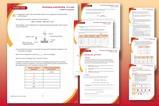
With this resource, learners connect moles and mass at the macroscopic, sub-microscopic and symbolic level. They use the macroscopic measurement of the mass of a gold ring to calculate the number of moles of gold, before then calculating the number of gold atoms forming the ring.
-

Download this
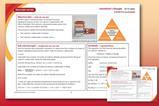
Use this student worksheet to introduce calculating the moles of gold and link to learners' understanding at three different conceptual levels.
View and download more Johnstone's triangle worksheets
Learning objectives
- Recognise element symbols based on Latin names.
- Calculate the number of moles of gold from the mass and relative atomic mass.
- Calculate the number of atoms of gold in a ring.
How to use Johnstone’s triangle
Use Johnstone’s triangle to develop learners’ thinking about scientific concepts at three different conceptual levels:
- Macroscopic: what we can see. Think about the properties that we can observe, measure and record.
- Sub-microscopic: smaller than we can see. Think about the particle or atomic level.
- Symbolic representations: Think about how we represent chemical ideas including symbols and diagrams.
For learners to gain a deeper awareness of a topic, they need to understand it at all three levels.
When introducing a topic, do not try to introduce all of the levels of thinking at once. This will overload working memory. Instead complete the triangle over a series of lessons, beginning with the macroscopic level and introducing other levels, in turn, once secure.
All of the levels are interrelated, for example, learners need visual representation of the sub-microscopic in order to develop mental models of the particle or atomic level.
Further reading
Read more about how to use Johnstone’s triangle in your teaching with these articles:
- Develop deeper understanding with models
- Improve students’ understanding with Johnstone’s triangle
- Practical ideas for using Johnstone’s triangle
Norman Reid’s book The Johnstone triangle: the key to understanding chemistry provides a more in-depth overview, the first chapter is available to read online.
Scaffolding
Share the structure of the triangle with learners prior to use. Tell them why you are using it and how it will help them to develop their understanding. Use an ‘I try, we try, you try’ approach when introducing Johnstone’s triangle for the first time.
Next steps
To further develop learners’ thinking in all areas of Johnstone’s triangle, try our Developing understanding of moles and mass worksheet. This includes icons in the margin referring to the conceptual level of thinking needed to answer the questions.
Downloads
Moles of gold Johnstone's triangle student sheet
Handout | PDF, Size 0.21 mbMoles of gold Johnstone's triangle teacher notes and answers
Handout | PDF, Size 0.23 mbMoles of gold Johnstone's triangle student sheet
Editable handout | Word, Size 0.53 mbMoles of gold Johnstone's triangle teacher notes and answers
Editable handout | Word, Size 0.53 mb
- Prepare(7)
 Ideas
IdeasWays to teach the mole at 14–16
Use these four ideas to effectively teach and contextualise this crucial chemistry unit
 Resource
Students’ difficulties with stoichiometry | Beyond appearances
Go beyond apperances and clarify the difficulties that students have around “the mole concept”.
 Ideas
IdeasStoichiometry and moles: how to explain it?
Use cooking as a fun, accessible introduction to why and how we use balanced equations


 Course
Quantitative chemistry | Self-led course
Build confidence in your quantitative chemistry knowledge and discover effective topic-specific teaching strategies

- Deliver(5)
 Resource
Amount of substance in moles | Structure strip | 14–16 years
Use scaffolded prompts to support learners to write about amount of substance in moles
 Resource
Moles of xenon | Johnstone’s triangle worksheets | 14–16 years
Introduce Johnstone’s triangle as a method of calculating the number of moles of xenon from a given volume of gas
 Resource
Moles and volume | Developing understanding | 14–16 years
Deepen your learners’ understanding of the idea that equal volumes of gases contain an equal number of molecules with this worksheet
currently reading
 Resource
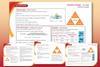
Moles of gold | Johnstone’s triangle worksheets | 14–16 years
Connect macroscopic, sub-microscopic and symbolic understanding of calculations involving moles and mass with Johnstone’s triangle
 Resource
Moles and mass | Developing understanding | 14–16 years
Develop understanding of the relationship between the mass of one mole, the number of moles and the mass of a substance
- Literacy(1)
 Resource
Quantitative chemistry | Key terms support | 14–16
Language support pack for quantitative chemistry, with key terms list, accessible glossary, Frayer models and unscrambling definitions
- Assess(3)
 Resource
Amount of substance in moles | Knowledge check | 14–16
Assess learning of amount of substance measured in moles with this higher level worksheet
 Resource
Amount of substance in moles | In context | 14–16
Put amount of substance measured in moles into context with questions based on common practical experiments
 Resource
Quantitative chemistry | Review my learning | 14–16 years
A set of differentiated worksheets with answers to identify learning gaps and misconceptions on the topic of quantitative chemistry
- Enrich(2)
 Games and puzzles
Moles equations | Gridlocks puzzle | 14–16 years
Reinforce your students’ understanding of moles equations using these sudoku-style puzzles, with printable worksheets and answers
 CPD article
How to teach moles at post-16
Use this explainer to help students overcome misconceptions of this fundamental quantity


No comments yet