








When black copper oxide powder is added to sulfuric acid, it reacts to form blue copper sulfate solution
If more and more copper oxide is added, eventualy all the sulfuric acid will react. After this point any copper oxide added will be in excess and clearly visible as a black powder in the new blue solution.
-

Download this
Use this student worksheet to think about excess reactants in the context of the reaction between copper oxide and sulfuric acid.
View and download more Johnstone's triangle worksheets
Learning objectives
- Explain the changes observed when copper oxide is added (in excess) to sulfuric acid.
- Recognie the compounds represented in the equation.
- Calculate the expected mass of excess copper oxide.
How to use Johnstone’s triangle
Use Johnstone’s triangle to develop learners’ thinking about scientific concepts at three different conceptual levels:
- Macroscopic: what we can see. Think about the properties that we can observe, measure and record.
- Sub-microscopic: smaller than we can see. Think about the particle or atomic level.
- Symbolic: representations. Think about how we represent chemical ideas including symbols and diagrams.
For learners to gain a deeper awareness of a topic, they need to understand it at all three levels.
When introducing a topic, do not try to introduce all of the levels of thinking at once. This will overload working memory. Instead complete the triangle over a series of lessons, beginning with the macroscopic level and introducing other levels, in turn, once secure.
All of the levels are interrelated, for example, learners need visual representation of the sub-microscopic in order to develop mental models of the particle or atomic level.
Further reading
Read more about how to use Johnstone’s triangle in your teaching with these articles:
- Develop deeper understanding with models
- Improve students’ understanding with Johnstone’s triangle
- Practical ideas for using Johnstone’s triangle
Norman Reid’s book The Johnstone triangle: the key to understanding chemistry provides a more in-depth overview, the first chapter is available to read online.
Scaffolding
Share the structure of the triangle with learners prior to use. Tell them why you are using it and how it will help them to develop their understanding. Use an ‘I try, we try, you try’ approach when introducing Johnstone’s triangle for the first time.
More resources
To further develop learner’s thinking in all areas of Johnstone’s triangle, try our Developing understanding of limiting and excess reactants (quantitative) worksheet or to introduce learners to the fundamental idea of limiting and excess reactants, try our Developing understanding of limiting and excess reactants (qualitative) worksheet. These include icons in the margin referring to the conceptual level of thinking needed to answer the questions.
Downloads
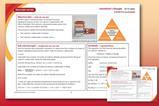
Excess copper oxide Johnstone's triangle student worksheet
Editable handout | PDF, Size 0.21 mbExcess copper oxide Johnstone's triangle teacher notes
Handout | PDF, Size 0.24 mbExcess copper oxide Johnstone's triangle student worksheet
Editable handout | Word, Size 0.53 mbExcess copper oxide Johnstone's triangle teacher notes
Editable handout | Word, Size 0.52 mb
- Prepare(3)
 CPD article
Teaching reacting masses at 14–16
Tackle this key concept in quantitative chemistry with these teacher-tested tips
 CPD article
How to teach gases at 14–16
Use these classroom activities and tips to boost your students’ understanding of quantitative chemistry
 Course
Quantitative chemistry | Self-led course
Build confidence in your quantitative chemistry knowledge and discover effective topic-specific teaching strategies
- Deliver(10)
 Resource
Decomposition of calcium carbonate | Johnstone’s triangle worksheets | 14–16 years
Think about reacting masses and gas volumes in the context of a decomposition reaction
 Resource
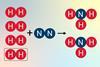
Reacting ratios: gas volumes | Developing understanding | 14–16 years
Connect learners’ ideas about balanced equations, the ratio of atoms and moles and the volume of reactants and products
currently reading
 Resource
Excess copper oxide | Johnstone’s triangle worksheets | 14–16 years
Explore the reaction of sulfuric acid with excess reactant copper oxide at three conceptual levels with Johnstone’s triangle
 Resource
Limiting and excess reactants: quantitative | Developing understanding | 14–16 years
Develop learners quantitative understanding of limiting and excess reactants with the support of bar diagrams
 Resource
Limiting and excess reactants (qualitative) | Developing understanding | 14–16 years
Introduce limiting and excess reactants using an analogy of ice cream and ice cream cones
 Resource
Reacting masses and gas volumes | Structure strip | 14–16 years
Use scaffolded prompts to support learners to write about reacting masses and gas volumes
 Resource
Fertiliser yield | Johnstone’s triangle worksheets | 14–16 years
Help learners calculate the actual and theoretical yield of ammonium sulfate using Johnstone’s triangle
 Resource
Yield | Developing understanding | 14–16 years
Part of the Johnstone’s triangle series, this resource includes teacher notes and a student worksheet to help learners understand the difference between actual and theoretical yield
 Resource
Reacting ratios: masses | Developing understanding | 14–16 years
Develop learners’ understanding of the ratio of the very large number of atoms or molecules in balanced chemical equations
 Resource
Extracting tin from tin oxide | Johnstone’s triangle worksheets | 14–16 years
Introduce calculations using reacting masses in the context of extracting tin from tin oxide
- Literacy(1)
 Resource
Quantitative chemistry | Key terms support | 14–16
Language support pack for quantitative chemistry, with key terms list, accessible glossary, Frayer models and unscrambling definitions
- Assess(3)
 Resource
Reacting masses and gas volumes | In context | 14–16
Put reacting masses and gas volumes into context with questions based on fertiliser in food prodcution
 Resource
Reacting masses and gas volumes | Knowledge check | 14–16
Assess understanding of reacting masses at foundation and higher level, plus gas volumes (higher only)
 Resource
Quantitative chemistry | Review my learning | 14–16 years
A set of differentiated worksheets with answers to identify learning gaps and misconceptions on the topic of quantitative chemistry
- Enrich(1)
 Job profile
Chief executive officer
Daniel is helping the world to reach net-zero carbon emissions by creating a way to turn manufacturers’ waste carbon dioxide into chemicals that can be used in everyday products




No comments yet