









Use balanced chemical equations and the number of moles of each reactant to determine the limiting reactant and the number of moles of product that could be formed
Developing understanding is a series of resources that encourages learners to connect their thinking at the macroscopic, sub-microscopic and symbolic levels.
-

Download this
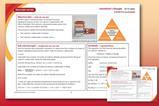
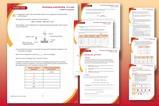
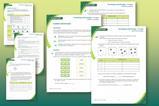
A ramped worksheet to help learners develop their quantitative mental models of limiting and excess reactants. With icons to indicate the conceptual level/s of each question.
View and download more Developing understanding worksheets
Learning objectives
- Use observation to identify an excess reactant.
- Determine the excess and limiting reactant using a balanced chemical equation and number of moles of each reactant at the start.
- Determine the number of moles of product that can be produced from a given number of moles of two reactants for a chemical reaction with a 1:1 reactant ratio.
- Determine the number of moles of product that can be produced from a given number of moles of two reactants for a chemical reaction with a 1:2 reactant ratio.
How to use this resource
This resource aims to develop learners’ quantitative understanding of limiting and excess reactants. The questions encourage learners to think about how information from a balanced chemical equation (symbolic understanding) and the number of moles of each reactant at the start (sub-microscopic understanding) can be used to determine the limiting reactant and the number of moles of product that could be formed. As a result, learners should develop more secure mental models to support their thinking about this topic.
- When to use? Use after initial teaching or discussion of this topic to develop ideas further. You can also use as a revision activity.
- Group size? Suitable for independent work either in class or at home. Or use the questions for group or class discussions.
- How long? 15–30 mins
To introduce learner’s to the idea of limiting and excess reactions, including an analogy using ice creams and ice cream cones, try our Developing understanding of limiting and excess reactants (qualitative) worksheet.
Johnstone’s triangle
Johnstone’s triangle is a model of the three different conceptual levels in chemistry: macroscopic, symbolic and sub-microscopic. You can use Johnstone’s triangle to build a secure understanding of chemical ideas for your learners.
Introduce learners to Johnstone’s triangle with our Excess copper oxide Johnstone’s triangle worksheet which introduces the idea of limiting and excess reactants in the context of observing excess copper oxide reacting with sulfuric acid to produce copper sulfate solution.
Further reading
Read more about how to use Johnstone’s triangle in your teaching with these articles:
- Develop deeper understanding with models
- Improve students’ understanding with Johnstone’s triangle
- Practical ideas for using Johnstone’s triangle
Norman Reid’s book The Johnstone triangle: the key to understanding chemistry provides an more in-depth overview, the first chapter is available to read online.
Support
This worksheet is ramped so that the earlier questions are more accessible. The activity becomes more challenging in the later questions. You can give extra explanations for the more challenging questions. If completing as an in-class activity, it is best to pause and check understanding at intervals, as often one question builds on the previous one.
It is useful for learners to observe macroscopic properties first-hand. You could circulate examples of substances in the classroom, run a class practical of a chemical reaction or show a teacher demonstration of properties.
Additional support may be needed for any learners still lacking in confidence in the required symbolic representation, for example by sharing and explaining a diagram or a simulation that can show movement of the particles.
Answers and guidance
There are three multi-part questions in the student worksheet. Answers can be found in the teacher notes.
The first question develops learners’ understanding of what they observe in a beaker at the end of a reaction (macroscopic understanding) and how this connects to the balanced chemical equation (symbolic understanding). The right-hand side of a chemical equation shows the products that are made and not necessarily what is found in the reaction vessel at the end of a reaction. Ideas about limiting and excess reactants at a qualitative level are explored qualitatively in the Developing understanding of limiting and excess reactants (qualitative) resource.
In question two learners develop understanding of how the number of moles of the product is limited by the number of moles of the limiting reactant (sub-microscopic understanding) and how the number of moles of product is determined by the ratio with this limiting reactant shown in the balanced chemical equation (symbolic understanding).
Question three develops learners’ understanding of how to determine the number of moles of product (sub-microscopic understanding) when the balanced chemical equation of the reaction has a ratio of reactants that is 1:2 (symbolic understanding). This question uses bar diagrams to support learners in recognising the limiting reactant which is a necessary step in determining the number of moles of the product. The last part of the question requires students to recognise that the number of moles of product relates to the mass of product formed (macroscopic understanding).
Downloads
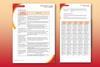
Limiting and excess reactants (quantitative) developing understanding student worksheet
Handout | PDF, Size 0.26 mbLimiting and excess reactants (quantitative) developing understanding teacher notes
Handout | PDF, Size 0.24 mbLimiting and excess reactants (quantitative) developing understanding student worksheet
Editable handout | Word, Size 0.47 mbLimiting and excess reactants (quantitative) developing understanding teacher notes
Editable handout | Word, Size 0.51 mb
- Prepare(3)
 CPD article
Teaching reacting masses at 14–16
Tackle this key concept in quantitative chemistry with these teacher-tested tips
 CPD article
How to teach gases at 14–16
Use these classroom activities and tips to boost your students’ understanding of quantitative chemistry
 Course
Quantitative chemistry | Self-led course
Build confidence in your quantitative chemistry knowledge and discover effective topic-specific teaching strategies
- Deliver(10)
 Resource
Decomposition of calcium carbonate | Johnstone’s triangle worksheets | 14–16 years
Think about reacting masses and gas volumes in the context of a decomposition reaction
 Resource
Reacting ratios: gas volumes | Developing understanding | 14–16 years
Connect learners’ ideas about balanced equations, the ratio of atoms and moles and the volume of reactants and products
 Resource
Excess copper oxide | Johnstone’s triangle worksheets | 14–16 years
Explore the reaction of sulfuric acid with excess reactant copper oxide at three conceptual levels with Johnstone’s triangle
currently reading
 Resource
Limiting and excess reactants: quantitative | Developing understanding | 14–16 years
Develop learners quantitative understanding of limiting and excess reactants with the support of bar diagrams
 Resource
Limiting and excess reactants (qualitative) | Developing understanding | 14–16 years
Introduce limiting and excess reactants using an analogy of ice cream and ice cream cones
 Resource
Reacting masses and gas volumes | Structure strip | 14–16 years
Use scaffolded prompts to support learners to write about reacting masses and gas volumes
 Resource
Fertiliser yield | Johnstone’s triangle worksheets | 14–16 years
Help learners calculate the actual and theoretical yield of ammonium sulfate using Johnstone’s triangle
 Resource
Yield | Developing understanding | 14–16 years
Part of the Johnstone’s triangle series, this resource includes teacher notes and a student worksheet to help learners understand the difference between actual and theoretical yield
 Resource
Reacting ratios: masses | Developing understanding | 14–16 years
Develop learners’ understanding of the ratio of the very large number of atoms or molecules in balanced chemical equations
 Resource
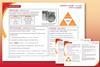
Extracting tin from tin oxide | Johnstone’s triangle worksheets | 14–16 years
Introduce calculations using reacting masses in the context of extracting tin from tin oxide
- Literacy(1)
 Resource
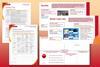
Quantitative chemistry | Key terms support | 14–16
Language support pack for quantitative chemistry, with key terms list, accessible glossary, Frayer models and unscrambling definitions
- Assess(3)
 Resource
Reacting masses and gas volumes | In context | 14–16
Put reacting masses and gas volumes into context with questions based on fertiliser in food prodcution
 Resource
Reacting masses and gas volumes | Knowledge check | 14–16
Assess understanding of reacting masses at foundation and higher level, plus gas volumes (higher only)
 Resource
Quantitative chemistry | Review my learning | 14–16 years
A set of differentiated worksheets with answers to identify learning gaps and misconceptions on the topic of quantitative chemistry
- Enrich(1)
 Job profile
Chief executive officer
Daniel is helping the world to reach net-zero carbon emissions by creating a way to turn manufacturers’ waste carbon dioxide into chemicals that can be used in everyday products




No comments yet